
Subscriber Benefit
As a subscriber you can listen to articles at work, in the car, or while you work out. Subscribe Now
Indianapolis development officials are hoping a proposed $18 million loan to be considered Wednesday by the Metropolitan Development Commission will salvage the long-delayed apartment conversion of the Gold Building—a project that sources tell IBJ was nearly derailed earlier this year due to ongoing financial challenges.
Local developers Gershman Partners and Citimark first proposed the redevelopment in 2022, through a deal with the city that consisted of the City Market property, the 20-story office tower and two other properties on the northern half of the block under the developers’ control.
But delays in funding have sidelined the conversion for more than three years, leading the developers to request multiple extensions on their existing loans just to maintain ownership of the property. Those difficulties came to a head earlier this year, when the city was forced to decide between walking away from the project altogether or stepping in with a bridge loan.
The city has decided to provide that loan with several conditions meant to ensure the redevelopment moves forward, but the deal must still be approved by the independent MDC—something expected to happen during the commission’s 1 p.m. meeting Wednesday at the Public Assembly Room in the City-County Building.
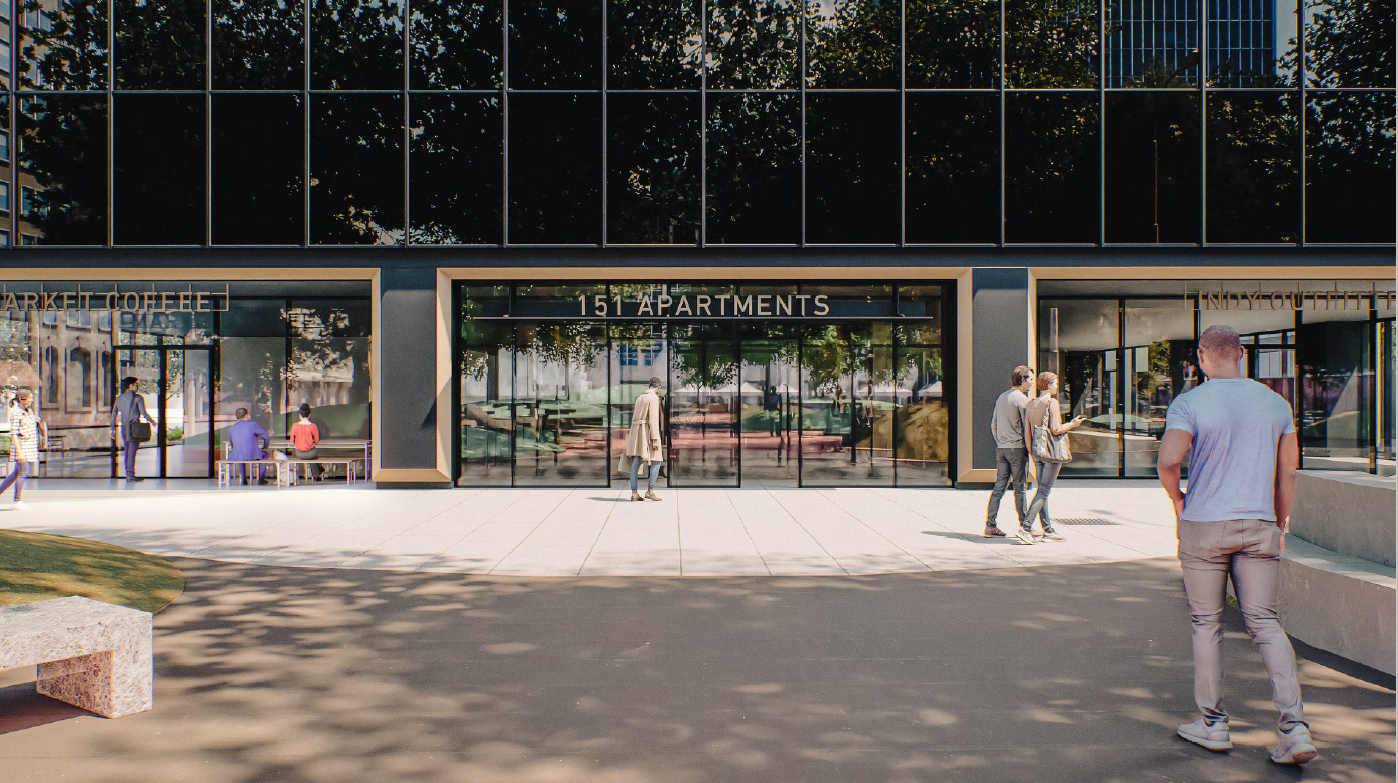
The Gold Building conversion at 151 N. Delaware St. is expected to replace 400,000 square feet of office space with more than 350 apartments and nearly 8,000 square feet of ground-floor retail, as well as a cleaned up Wabash Street alley between the northern and southern halves of the block.
Over the past two years, Gershman and Citimark have invested about $15 million into renovations for the 251 E. Ohio St. office building and the parking garage between that structure and the Gold Building.
Sources close to the deal have told IBJ that the project has been a point of frustration for Indianapolis Mayor Joe Hogsett, his administration and other economic development insiders at the local and state level for several months. That’s both because of the faltered efforts to secure funding and because it has led to further delays for other components of the effort to reshape the City Market block north of the City-County Building.
While the firms have partners lined up for the project—Carmel-based Merchants Bank will provide the construction loan while local developer Milhaus has signed on as an equity and development partner—they are now in a race against the clock to close on the deal.
Foreclosure threat
Three sources familiar with the Gold Building deal told IBJ the $185 million project nearly fell through this spring. But officials with the city’s Department of Metropolitan Development and Indianapolis Economic Development Inc. stepped in with a bridge loan offer, preventing foreclosure on the property and the others under the developers’ control in the same block.
Each source spoke on the condition of anonymity because they were not authorized to speak publicly on the matter.
The insiders each separately told IBJ the developers had exhausted their options on the original $18 million mortgage for the Gold Building and its other two properties, which was secured as part of Gershman and Citimark’s acquisition of the buildings in 2019. The sources said the firms were at risk of a foreclosure suit from Cincinnati-based lender First Financial Bank until the city stepped in—something that could be put back on the table without final approval on the city’s loan offer.
According to public records, the original mortgage for the Gold Building and the other two buildings on the northern half of the City Market block first came due in March 2022, but the sources said the term was extended multiple times over the past three years to allow Gershman and Citimark time to redevelop the properties.
The bank only allowed Gershman and Citimark to receive another extension on its mortgage because the Hogsett administration became more directly involved in the project, each of the sources said.
But Eric Gershman, partner at Gershman Partners, disputed the sources’ characterization of foreclosure concerns in an interview with IBJ on Saturday.
He said while the development team has received multiple 12-month extensions on the loan and First Financial wanted out, there have “never been any threats” from the bank requiring the loan be paid off by a certain date, nor has the developer ever been reprimanded for its delays on the project.
“We have definitely never missed a payment and are not in default of the loan,” he said. “The loan has been extended, and [First Financial] would like to be paid off, as they’ve been patient with us—they want to move on. So we’re working to pay them off when we do the development.”
He said the loan First Financial first signed on for was tied to a planned office building refresh, rather than the wholesale redevelopment of the structure and the surrounding properties.
According to the loan agreement, made public Friday afternoon, the city’s bridge loan would go directly toward repaying the developers’ outstanding mortgage with First Financial and would in turn assign the debt on the project to the city directly—giving it legal authority to take the properties if the redevelopment funding plan fell through.
Office owners typically refinance or sell at the end of a loan term, but with redevelopment plans in play, the firms held on. Banks are often reluctant to foreclose on properties, especially ones that are involved in a potential redevelopment project, because doing so can limit the amount they could recover.
For developers, foreclosures are also a last resort because they can create costly legal issues and damage their reputation with lenders and the public.
The city’s deal with Gershman and Citimark helps solve the mortgage problem by paying off the loan—with stipulations—and giving the developers more time to close on a construction loan to finance the rest of the project.
The Indiana Economic Development Corp. has also agreed to provide $10 million in redevelopment tax credits for the project, an offer made by then-Gov. Eric Holcomb’s team. The change in administrations—Gov. Mike Braun took office in January—meant a new review of the incentive, which delayed a final commitment.
“The state has been at the table with us the whole time through the change in administration,” said Gershman. “They wanted to review where their priorities were and there was a delay, but no fault of their own. They … wanted to review where their priorities were. They stayed with the project and we’re working with them to finalize the state incentives.”
The state has also offered up to $10 million more for the project through the Regional Economic Acceleration and Development Initiative, according to the agreement for the bridge loan.
In addition to written commitments from the developers’ lenders and partners in the project, the city has asked for letters of commitment from the state for its redevelopment tax credits and READI funds allocations before it’s willing to finalize the loan for the developers. A spokesperson for the IEDC did not respond to a request for comment Friday afternoon.
Gershman said the deal was sidelined from its original late 2022 start by continued conversations with the city and state related to incentives, as well as continued uncertainty related to the development market. He said issues have been further compounded by changes at the federal level, including tariff concerns.
The original cost to redevelop the 47-year-old Gold Building—which includes installing a modernized facade that does away with the iconic golden coloration— was originally expected to cost about $90 million. Now the project will cost at least $185 million and up to $200 million total.
Construction on the project is expected to start in the first quarter of next year and finish by mid-2028, Gershman and Citimark officials have said this month.
Inside the deal
According to Eric Gershman and others involved in the project, the city’s $18 million loan would not replace the up to $18.8 million in tax-increment financing bond incentives approved in early 2023 for the entirety of the City Market block redevelopment.
The loan would be funded through money from the city’s consolidated downtown TIF district—a separate funding mechanism from the already-approved bonds.
It would also be eligible for forgiveness if certain conditions are met, either outright or through a schedule in which the city would essentially reinvest funds in the project. A copy of the loan forgiveness schedule was not immediately available.

According to the agreement, the city would be able to withdraw its loan offer if Gershman and Citimark don’t secure construction funding. The agreement also requires the developers to meet monthly with its financial partners, the DMD and Indianapolis Economic Development Inc.
The companies must also finalize their construction loan for the Gold Building redevelopment within nine months of securing the bridge loan and repaying their original bank.
Matt Carlstedt, managing director of Citimark, told the MDC earlier this month that financing could be finalized by the end of this year, with initial plans to close on the loan in December.
The agreement includes a clause that allows the city to foreclose on the Gold Building and the other north-block properties if the developers’ financing plan falls through after the city pays the loan. That’s because the city would at that point be the primary mortgage holder on the properties, replacing current lender First Financial.
The arrangement would also require the developers to repay the loan immediately, with 7% interest, if the construction loan fell through.
If the city took possession of the Gershman and Citimark buildings, it would likely solicit redevelopment proposals, with two sources telling IBJ that the Hogsett administration would be open to demolition of one or more of the structures, including the Gold Building.
The same sources said the city initially considered whether it should buy the property directly from the bank and find another partner for redevelopment but ultimately decided retaining the current team was the wiser move.
The proposed agreement includes a shared appreciation clause that allows the city to profit from any sale of the property within a certain period. Those clauses have become more popular with the city of late, particularly on projects that received city assistance but could be sold within a few years of their completion.
Gershman said that without the loan, the developers would either have to call off the project entirely or would be looking for a buyer for the properties.
“This is no different than a ground-up development, other than the structure is sitting there,” he said, “If we were building new on the ground and the incentives didn’t come to fruition from the city and the state, then the project wouldn’t get built here—the redevelopment would not happen.”
Megan Vukusich, director of the Department of Metropolitan Development, told IBJ she believes the loan improves the chances of Citimark and Gershman Partners’ project coming to fruition.
“I think with the city’s involvement, there’s less of that concern, and that’s why we are stepping in at this point,” she said.
Delays and city decisions
Gershman and Citimark have been eyeing updates to the Gold Building since early 2020, although initial plans evolved from office space renovations to a focus on multifamily and retail in the wake of the coronavirus pandemic.
In response to the city’s request for proposals for the southern half of the block, including City Market in early 2022, the developers offered a concept that aimed to blend the market property with its own plans for the area.
Along with the Gold Building redevelopment and $40 million in total investment for its other two properties on the northern half, Gershman Partners and Citimark floated a separate $40 million apartment tower for the east plaza—a project not currently moving forward.
The city announced in June 2022 it had chosen Gershman and Citimark’s proposal from three finalists, besting concepts from TWG Development LLC and Flaherty & Collins. At the time, city officials said the companies’ ownership of all three buildings immediately to the north significantly affected planning around City Market.
But the ongoing challenges with the Gold Building led the city to withdraw its partnership with the developers on the west plaza earlier this year, a component that was incorporated into the redevelopment plans after Gershman and Citimark were chosen as partners.

The planned $15 million project is expected to expose most of the historic Indianapolis Catacombs (see image above) as part of a new outdoor amenity that will still serve as the new front entrance to the office-to-apartment conversion.
But the firms are no longer involved, with the city last month issuing a request for proposals to find a developer to build the space on the city’s behalf. Sources said the city didn’t want to risk further delays to those plans because of Gershman and Citimark’s challenges and felt it would be better to find another group to complete that project.
Eric Gershman said he did not consider the move to be retribution for delays to the Gold Building project, but instead “more of a divide-and-conquer” approach that will allow the Gold Building and West Plaza to be under construction concurrently. It would also allow the city to begin reevaluating plans for City Market—which has been closed since March 2024—as those two projects have largely stymied conversations on that component.
He said he’s hopeful the east plaza redevelopment will still be an element with which his company and Citimark have involvement, but DMD’s Vukusich said that discussions on that matter have been tabled until the conversion project is further along.
“We want them focused on the Gold Building,” Vukusich said.
Please enable JavaScript to view this content.
Charge Gershman 15% on the cash like a personal loan because that is basically what it is….
Obviously the developers are in over their heads and/or the market for the proposed project doesn’t really exist. That’s part of the risk of development and I don’t want to see any city money extended to ensure this group is insulated – much less profit – from not being able to deliver on their promises. Businesses across the city have to hustle every day to keep their doors open and have no chance of a government bailout if they make bad decisions, this should be no different.
No city money will be extended. The land underneath will revert to the city if the loan fails, which won’t happen. And: IBJ and the reporter are to be commended on this article. It’s extremely in-depth.
This is a perfect example of developer over-reach. But, the underlying real estate requires a long-game approach.
@Rick S – City to consider $18M bailout loan – the only money the city has is taxpayer money unless they are getting a grant for this.
Questions:
– You state that the land underneath will revert to the city of the loan fails. What happens to the building? Who will own it?
– The real estate and building do require a long-game approach. Who hired this developer? The city?
Answers:
* the land would revert to the city. In the absence of a long-term lease or similar document, the building, if it’s still standing, would also revert to the city.
* multiple proposals were presented, and the city chose this development team. That team in turn selected a multi-tiered financing approach…and it started in the throes of Covid, which was a wicked mortgage/finance environment.
Gershman is a good developer, and of course they’re local. When a complicated finance deal gets sideways, it’s vital to have a local developer in the driver’s seat. And if their plan has to go back into the finance market, it’s a much better borrowing climate now than four years ago.
I’m a finance guy with commercial real estate experience and I got lost in the web of 8-figure transactions on these properties. Not bad writing, just a huge flub on the part of the developers. Not sure why the city is so eager to bail these guys out. I’m with “21 R.” – the market (the banks) have spoken. Take your lumps instead of wishing for a bailout. If the bank thinks it’s dumb, let it fail.
The entire project has become a joke. Forcing City Market tenants out over two years ago with no construction started is an embarrassment to the City. The site is overgrown with weeds and both buildings and site have become an eyesore. The City needs to be more careful on selecting local developers. The City Hall/21C project seems to be following the Gold Building/City Market project with no construction started. Maybe Hendricks Development Group should take over these projects.
You’ve hit the nail on the head – there appear to be no local developers who can deliver reasonably on time or reasonably on schedule.
Not these guys. Not Keystone. Not Kite. Not Buckingham.
Amen on being more careful hiring local developers. Appropriate funding from a developer, an established timeline and a project manager that is able to drive the project should be vetted and established before a project is awarded.
The least the city should do is keep the outside area cleaned up and maintained–and that cost should be billed back to the developer.
Indy has no good local developers. Or at best, they do their best work out of market. Freeze them out.
Good article, although saying the Metropolitan Development Commission is ‘independent’ is stretching the facts a bit beyond reality. In legislation and theory maybe, but the commissioners are appointed by the mayor and council. The DMD director is appointed by the mayor with CC Council approval, and the DMD staff works for the director, the mayor, and at times the council.
The old ‘too important to fail’ adage, is another failure by the city and the developer, although the developer has bitten off more than they can chew, and were unable to focus on the actual gold box. Basically 6 projects at once and no real ability to focus on the original single project without dragging the surrounding shiny objects into the mix, while they all grow weeds.