
Subscriber Benefit
As a subscriber you can listen to articles at work, in the car, or while you work out. Subscribe Now
Just as Hoosier farmers are firing up their combines for the fall harvest, ag giant Corteva Agriscience is reportedly mulling a split of its seed and pesticide businesses, a move that could alter the company’s presence in Indianapolis as well as the state’s agriculture industry.
Corteva, which made Indianapolis its global headquarters in 2022, has not commented on the potential split, first reported last week by The Wall Street Journal, which cited unnamed sources. But the company might disclose its plans soon, the WSJ reported.
A spokesperson for Corteva did not respond to a request for comment from IBJ.
Separating Corteva’s seed business from its crop protection (fungicides, herbicides, pesticides) unit could help shield the seed business from potential future liabilities related to pest- and weed-killing chemicals, according to the report.
Corteva would follow other companies that have restructured this year, including Warner Bros. Discovery, Kraft Heinz and Honeywell.
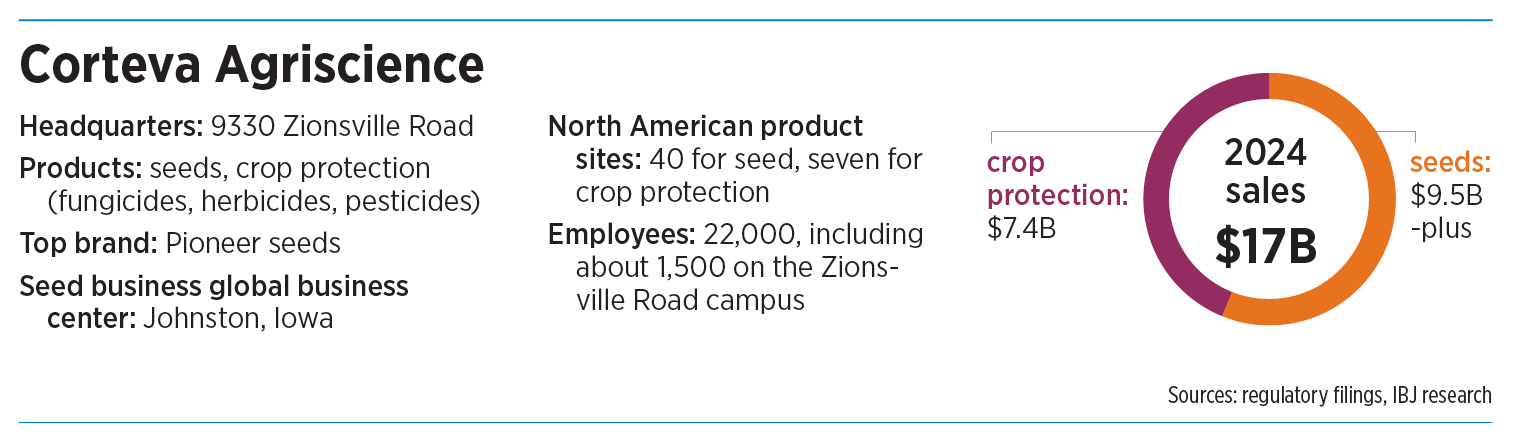
Corteva, with almost $17 billion in revenue last year, ranked No. 5 on IBJ’s list of Indiana’s largest publicly traded companies.
For Indiana and its sizable agriculture sector, the effect of any potential split remains unclear, with Corteva already well distributed as a large international company with significant Midwest functions in Indianapolis and, for its seed business, in Iowa.
“Hopefully, they will keep those companies in Indianapolis,” said Michael Langemeier, professor of agriculture economics at Purdue University. “If they keep those companies in Indianapolis, I don’t see a lot of changes from a producer standpoint.”
A giant
In 2024, the seed business, led by well-known brands Pioneer and Brevant, made up about 56%—or more than $9.5 billion—of Corteva’s revenue.
The company is a leader in many markets with corn and soybean seeds in North America; corn and sunflower in Europe; and corn in Brazil, Argentina and Africa.
Corteva’s business is spread across 40 seed-production sites and seven crop-protection sites in North America, including Indiana sites in Tipton and Rushville.
Corteva had roughly 22,000 employees in 2024, according to regulatory filings. About 1,500 are based at its Zionsville Road headquarters in Indianapolis, just south of the junction of interstates 465 and 865 on the city’s northwest side. The company has roughly 3,000 employees in Iowa, according to a report by Iowa-based farm economic group America’s Cultivation Corridor.
Langemeier, who is also director of the Center for Commercial Agriculture at Purdue, said there are good reasons for a seed company to have several production sites.
“You want to develop hybrids that are not only beneficial to Iowa, [which] has a different climate than Indiana and Ohio,” he said. “Also, probably more importantly, from a risk standpoint, if they have some weather issues in Iowa that makes seed production difficult, those same issues might not hit Indiana.”
In Indiana, Corteva faces intense competition from rivals, including privately held Beck’s Hybrids, based in Atlanta in Hamilton County.
Beck’s describes itself as the largest family-owned retail seed company and the third-largest seed brand in the United States.
“Beck’s, slowly but surely, is headed west,” Langemeier said of Beck’s growth to Great Plains states like Nebraska.
For farmers in the so-called fertile “I-states”—Iowa, Illinois and Indiana—selecting the best seed provider is a crucial, “very tangible” choice, Langemeier said. Farmers literally see the results of their decision growing, while yield changes from tweaks in pesticides might be harder to determine.
And the investment in seed is substantial. An Indiana farmer with 3,000 acres of corn and soybeans spends around $120 an acre on seed for corn and around $75 for soybeans, he said—an annual expense of $225,000 to $360,000.
Agriculture experts say farmers often have long-term relationships with their seed vendors but do switch for better yields or prices, or sometimes buy corn and soybean seed from multiple vendors.
Typically, corn yields gain about two bushels per acre per year. But that does not always mean more profit.
The top uses for corn from Indiana, Langemeier said, are feed grain for animals, industrial uses like ethanol, and export.
In reporting its second-quarter earnings in August, Corteva reported a net sales increase of 3% for the first half of the year. The company also said it had expectations for a large production year but noted trade uncertainty has “pressured grain prices in most major growing regions.”

Indeed, the news of Corteva’s potential split comes during a down cycle for Indiana’s farm economy, said Todd Davis, chief economist for Indiana Farm Bureau.
“It could be a record crop,” Davis said. “Profit-wise, that’s a different story.”
He said prices for corn and soybeans could be below break-even for farmers.
Such shrinking margins have farmers under pressure to expand to maintain income and grow their business, with vital vendors like Corteva and Beck’s.
“Farmers are always looking for the right package of technology,” Davis said. “You’re buying the technology, and you’re buying some services and everything else.”
Dividing up a large company like Corteva is a complex decision.
Analyst Kristen Owen, of New York-based brokerage and investment bank Oppenheimer, wrote in a research note published after the report of the potential split that carving up the units makes sense from a purely financial perspective.
“Over time, we see an incrementally greater proportion of [Corteva’s] earnings driven by seed,” she wrote.
Owen, however, said the merits of splitting the company over concerns about potential future liabilities “are debatable.”
And for Corteva, an integrated seed and pesticide service provides a “full-acre solution” for farmers, which is a competitive advantage, she said.
More division
Companies with multiple business units—even those closely related—are coming under more pressure to separate to make risk analysis of individual companies simpler for investors.

“I first began following this kind of breakup trend back with oil and gas. I’m from Texas originally, and so it was really fascinating to me when you saw Conoco Phillips separate,” said Matthew Josefy, associate professor in the Department of Management and Entrepreneurship at the Indiana University Kelley School of Business.
He added that investors increasingly are saying, “Show me a company that I know what it is and what it looks like, and I’ll decide then, ‘Do I want 80% of this and 20% of this?’ I can make those choices of how to construct my own portfolio.”
Corteva already is the result of corporate divisions and diversifications.
In 1989, Eli Lilly and Co. and Dow Chemical Co. formed DowElanco, a joint venture meant to produce agricultural products. In 1997, Dow acquired full ownership and renamed the operation Dow AgroSciences.
In 2015, Dow and DuPont announced plans to merge, then divide into three companies that eventually merged into DowDuPont with Indianapolis as one of its centers. Corteva Agriscience was unveiled in 2018 as the agricultural division’s new name. Later, Delaware-headquartered DowDuPont spun off Corteva.
IU’s Josefy said bigger companies have larger scale and legitimacy but also face greater scrutiny and have more bureaucracy.
“Size itself of a company is a strategic decision,” he said, “and so management has to constantly be reassessing which corporate structure gives all the brands in the portfolio the best chance of being successful.”•
Please enable JavaScript to view this content.
Editor's note: You can comment on IBJ stories by signing in to your IBJ account. If you have not registered, please sign up for a free account now. Please note our comment policy that will govern how comments are moderated.