
Subscriber Benefit
As a subscriber you can listen to articles at work, in the car, or while you work out. Subscribe Now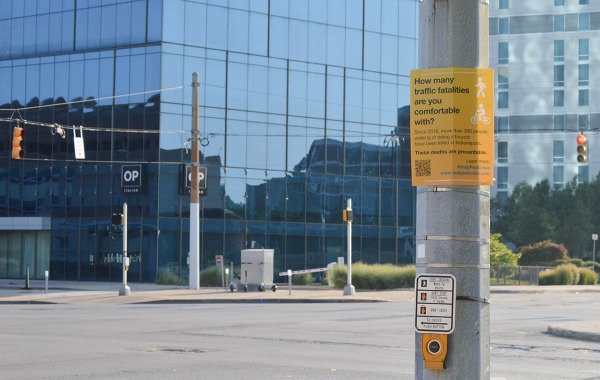
City-County Council members gave initial approval Tuesday evening to an additional $20 million spending package from the city for 2026, including funds for homelessness, street safety and eviction court assistance in Indianapolis.
Councilors on the Administration and Finance Committee voted unanimously to send the tweaked package—amended to fund some council priorities—to the full legislative body for approval.
The $20 million fiscal package is an addendum to the Hogsett administration’s $1.7 billion proposed budget for 2026. Abby Hanson, the city’s controller, told the committee that the spending plan was created from underspent funds in the previous year.
The $20 million package was initially made up of a $10 million commitment to a citywide initiative to end street homelessness and $10 million dedicated to road design. But Indianapolis was granted permission to shift the use of unspent federal funds, in what Hanson called “an exciting opportunity” to accomplish additional priorities without reducing the city’s original commitments.
Federal officials approved the city’s request to redirect a $5.9 million grant that had been intended to build permanent supportive housing to the citywide Streets to Home initiative. Hanson said city officials made that request after it was clear that the housing development would not come to fruition in time for the city to fulfill the grant’s requirements.
The $5.9 million grant will now be reallocated from the Department of Metropolitan Development’s budget, while the fiscal package allocates the remaining $4.25 million.
Councilor Andy Nielsen, a Democrat, introduced the amendment in tandem with the city’s controller. It includes $2 million for strip patching, an additional $750,000 for the city’s eviction court assistance program, an additional $2 million for roadwork design and $1 million for pedestrian and traffic safety rapid response initiatives.
“In this budget process, we’ve heard pretty clearly of needing a focus on pedestrian and traffic safety,” Nielsen said. “We’re making a million-dollar investment in that, plenty more to go.”
Just last week, the lack of funding for Vision Zero was a hot topic in city budget hearings. At a Sept. 24 Board of Public Works meeting, board members Leslie Schulte and Dan Haake told Department of Public Works leaders they were disappointed to see a lack of funds for pedestrian and cyclist safety.
Vision Zero is a City-County Council pledge to eliminate traffic-related fatalities and serious injuries.
“The fact that it’s not in the budget shows that it, in fact, is not a priority of the department to approach Vision Zero,” Haake said.
Department of Public Works leaders said that Vision Zero wasn’t explicitly funded in the budget because the Vision Zero Task Force has not formally passed an action plan.
Connie Szabo Schmucker, advocacy director at Bicycle Garage Indy, told the council’s Public Works Committee at a Sept. 25 meeting that “not budgeting funds to address traffic violence because there’s no Vision Zero action plan is a cop out.”
But Director Todd Wilson said safety is inherently included in everything the department does. He said investments in school zone flashers, street lighting, protective bike infrastructure, sidewalks and intersection improvements exemplify the department’s commitment.
“DPW’s compass always points in the direction of safety,” Wilson said.
Please enable JavaScript to view this content.
Would it help if we actually locked up the people committing the crimes?
No, because you all consider drug addiction a crime and not something that people need help with, so you throw them in the slammer and make it worse. The punitive approach to petty criminality (let’s be abundantly clear, I’m not talking about serious crimes like homicide, rape, assault, etc.) has been a total failure.
IBJ – would you dig into the money spent on street homelessness to date in 2024 and 2025? (The $20 million package was initially made up of a $10 million commitment to a citywide initiative to end street homelessness)
Why was so much money unspent??
How much of this money was actually spent on homelessness in 2025? (Federal officials approved the city’s request to redirect a $5.9 million grant that had been intended to build permanent supportive housing to the citywide Streets to Home initiative. Hanson said city officials made that request after it was clear that the housing development would not come to fruition in time for the city to fulfill the grant’s requirements.)
Can we start with NOT installing the new blue line bus islands that not only take up 3 of 5 traffic lanes, but are RIDICULOUSLY dangerous for pedestrians getting from the sidewalk to the MIDDLE OF THE STREET to catch the bus? Oh, wait–there aren’t many riders, so let’s just scratch that project alltogether and reallocate that money to a project that would be helpful to someone! (“In this budget process, we’ve heard pretty clearly of needing a focus on pedestrian and traffic safety,” Nielsen said. “We’re making a million-dollar investment in that, plenty more to go.”)
And what happened to the new downtown tax-fee approved last year, to partially fund homeless and shelters?
1) Blue Line dollars can only be used for Blue Line. It legally cannot be used for any other purpose. Federal funds are non-fungible and I really don’t understand why Conservatives can’t wrap their head around that core concept. If we don’t use it for Blue Line, we send it back to the Feds and get nothing. Washington Street is also one of the worst offenders for pedestrian safety, so we would lose out on millions of dollars in safety money, too.
2) The BRT system has been operational for six years, and opened a second line, and so far, the number of fatalities for people reaching the median BRT stations is zero. People have to cross the full length of the street to get to the bus stop on the opposite side for the majority of routes, is that also a problem?
3) 200,000 riders per month on just the Red and Purple Lines is pretty far from “not many riders.” Are you sure you don’t mean, “not many riders that I deem acceptable and participant members of society”? You smack of classism.