
Subscriber Benefit
As a subscriber you can listen to articles at work, in the car, or while you work out. Subscribe NowEfforts to legalize marijuana for either medical or adult general use have always faced an uphill battle in Indiana.
In 2023, Rep. Heath VanNatter, R-Kokomo, made history by getting a legislative hearing on his bill to decriminalize possession of 2 ounces or less of marijuana. Ultimately, the bill failed to advance.
But now, President Donald Trump has announced he might support federal reclassification of marijuana as a less dangerous drug with medical benefits, a move that advocates hope will spur Indiana to permit legalization in some form.

Justin Swanson, a partner with Bose McKinney & Evans LLP and chair of the firm’s Cannabis group, said the federal Drug Enforcement Agency could either issue a final order as part of a previous undertaking to reclassify the drug or the DEA could restart the process, which require issuing a formal notice for comments.
“It remains to be seen if it’s going to happen or not,” Swanson said, adding, “I think it would certainly add to the momentum we’ve seen in the last couple of years.”
Swanson noted that Trump has signaled some support for marijuana in his first campaign but didn’t follow through once he was elected.
During his run for president in 2016, Trump said that he backed medical marijuana and that legalization should be left up to the states. But then during Trump’s first term, Attorney General Jeff Sessions lifted an Obama-era policy that kept federal authorities from cracking down on the pot trade in states where the drug had been legalized.
Trump said Aug. 11 that he plans to decide in the coming weeks whether to support changes to the way marijuana is regulated.
The Justice Department last year formally moved to reclassify marijuana from a Schedule I drug—a classification that includes heroin and LSD—to a less dangerous Schedule III substance, which includes ketamine and some anabolic steroids.
That proposal drew nearly 43,000 public comments.
The DEA was still in the review process when Trump succeeded Biden in January, triggering a re-examination of policies across the federal government, the Associated Press reported.

Chad Dickerson, an attorney and CEO of Viridis Law PC, is board member of the cannabis advocacy group Indiana NORML. He said reclassifying marijuana as a Schedule III drug could shift attitudes among Indiana state lawmakers, who have repeatedly declined to seriously consider legalization.
Dickerson said that legalizing the medical use of marijuana in Indiana could be on the agenda if the reclassification occurs, especially because lawmakers have routinely pointed to the Schedule I designation as a barrier to action. Former Gov. Eric Holcomb had also maintained a stout opposition to legalization as long as marijuana was classified as a Schedule I drug on the federal level—but Braun has appeared more open.
Waiting on the feds
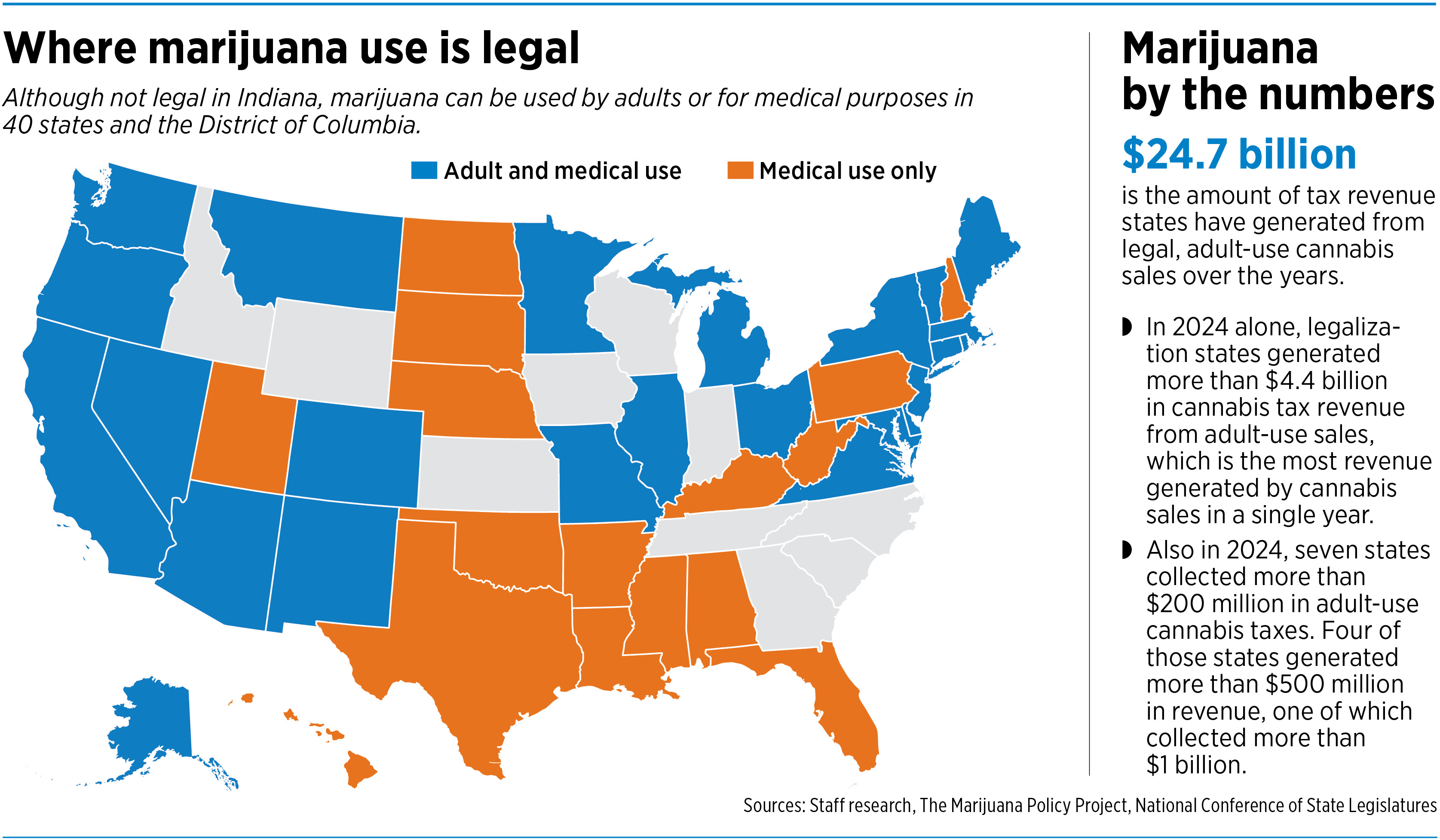
Medical marijuana is already legal in 40 states and the District of Columbia, with recreational use now permitted in 24 states and D.C.
Indiana is surrounded by states where marijuana is legal for either both uses, or in the case of Kentucky, for medical use only.

Senate President Pro Tempore Rodric Bray told The Indiana Lawyer in April that “it’s important that we acknowledge that we are now essentially surrounded as a state” by neighbors who have legalized marijuana in some way.
“We can’t exist in a vacuum,” he said.
At the time, Bray said he was not convinced that legalizing marijuana and endorsing it as a product would be good for the state of Indiana.
“I think in particular, there’s an awful lot of studies that have a lot of veracity to me that suggest that it’s not healthy, in particular for the mental health of young minds,” Bray said. “And so I don’t feel like we need to weigh in on that and legalize it very quickly.
“I know that it’s becoming more and more popular, of course, across the state of Indiana and also in this building,” Bray added, referring to the Statehouse.
When asked about Trump’s announcement and the possibility of federal reclassification, Molly Swigart, Bray’s communications director, told The Indiana Lawyer that Bray “isn’t going to speculate about what steps the federal government might take and will wait until any formal steps are taken to comment.”
A spokesperson for House Speaker Todd Huston, R-Fishers, did not respond to The Lawyer’s emailed questions regarding Trump’s announcement.
Braun said during his campaign that he was open to discussion on legalizing the drug for medical use. Then after Trump’s announcement earlier this month, Braun told The Indianapolis Star that the president’s support could add “a little more fuel to the fire” in terms of legalizing marijuana in the state.
Impact of reclassification
Rescheduling marijuana at the federal level doesn’t legalize it—nationwide or in any state.
It would remain a federally controlled substance, meaning its manufacture, distribution, and possession would still be illegal under the Controlled Substances Act, according to the Drug Enforcement and Policy Center at the Ohio State University.
However, the criminal penalties related to manufacturing, distributing or possessing a Schedule III drug are typically less severe than for Schedule I drugs.
Also, Congress has prohibited the Department of Justice from using federal funds to prosecute state-legal medical marijuana activity.
“As long as Congress continues to do that, such activity is shielded from federal prosecution, and that would be unchanged if marijuana is rescheduled,” the Drug Enforcement and Policy Center writes.
The change could also affect public sentiment about marijuana use and legalization.
About 6 in 10 voters across the country said last year they favored legalizing recreational use nationwide, according to an AP VoteCast survey of more than 120,000 U.S. voters conducted during last year’s election.
Polling from Gallup shows support for marijuana legalization has grown significantly, from just 36% support in 2005 to 68% last year.
In Indiana, Ball State University’s 2024 Hoosier Survey found strong support for marijuana legalization, with 62% favoring full—recreational and medicinal— legalization and an additional 25% backing medical-only legalization.
“The vast majority of Hoosiers want to see a change,” Dickerson said.
For the 2025 session, Dickerson said legislators could establish a cannabis board to develop a framework of rules for taxing and regulating use.
He said some states, including Ohio, spent at least a couple of years setting up their regulatory infrastructure before approving legalization.
Swanson said that what some marijuana advocates are seeking to reframe the issue of legalization and ask legislators questions, such as: How does marijuana prohibition impact law enforcement?
He said the general public in Indiana is already ahead of the state and federal government in terms of acceptance of marijuana.•
Please enable JavaScript to view this content.
While our legislature leaders continue to whine and cry of all the old myths and reefer madness fears and misinformations, the 65-80+% of us adult voting citizens are being ignored and avoided. In case the legislators really don’t get it, all of us, including the young and the youth, are buying their pot and cannabis from the black, illegal, and street markets, or just driving 1-3 hours to the state line. Bray claims he’s worried about the youth smoking pot. He doesn’t realize they’re smoking it now, and in many cases supplying to adults, and/or kids younger than them.
If we adults could all walk-drive down to the local dispensary, crime would lessen, less kids would have access to it, businesses would thrive, and taxes would be made for the various governments. It’s all so simple, if only our leadership could get on board with what 65% to 80+% of the Indiana population has said they want!