
It’s common to hear arts lovers railing against cell-phone ringing (rare but unconscionable), and the light from text
messaging (frequent and frustrating) during live performances. Conversations and candy unwrapping remain high on the list
of audience offenses as well, along with the rambunctious children of overindulgent parents (OK, you made a mistake, now get
the kid out into the lobby.)
But for me one of the biggest annoyances as an audience member—and a problem that doesn’t seem to garner much
attention—doesn’t have to do with the people out in the seats. It has to do with something seen on stage.
Or, I should say, something that shouldn’t be seen.
The problem reared its head most recently for me during Dance Kaleidoscope’s production of “Pictures at an Exhibition”
at the Indiana Repertory Theatre (May 20-23).
Before I get to that, let me briefly say that the title piece, a new one from David Hochoy, showcased the most and least
effective aspects of the company, with cringe-worthy superhero silliness sharing the stage with dramatic physical interpretations
of Mussorgsky’s music. Thematically, the title piece lost me after the opening sequence, but I don’t look for
strong narrative in dance pieces. This time, I found myself more engaged by the exploratory energy of the dancers rather than
by any cohesive choreographic theme.
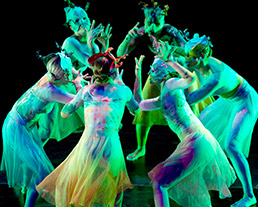
Costuming
and lighting share credit with choreography and dance in the work of Dance Kaleidoscope. (Photo courtesy Crowe's Eye Photography)
“Pictures” was preceded by a revised revival of Hochoy’s “Writing on the Great Wall.” This
piece was evocative and clear, with long ribbons gracefully incorporated as writing implements and the “text”
seeming to disappear as it was written. The temporal nature of this “writing” connected with the temporal nature
of both the body and of culture itself, made for a thought-provoking first half.
The performance would have been upgraded, however, if there wasn’t the distraction—not just of a child and a
few texters—but also of being able to see into the IRT wings during the performance.
Dance and theater are delicate things. Actors and directors and choreographers—in cahoots with lighting, costume and
scenic designers—work hard to create new worlds. Whether that’s a realistic kitchen set for a play or an empty
space for dance, place is important.
We accept theatrical conventions of course. We know that, within our view, there are likely to be the heads of people in
front of us, the proscenium arch over the stage, and some dark curtaining to keep the rest out of sight. There might be some
empty space above the set or the bobbing head and torso of a conductor in view.
And if it’s an outdoor performance, the expected distractions are multiplied. And we, the malleable audience, allow
for that.
But there’s no excuse, from a spot just three seats off a central aisle, to have in-the-wings dancers within sight.
There’s no reason for the careful grace of what’s happening on stage to be fighting for attention with draped
towels and dancers who have already left the stage.
This is not a problem unique to DK and the IRT stage. I clearly remember watching a play at Lincoln Center in New York with
one hand in front of my face like I was taking an eye test. The goal: Block out the sight of stage hands eating microwave
popcorn in the wings during a show that was set at the end of the 19th century.
When so much work and talent is involved in creating an artwork, I don’t think it’s too much to ask for someone,
during rehearsals, to pay a visit to the seats beyond the center to get an idea what the audience will be seeing. And to make
adjustments accordingly.
____________
Before I get labeled a curmudgeon, allow me to offer some heartfelt praise to a likely overlooked but much-used performing
arts tangent—the program book for the Indianapolis Symphony Orchestra.
This fairly hefty volume is an asset for a number of reasons, including:
• Like its brethren at other venues, the ISO program provides the basic information on what will be performed.
• Ample space is given to fairly lengthy biographies of the guest artists and conductors.
• The program covers a two-month span, meaning there’s information about shows you missed and, more important,
future shows you might be convinced to attend.
• For all but the hardest-core classical fan, there’s a lot to learn about the music being performed. And Marianne
Williams Tobias’ detailed, clear, insightful program notes are outstanding. At every ISO classical concert I’ve
attended, her accessible-but-never-trivializing notes have added to my experience.•
__________
This column appears weekly. Send information on upcoming A&E events to lharry@ibj.com. Visit www.ibj.com/arts for
more reviews, previews and blog posts. Twitter: IBJarts


IBJ Conversations
9 Comments
Add Comment
As a professional lighting designer and production manager and, ultimately, the one who is responsible for the â??visual distractions in the wingsâ?? that Mr. Harry reviewed, I feel compelled to respond.
Dance Kaleidoscope has performed at the Indiana Repertory Theatre for many, many seasons â?? not just the last six years on the Mainstage. The company has a wonderful history associated with the IRT. They have supported DK through much of our history. Dance Kaleidoscope is blessed to have an intimate, downtown space to perform in. Our patrons -- our audience -- appreciate our move downtown. And frankly, there arenâ??t any other options that we can afford, because we make it a huge point to be a fiscally responsible not-for-profit arts organization.
That said, yes, Mr. Harry, there are sight line problems at the IRT. Both DKâ??s and IRTâ??s production staffs have worked very hard to minimize the problem of the audience seeing into the wings. Believe me, I have borne the brunt of complaints from colleagues and mentors about the exact problem you hit upon in your review of our last show.
My response is always the sameâ?¦
Would you prefer to see our dancers dance on a very narrow stage? Would you prefer to see the breadth of David Hochoyâ??s vision narrowed down to a 28â?? wide by 30â?? deep space, simply so that you do not see what happens offstage?
I, respectfully, ask them all to pay attention to what happens onstage. Believe me, there is enough happening there to catch their attention.
Honestly, Mr. Harry, I do understand your criticisms. I ask you to understand our physical limitations and to, ultimately, respect how we deal with them.
I write this having missed DKâ??s performance but having enjoyed Louâ??s broader observation about distractions at arts events. As such, I was surprised that it stirred up such a hornetâ??s nest.
All art takes place within a context, and it is the combination of context and art that creates the full experience -- and it's that experience that Lou is writing about here.
If this were not the case, galleries wouldn't worry about the color of the walls on which they hang art, acting companies wouldn't worry about the stages on which they perform, and orchestras would perform in parking garages. That's not to say context always should be a dominant factor, but it certainly can't be ignored. In fact, often it is manipulated with great effect for the very purpose of enhancing the experience or making it particularly memorable. (Anyone who heard the Carmel Symphony Orchestra perform in a quarry a few years ago will attest to that -- I can't say what the CSO performed in that quarry, or even whether it was a particularly great performance, but I do remember the overall experience as inspiring and exciting.)
In addition, I think it should be noted that Lou typically seems to strive to balance his pieces between those that speak to veteran, knowledgeable art fans and those that speak to fresh-eyed newcomers. Longtime dance fans might not be distracted by what's happening in the wings ... they are so connected with the dance that they are blinded to any supplemental activity. But first-time attenders -- whose second go-round, and third and fourth, etc., will be greatly influenced by this first exposure -- likely will need help connecting to the art. And distractions from the wings will indeed disrupt their enjoyment.
Lou sees the big picture. Attending the theatre, dance, museum, symphony, whatever, is a full-package experience, and it should be treated as such.
Freddie: You say Lou is being paid to critique a dance performance. My estimation is that Lou (as well as his employer) believes he is being paid to assess the audience experience. In that, Henry, he IS giving the audience useful information. Doug: Your beer analogy is not bad, but I would be more inclined to compare Louâ??s observations with going to hear a concert and complaining that, say, the air conditioners kicked on loudly at key moments of a quiet concerto. Sara Lyn: You betray your position in your second graph, by saying â??I am expecting or hopingâ?¦.â?? In other words, you bring expectations to the review and expect it to conform to them â?¦ just as reviewers (like Lou) bring their perspectives to a performance. The problem is not in what is right or wrong; it is simply that you and Lou saw or expected a different purpose for this particular piece. Lou took it as an opportunity to consider a broader issue; you wanted him to focus on the specific performance at hand. My guess is that we will simply have to agree to disagree on whether he was right to do that.
If you read Lou regularly, you know that he does a good job of letting audiences know what to expect, whether that means talking about the performance, the sets, the original work of art or the context in which it occurs. Trust me, Freddie, youâ??re right: Lou is a smart guy. And I think the great majority of audience members â?? whose interests he holds first and foremost â?? appreciate that fact.
Still, thanks for reading and taking the time to comment. I really do appreciate it.
To clarify a bit: There's a reason why I don't offer star ratings to arts events or give thumbs up or thumbs down. I write about arts experiences and IBJ grants me the liberty to write about whatever aspect of that experience inspires me and that I think is worth sharing with readers.
Sometimes, that takes the form of commentary on performances, sometimes it takes the form of commentary on the material, sometimes it takes the form of commentary on other things that impact the performance. Sometimes it's just gushing and an encouragement to go buy tickets.
I've heard comments, negative and positive, about all of these approaches--including the one I took in this column in discussing the wing distraction of the DK show and the added bonus of the quality program notes at the ISO.
If you've been around for a while and are a lover of dance (which clearly you five are) you may know that I have written about nearly every DK performance over the past three years. I've highlighted individual dancers, discussed the choreography, written of the lighting and costumes, and talked about the relationship between music and dancer.
In this case, I chose to focus on an aspect of the experience that was a major distraction and could have been avoided. And it's a problem I've seen, as I said, at performances large and small.
It's clear that this wasn't what you were looking for in the piece. However, I stand by what I wrote.
Next time, perhaps, I'll focus on the dancers. Or not.
Of course, you are free to comment on any of the performances you see on our weekly You-review-it Monday blog. You can find it by clicking either the A&E or Blogs button up there on the top bar. I look forward to reading your words there.
And I'd hope this goes without saying, but I'll say it anyway: If I didn't respect the overall quality of what DK does, its work wouldn't be featured so often in my weekly e-mail, radio and TV previews. And I wouldn't take the time to go to see as many of the company's shows as I do for this column.
Also, I happened to have been having a very good day that day. But thank you for your concern.
Respectfully (and not under the influence of medication),
Lou
When I take time to read a reviewer, I am expecting and /or hoping for a thoughtful and intelligent analysis of a performance that provokes me into a new perspective on the piece or that adds something to my experience of it i.e., gives new perspective, enlightens and deepens my appreciation of a work. That is also why I too enjoy and appreciate Marianne Tobias�s liner notes in the ISO Program. They are well researched and filled with helpful information and a knowledgeable perspective from which I learn.
But, I am puzzled by your recent article ââ?¬Å?Louââ?¬â?¢s Views: Theatrical distractions abound, both in audience and in wings.ââ?¬ï¿½ What were you trying to do in your article? Was this an attempt to compare DK ââ?¬Ë?s production of Pictures at an Exhibition with the ISO Program? Was it supposed to be a review of PICTURES? Or were you just having a bad day and needing to get a pet peeve off your chest and share that with all of us?
Your article strikes me as self-absorbed and low and a waste of the reader's time. We read, expecting a performance review, and instead find that we are assaulted by your whining about your little theatre staging annoyances at several theatres you�ve been in. Pulling in PICTURES as the focus of your rant, with nothing said about the individual performers or the whole experience, makes this not a review but simply a thoughtless and disrespectful kvetch played out at the expense of those who work so hard to make our world more beautiful and wonderful here in Indianapolis. How insulting to those artists and to your readers!
Perhaps you should read your ââ?¬Å?reviewââ?¬ï¿½ drafts before publishing them, and then ââ?¬Å?. . . make adjustments accordingly.ââ?¬ï¿½
If you have a staging problem, tell David or Laura so it can be corrected. Don't ignore the dance or dancers for a light on in the wings or a missing blackout curtain. Be a reviewer of dance and challenge those attending to look for the quality, atheleticism, or sheer entertainment; and encourage those not attending to give it a try, now or next show.
You dismissed the dancers of Dance Kaleidoscope with two words: "exploratory energy".
I suggest you leave your keyboard, and come to a rehearsal. There you'll see how hard the dancers work to prepare for a performance. Every time they dance, they risk injury. They are doing this because of their passion to communicate with you. But you've got lost somewhere in the wings. Perhaps you have attention deficit disorder, and need help.
Next time you watch DK dance, try a bit harder to watch the performance and appreciate the dancers, as well as the choreography of David Hochoy, the lighting of Laura Glover,the costumes of Cheryl Sparks, and many other professionals too numerous to name.
Someone is paying you to critique a dance performance. You're a smart guy, Lou. I think you can handle it. So, why don't you give it a try?