
IBJNews

Medical device startup FlowCo enlists Guidant alums

Back to TopCommentsE-mailPrint

The upstart developer of a device to help doctors choose the right-sized stent to prop open clog-prone arteries has brought aboard former Guidant Corp. executives.
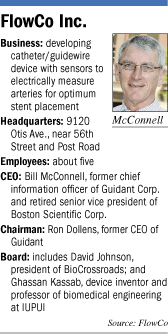
FlowCo factboxTheir regulatory and marketing expertise could help FlowCo Inc. bring its artery-measurement product to market as soon as 2011.

Indianapolis-based FlowCo earlier this year named as its CEO Bill McConnell, who’d been chief information officer at Guidant, the coronary products company spun off from Eli Lilly and Co. in the 1990s and acquired by Boston Scientific in 2006.

McConnell had recently retired as a senior vice president at Boston Scientific’s cardiac rhythm management unit in Minnesota.

Just a few months earlier, FlowCo device inventor Ghassan Kassab, a biomedical engineer and IUPUI professor, lassoed no less than former Guidant CEO Ron Dollens to serve as chairman of the budding firm.

 

Dollens Dollens

Dollens replaced Eli Lilly’s former chief science officer, Gus Watanabe, who died last summer. Watanabe was also chairman of the local life sciences initiative BioCrossroads.

“When Gus died, I worried more about FlowCo. He was so instrumental,” said David Johnson, president and CEO of BioCrossroads.

“Here you have this little company with these really heavy hitters. It remains one of the most cool, promising companies,” Johnson said of FlowCo, on whose board he serves.

And it’s ambitious.

FlowCo intends for its technology to challenge what is now the No. 1 tool in the market for complicated stent placement—intravascular ultrasound, or IVUS, technology.

Typically, surgeons use X-ray images to judge artery characteristics and select the appropriate stent size and placement. Stents are metal tubes with slots and have been used for years to keep open arteries clogged by plaque.

In some cases, however, it’s hard to image the artery. To minimize the risk of complications from poor stent implantation, many insurers, including Cigna, will pay for IVUS when, for example, “the angiographic image does not explain the individual’s degree of symptoms.”

FlowCo’s device uses not ultrasound but electrical impedance to gauge artery characteristics.

It’s said to be more precise, less cumbersome to use, and less expensive than IVUS. It will also be able to measure flow reserve in a diseased artery, a measurement today that requires the use of a different device.

But competing with IVUS in what could be a $1 billion annual artery measurement market won’t happen unless FlowCo can first thread Kassab’s “LumenRECON” device through the tortuous bureaucracy of the U.S. Food and Drug Administration.

Last month, FlowCo completed a human pilot study and is in the process of preparing a filing with the FDA, McConnell said.

To avoid years of regulatory exercises, McConnell and Dollens are trying to get the device classified by FDA as “substantially equivalent” to products using the IVUS and flow-reserve technology.

“There may be some additional clinical work that’s required,” McConnell said, before it can be classified as equivalent.

FlowCo could have its device on the market for use in peripheral arteries next year, with a coronary version perhaps in 2012, McConnell said.

He cautions that’s only a best guess, based on his experience with heart stents, defibrillators and other products.

The company’s lifeblood—funding—has been flowing smoothly so far. FlowCo in 2007 landed $250,000 from BioCrossroads’ Indiana Seed Fund. That year, it also pulled in $2 million from the state’s 21st Century Research and Technology Fund.

And last November, FlowCo raised $1.2 million from outside investors, according to Securities and Exchange Commission records.

“The company has attracted a tremendous amount of highly sophisticated angel investment and other funding,” Johnson said.

Better mousetrap?

That such a product opportunity exists in a maturing stent market may be surprising to those outside the operating room—particularly now that stents are coated with drugs to further reduce the likelihood the passage where the stent is placed will narrow again—known as restenosis—or develop dangerous blood clots.

The restenosis rate averages 4 percent to 8 percent, depending on which study one reads. Put in too big a stent and vessels can be damaged. Too small a stent can cause turbulence between the tube and cell wall—inducing blood clots.

Either way, the complications can be expensive. A few years ago, in an interview with CathLabDigest, Kassab estimated that an 8-percent restenosis rate could translate into 56,000 patients per year, with retreatment costs of more than $15,000 per patient—or more than $800 million a year.

Kassab used his electrical engineering expertise to design a better mousetrap, mindful of the key weaknesses of IVUS. That technology requires some interpretation by doctors of the ultrasound image, making it more subjective.

It also is a two-step process, with its sensors housed on a separate catheter from that used for the angioplasty balloon system that presses the stent into the artery wall. The wires used with IVUS can also be difficult to maneuver through certain kinds of arteries. Measuring flow reserve requires yet another, specific-purpose guide wire.

In contrast, Kassab’s device can use standard catheters or guidewires with which surgeons already are accustomed. Lumen-RECON has four tiny wires, or electrodes, running through the center of the guidewire, popping out at the tip.

Two of the wires send an electrical current and the other two measure the voltage difference, to take key measurements of the artery.

The conductivity of electrical current differs depending on the material through which it passes. That holds potential for getting a better idea of the composition of plaque in a patient’s arteries.

The electrodes also take measurements as the balloon is inflated and give the surgeon real-time, digital data as to how much to expand the stent.

“It’s a more complicated process to interpret what you see from the IVUS image,” McConnell said.

Price-point potential

Perhaps the biggest selling point could be on price.

McConnell declined to elaborate, but said the FlowCo device could run roughly half that of the combined cost of IVUS and flow-reserve devices. In the United States alone, there are about 1 million coronary artery interventions annually, plus about 400,000 procedures on peripheral arteries.

Kassab hailed from the University of California, San Diego. He trained under Y.C. Fung, known as the father of biomechanics. Kassab inherited Fung’s program in California. IUPUI later recruited him and 14 of his staff. Among local firms involved in the design of the FlowCo product are Catheter Research Inc. and engineering/prototyping firm Priio.•

ADVERTISEMENT

  • Know Your Facts
    Ron Dollens and Bill McConnell are of great character. Dishonest is a strong word. Know the story before throwing stones.
  • Potential "FLOWCOrruption"
    Based on the headlining article in the Company News section, I don't know if I would be putting the welfare of my upstart company into the hands of dishonest former Guidant executives. This would seem to lead itself to difficultly in establishing corporate and public trust for your products.

Post a comment to this story

COMMENTS POLICY
We reserve the right to remove any post that we feel is obscene, profane, vulgar, racist, sexually explicit, abusive, or hateful.
 
You are legally responsible for what you post and your anonymity is not guaranteed.
 
Posts that insult, defame, threaten, harass or abuse other readers or people mentioned in IBJ editorial content are also subject to removal. Please respect the privacy of individuals and refrain from posting personal information.
 
No solicitations, spamming or advertisements are allowed. Readers may post links to other informational websites that are relevant to the topic at hand, but please do not link to objectionable material.
 
We may remove messages that are unrelated to the topic, encourage illegal activity, use all capital letters or are unreadable.
 

Messages that are flagged by readers as objectionable will be reviewed and may or may not be removed. Please do not flag a post simply because you disagree with it.

Sponsored by
ADVERTISEMENT

facebook - twitter on Facebook & Twitter

Follow on TwitterFollow IBJ on Facebook:
Follow on TwitterFollow IBJ's Tweets on these topics:
 
Subscribe to IBJ
  1. liek the rest of America

  2. These quaint,obsessed musings by the stalkers are certainly entertaining, but I'm trying to figure out what, if anything, all the yelping below has to do with Zak Brown.

  3. It's evident that Moffett was pushing the right buttons and corporate America is now trying to squash him. He just wanted to withdraw the free pilot services provided to the company by the pilots to try and put some pressure on a company that has not been interested in negotiating a contract in over 5 years. The company does not provide a contract because not having one has saved them a bundle of money. Shame on any Republic pilots not standing behind their union leader just because things are getting tough, can you not see such strategic moves by the company as putting the last union president in a corporate position and into THEIR pocket. Do you really believe the last union president is so appalled at the attempts by Moffett, do you not remember his oppositions to the company? We stood behind him. It has been proven over and over again for thousands of years without fail, a man cannot serve two masters. Anyone that believes people vote contrary to their paycheck and livelihood deserve to be taken advantage of, the recent statements by the former union president are laughable as he denounces the current union president from his new corporate position. Have you ever seen a drafted sports player score points for his previous team, it cannot be done, he is not on the pilots side anymore, he gets his money a different way now than you and I do, and he should not be allowed to remain on the seniority list. A drafted player brings strength, credibility, tactical knowledge, and a strategic advantage to his NEW team, he would not be drafted or paid were it otherwise. We are all forced to choose only one side to play for and support, not doing so has many references in life such as insider trading and shaving points, all illegal for good reason. This basic fact is why corporate moguls, scientist, and engineers all sign non-discloser agreements and non-compete clauses, as protection in case they are lured into switching sides as our former union president has done. No NFL coach ever drafted a player so that both teams could benefit and better understand each other, they are recruited to win the game against that former team, period. Likewise the company does not recruit the former union president by accident or mutual understanding, its strategy. Don't confuse playing the game with good sportsman-like conduct in support of common business and prosperity goals, with the requirement to only play for one side. Good men we all love and favor fall subject to this manipulation, often without their knowledge, and it is not a betrayal of their friendship to oppose them when they switch sides. If we did not love and trust them, they would not have been chosen and lured to the other side in the first place. The deception by the drafted player is not made at a conscious level, it's just human nature and it's all about money and power which corrupts our ability to be objective and loyal to two masters. This is why our court system created the defense attorney, and why our military created counter intelligence. Its strategy and its propaganda, and it works, and that's why the "powers to be" manipulate the chess pieces by sometimes changing their colors. Some players know they are being manipulated when their color is changed, but it brings them more money and power so they do not care. The rest have good intentions but do not even realize they are being manipulated. This tactic is also known by another name, Divide and Conquer. In battle sending an imperfect message with an imperfect team is obviously not ideal, but it's still being sent by YOUR team, your union leader, a leader that has common goals and common rewards with you, they are the best, because we have elected them to do a job for us. If you are not backing Moffett but believing the spin by those that have recently switched sides, you are taking food out of your own mouth. Showing unity and backing an imperfect situation still results in taking just as much ground, it's about unity and bargaining power. It's not necessary to wait around for that perfect attack because it will never come, the company will spin and attempt to destroy anyone that gets in their way. Ultimately it's not about any specific attack anyway, ASAP or whatever it makes no difference, it is and always has been only about power. If this company cared about safety it would not build pairings with 8 hour overnights, come on, are you that naive? Besides, do you really think Hoffa cares, no, he got a call from corporate America and was squeezed into denouncing Moffett. If he didn't they would spin the safety card against him and the Teamsters National with implication for truckers, future contracts, insurance rates etc...saying something like the Teamsters use safety as a bargaining chip, blah blah blah... Do you really think any pilot is going to do something unsafe for the contract, absolutely not, the only ones threatening safety here is the company with reduced rest, fatigue, and poverty. Do you not find it odd that Hoffa and the Teamsters are opposing a Teamster president publicly? Would the Teamsters National not normally support and work with one of their own? Why did they not sit down and help him strategize, correct any mistakes, and charge ahead? Would the Teamsters National not normally support and leverage a contract for all those pilots that have been paying Teamster dues, isn't that why we have all been paying Teamster dues in the first place? I sure haven't been paying dues so that the Teamsters National could come along and write this kind of an article undercutting our union leader and our unity. Whose side is the Teamsters National really on, it's obviously not the Republic pilots side.

  4. No matter what Moffatt does the company is going to spin it like he is the terrorist and brainwash people like you into believing it, wake up, back your players that are trying to change things for you and your livelihood. Where has Hoffa been for the last 6 years, except collecting our dues. Seriously, do you really think an FO going for upgrade, signed off by a checkairman ready for the upgrade, who then fails, is not even capable of returning as a First Officer.

  5. whoa!

ADVERTISEMENT