
Subscriber Benefit
As a subscriber you can listen to articles at work, in the car, or while you work out. Subscribe Now
The news about venture capital investing isn’t entirely bad. After all, Orbis Education, an Indianapolis-based developer
of nursing education software, snagged an $8 million infusion in January. And Scale Computing, which offers data storage devices,
landed $9 million in January.
But Orbis and Scale are exceptions.
Most local venture funds are standing pat not only because the economy is weak, but also because they’re no longer
in fund-raising mode. Having invested most of their funds, the firms have shifted to the nurturing, or “harvesting”
stage, to try to improve investment returns.
“It’s a different world right now,” Orbis CEO Dan Briggs said. “The venture capitalists are still
sitting on some good-sized funds; they’re just being more selective. They’re not going to pump $20 [million] to
$30 million into an idea.”
It isn’t as if Indianapolis stands out as a lonesome loser. Venture activity is weak nearly everywhere.
 Only $15.2 billion in venture capital was raised in the United States last year, according
to the Arlington, Va.-based National Venture Capital Association. That’s the least since 2003 and less than half of
2008 levels. Worse, just 120 funds raised money last year, the fewest since 1993.
As a result, entrepreneurs are searching longer and harder for critical financing in a climate that favors investors.
Entrepreneurs actually are twice-clobbered. Few venture firms are beating on their doors looking for deals, and the economy
has driven down values of their companies, so venture firms demand greater stakes for smaller infusions.
Funds now might demand as much as 25 percent of a company instead of the 10 percent that was typical before 2008.
“Right now, cash is expensive,” said Orbis Education’s Briggs. “If you don’t have a need for
the money, don’t take it, because it’s not going to be cheap.”
The Orbis infusion came no thanks to local venture firms. Orbis was sought out by Menlo Park, Calif.-based Lightspeed Venture
Partners.
Lightspeed’s interest in Orbis only magnifies the dearth of investments originating from local funds, which, when they
do invest, focus on later-stage deals, said Don Aquilano, managing partner of Cincinnati-based Blue Chip Venture Co., which
has a Carmel office.
“Because of the economy, and because of how long it’s taken some of these companies to mature in this economy,”
he said, “very few funds are being raised.”
To that end, Aquilano has raised an early-stage tech fund called Allos Ventures. Allos has raised $20 million from investors.
Blue Chip helped invest $6 million in the Indianapolis-based data storage upstart Scale Computing Inc., which earlier this
month received a $9 million, second-stage infusion—also from an out-of-state fund, Benchmark Capital in Silicon Valley.
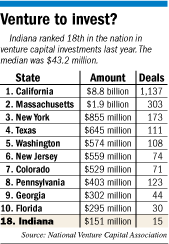
The 15 venture deals in Indiana last year totaled $150.7 million, ranking the state 18th in investment, according to the
National Venture Capital Association.
That type of activity led New York-based Navidar Group LLC, an investment banking firm, to locate an office in Carmel upon
its launch in March 2009.
Chris Day, a managing partner in New York, said the firm has been hired by several Midwestern companies to help find growth
capital or buyers.
In spite of the treacherous investment market, he’s optimistic this year will bear more deals.
“The climate, it’s getting better,” Day said. “It’s challenging, but it’s certainly getting
better.”
‘Abysmal’ IPO market
A venture fund has a normal life span of about 10 years. The first five are dedicated to making new investments
and the rest are devoted to nurturing the companies toward lucrative sales or initial public offerings.
The recession, however, has taken its toll on both mergers and acquisitions and IPOs.
Through mid-March, just three venture-backed IPOs had been consummated nationwide, signaling another poor performance from
the industry, according to the venture capital association.
And the dozen IPOs last year weren’t a big improvement over the six in 2008, considering that 100 in a given year is
typical, said Emily Mendell, the association’s vice president for strategic affairs.
“We’re way off that,” Mendell said. “The IPO market has been abysmal.”
Venture-backed companies, in turn, are remaining in fund portfolios longer than investors envisioned, prohibiting them from
reinvesting profits in new interests.
The effect on entrepreneurs is that they are receiving less interest from venture funds—unless their business models
are really compelling, said David Millard, chairman of the business department at Indianapolis-based law firm Barnes &
Thornburg LLP.
“In a good market, you’d like to have at least two term sheets, if not three, to play them off of each other,”
he said. “In today’s market, that’s just not reasonable. The venture capitalists are going to dictate the
terms.”
Even so, venture capitalists can’t be “pigs” and make outlandish demands, Millard said, or they’ll
stifle sales.
Deal terms are seldom disclosed. Doing so would tip the investors’ hand when it comes time to cash out, said Briggs
of Orbis Education.
But the terms Millard and others are seeing are similar to those of past years, in which first-round investments include
preferred stock with a 6-percent to 8-percent dividend that’s returned at the time of an acquisition or IPO.
For instance, a $5 million sale in which an investor contributed $1 million would return the $1 million investment as well
as the dividend. The remainder would be split among the investor and common shareholders, which might include company founders,
employees or early angel investors.
Millard, who helps structure venture deals for clients, is optimistic venture capitalists are jumping back into the market,
whether they’re local or not.
Said Millard: “Some of them came out of their caves a quarter earlier than people thought they would.”•
Please enable JavaScript to view this content.
Editor's note: You can comment on IBJ stories by signing in to your IBJ account. If you have not registered, please sign up for a free account now. Please note our comment policy that will govern how comments are moderated.