
Subscriber Benefit
As a subscriber you can listen to articles at work, in the car, or while you work out. Subscribe NowAny case federal prosecutors pursue against Tim Durham or his associates likely would revolve around what his Fair Finance Co. disclosed—or didn’t disclose—to potential investors, legal observers said.
The FBI isn’t saying what it was after when agents swooped in to two Durham companies—Indianapolis-based Obsidian Enterprises Inc. and Akron, Ohio-based Fair—on Nov. 24 and hauled out bankers boxes full of documents.
But in a written statement, the FBI did urge “anyone who has had dealings with Fair … or has information or concerns” about the company to contact the agency.
And in an e-mail, Dennis Ginty, a spokesman for the Ohio Department of Commerce’s Division of Securities—Fair’s primary regulator—said: “The division will most assuredly assist the FBI in any way it can that will serve to protect the interests of Ohio investors.”
 Durham
The dramatic FBI raids came a month after IBJ published an investigative story questioning whether Fair, which purchases customer-finance contracts from retailers and other firms, had the financial wherewithal to repay Ohio investors who had purchased $197 million in investment certificates.
The story reported that, since Durham bought the business from Donald Fair in 2002, he had used it almost like a personal bank to fund a range of business interests, some of them unsuccessful. The story noted that he and related parties owe Fair more than $168 million.
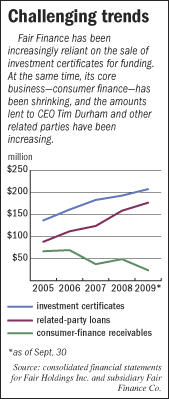
The company has since filed new financials with the Division of Securities that show its performance has declined during the economic downturn. They also show that insider loans have climbed to $177 million, and investment certificates outstanding have swelled to $207 million.
Meanwhile, customer-finance contracts—which used to be the source of most of the company’s profits—have dwindled to $24 million. That means paying back the purchasers of investment certificates mainly hinges on Durham’s and related parties’ paying back their massive insider loans.
“I hope they get all those investors paid off, but there is reason for concern about that,” said James Klimek, an Indianapolis securities attorney who reviewed the latest financials for IBJ.
Some of the investors are getting worried. Many have been purchasing or rolling over investment certificates for years, enticed by lofty interest rates. Fair has be
en paying as much as 9 percent on 24-month notes.
That’s more than triple what banks are paying on certificates of deposit with similar terms. But CDs come with a government guarantee. Fair’s investors—who are required to be Ohio residents and who primarily live in the northeastern part of the state—have no backstop if the company fails to pay what’s due.
Harley Himes, 82, said he and his wife live off the monthly interest payments they receive on their Fair certificates. He said they’re waiting to find out what happens next.
“I was an investor back when the original owner owned it,” said Himes, who lives near Wooster. “We didn’t have any problem with him. You kind of get used to a good thing. Then you find it is not such a good thing.”
Disclosures to investors
Durham has his primary office at Obsidian, a leveraged-buyout firm on the top floor of the Chase Tower downtown. It’s not clear whether the FBI is interested in Obsidian itself or only records held in those offices that relate to Fair.
Securities attorneys say the stickiest issue for Durham might be whether the Fair offering circulars provided to prospective investors included material misrepresentations or omissions.
Attorneys who have read through the circulars, which run more than 40 pages, say they’re difficult to decipher, especially portions disclosing details about insider loans and what serves as collateral for those loans.
“Are you telling enough about the entities receiving insider loans, and what kind of shape they are in?” asked Mark Maddox, an Indianapolis securities attorney who is considering representing investors in civil litigation against Fair.
If Fair failed, that in itself wouldn’t open Durham or associates to criminal prosecution for securities fraud or other violations, since there is no crime in running an unsuccessful business.
Though insider loans are controversial because of the potential for conflicts of interest, their prevalence also might not be problematic. That’s because the company was forthright in the “use of proceeds” section of recent circulars that some money would be used that way.
John Tompkins, an Indianapolis attorney representing the 47-year-old Durham, said his client is cooperating with investigators and believes he has done nothing wrong. He said Durham met with FBI agents and answered questions the day the raids occurred. He wouldn’t say what they discussed.
Future challenges
Pressures were intensifying on Fair Finance even before the raids. The company reported a loss of $1.78 million in 2008, in part because it added $2 million to reserves to cover potential loan losses.

The figures are contained in a proposed offering circular Fair filed with Ohio’s Division of Securities Oct. 29. The company sought a new registration because an existing one from July 2008 was set to expire Nov. 24.
But instead of signing off on the new registration, Mark Heuerman, registration chief counsel, sent a letter to Fair’s attorney saying “the offering is impossible to review under our standards without further documentation.”
He asked for additional information on a range of topics, including documentation that would help him untangle the morass of insider loans.
“Please include sequential transactions on multiple levels where related parties engage in further transactions with related parties,” he said.
Ronald Kaffen, an Akron attorney representing Fair, characterized the back and forth as routine.
“That’s sort of standard procedure. You make a filing. You get comments back, and you respond to those comments,” Kaffen said.
The company submitted its responses Nov. 24, and the Division of Securities is reviewing them. In the meantime, because Fair’s prior registration has expired, it can’t sell additional investment certificates.
That could help limit losses if Fair were to fail, since new investor dollars won’t be coming in the door. But Klimek, the securities attorney, said he wonders if Fair can keep going without those infusions.
In the proposed offering circular, the company acknowledges its concern over the “effect that the country’s economic downtown may have upon Fair’s ability to obtain sufficient capital to pay interest to investors and to repay investment certificates as they become due.”
As a result of that concern, the document says, Fair in February raised cash by selling several million dollars in consumer finance loans to an affiliate of CLST Holdings, a publicly traded Dallas company where Durham is a board member and major shareholder.
Fair also says in the circular that New York-based Fortress Credit Corp. in June reduced the company’s credit line from $50 million to $35 million.
And the company acknowledges it’s been selling off better-performing finance contracts to raise cash, leaving it with a portfolio of loans that may experience higher default rates.
“Fair has felt it necessary to liquidate a large portion of its finance receivable portfolio in order to provide sufficient funds to pay investor interest and to redeem certificates as they come due,” the circular says.
Further, Fair acknowledges that “at times” within the past year, it has delayed the repayment of principal on maturing certificates for 60 days—something the company has authority to do in months when payments due investors exceed 10 percent of its cash collections.
Fair said that as soon as economic conditions allow, it plans to jump back into the purchase of customer-finance contracts.
But in the interim, management is thinking entrepreneurially. Within the next 60 days, Fair plans to launch a division called Fair Communications, which will operate call centers for third parties out of excess office space.•
Please enable JavaScript to view this content.
Editor's note: You can comment on IBJ stories by signing in to your IBJ account. If you have not registered, please sign up for a free account now. Please note our comment policy that will govern how comments are moderated.