
The smoking-ban debate in this city and state is getting a new spark from a fired-up group of tourism and convention officials.
They’re trying to light a fire under lawmakers, who have been reluctant to approve the kind of comprehensive smoking
ban that health—and now tourism—officials say is needed here.
Indianapolis Convention and Visitors Association CEO Don Welsh and other area tourism and convention officials say Indianapolis
officials’ unwillingness to strengthen anti-smoking legislation is imperiling the city’s growing tourism trade.
“In many cases, the ordinances have been driven politically or solely due to the desires of local citizens,”
Welsh said. “While I understand that, the desires of visitors who spend billions of dollars in our community every year
have not been considered.”
On the state level, the Indiana House on Feb. 24 passed a measure that
would ban smoking in all enclosed public places except casinos and horse tracks. Several local tourism officials said they
plan to get in the ear of state politicians as the bill progresses through the General Assembly.
A number of cities in the United States and abroad have passed legislation outlawing smoking in all public places, including
hotels, restaurants and bars. Welsh said he recently heard from visitors from New York who were disgusted by Indianapolis’
policy.
“When Paris passed their anti-smoking legislation 18 months ago, that set the tone globally,” Welsh said. “It’s
what people come to expect, and Indianapolis is being left behind.”
Welsh is far from alone in his concern.
Jeff Sweet, president of the Greater Indianapolis Hotel and Lodging Association and general manager of Hilton Indianapolis
Hotel and Suites, said the complaints he hears from visitors about Indiana’s smoking policies are becoming louder and
more frequent.
“Our guests, quite frankly, are taken aback by the smoking in our city,” said Sweet, whose hotel is in the process
of going completely smoke-free. “There’s no getting around it. It’s starting to affect the city’s
image, and not in a good way.”
Dirk Ebener, CEO of Atlanta-based NuernbergMesse North America, which represents more than 100 trade shows globally, said
a city’s smoking policy has a major impact on its image. Ebener, who recently conducted a site inspection in Indianapolis,
said the smoking in entertainment hot spots here is a definite drawback.
“There are a growing number of conventions in various sectors that definitely prefer a non-smoking city,” Ebener
said. “A city’s smoking policy says a lot about it. It speaks to cleanliness of the city, demonstrates the health
awareness of the city, and calls attention to its overall progressiveness.”
In 2006, the City-County Council enacted an anti-smoking law, but there are several exemptions, including bars and other
establishments that don’t allow anyone under 18 and businesses that don’t employ anyone under 18.
In October, the City-County Council voted against an ordinance that would have strengthened the existing smoking ban to include
bars and the vast majority of workplaces. Council members then decided in a 14-13 vote to table the legislation, which means
it can return to the council agenda at a future meeting.

Local
patrons like Kenneth Fegett still enjoy a smoke at the Front Page and other area bars. (IBJ Photo/ Perry Reichanadter)
Mayor Greg Ballard has said he would veto such an ordinance if it reaches his desk.
That stand, Welsh said, is endangering a critical sector of convention business the ICVA is trying to develop.
“Many in the life sciences, bio and medical fields are vehemently against smoking in public places,” Welsh said.
“I’m not sure it’s always a show stopper, but it’s certainly an unnecessary worry and concern that
we shouldn’t have.”
Medical and life sciences conventions and corporate meetings are key to the city’s plan to grow downtown and its convention
business, Sweet said.
“Bio and life sciences is a premium-rated business,” he said. “There’s a huge benefit to getting
a foot in the door with that industry. Since that sector is growing rapidly, now is a critical time for this city to put its
best foot forward with those organizations.”
Sweet said the current policy hurts the city’s otherwise pristine reputation among convention-goers.
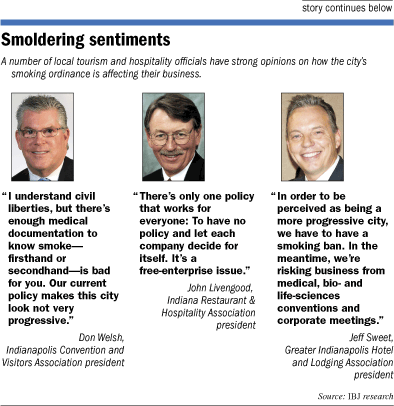
“In order to be perceived as being a more progressive city, we have to have a smoking ban,” he said.
The city’s rapidly growing tourism and convention business means there’s plenty at stake.
A 2006 study by Washington, D.C.-based industry analyst D.K. Shifflet and Associates showed the city’s annual visitor
spending hitting $3.6 billion.
Life sciences currently generates 4 percent of Indianapolis’ convention and visitor business, but within a few years,
Welsh said, it could account for 20 percent. Sports is the city’s largest convention and visitor moneymaker, he said,
making up 24 percent of the pie.
While the money spent on life sciences and medical conventions is considerable, it’s just part of the benefit. ICVA
and its partners in the endeavor to grow that sector hope exposure from the medical and bio gatherings gives the region further
gravitas as a life sciences hub. That, BioCrossroads President David Johnson said, will help build the credibility of companies
located here.
“If we could make Indianapolis ground zero for these types of meetings, that would be a tremendous way to show the
strengths of this community in a way others in the industry don’t normally think of,” said Johnson, whose organization
heads economic development for Indiana’s life sciences initiative.
Not everyone in the local convention and tourism sector favors strengthening the city’s anti-smoking law. John Livengood,
president of the Indiana Restaurant & Hospitality Association, said there’s an intense divide among members of his
organization.
While some agree with Welsh and Sweet that Indianapolis’ smoking laws are scaring off certain visitors, he said others
fear an all-out smoking ban will hurt the city with other patrons.
“There’s only one policy that works for everyone,” Livengood said. “To have no policy and let each
company decide for itself. It’s a free enterprise issue.”
Waiting for local businesses to conclude that smoking must be banned, Welsh said, could have detrimental consequences.
“I understand civil liberties, but there’s enough medical documentaion to know smoke—firsthand or secondhand—is
bad for you,” Welsh said. “Our current policy makes this city look not very progressive.”•


IBJ Conversations
57 Comments
Add Comment
Are you telling me people who don't smoke are going to patronize my bar,because of the ban - not likely. It's hard in these times to keep a business running without anymore laws and regulations!
I hardly ever go out anymore. I need a list of bars in Indy that still allow smoking.
Any ideas? PS You non-smokers that think we don't mind you are so wrong.
The evidence is suggestive but not sufficient to infer a causal relationship between secondhand smoke exposure and acute respiratory symptoms including cough, wheeze, chest tightness, and difficulty breathing among persons with asthma.
The evidence is suggestive but not sufficient to infer a causal relationship between secondhand smoke exposure and acute respiratory symptoms including cough, wheeze, chest tightness, and difficulty breathing among healthy persons.
The evidence is suggestive but not sufficient to infer a causal relationship between secondhand smoke exposure and chronic respiratory symptoms.
The evidence is suggestive but not sufficient to infer a causal relationship between short-term secondhand smoke exposure and an acute decline in lung function in persons with asthma.
The evidence is inadequate to infer the presence or absence of a causal relationship between short-term secondhand smoke exposure and an acute decline in lung function in healthy persons.
Why is it so hard to smoke outside? IT ISN'T!
For those of us who went to college and believe in science. Smoking causes cancer. Cancer kills people. Get rid of it. I am sick of my rights being trampled in the form of taxes to pay for state subsidized cancer treatment. We would shut down any business that had asbestos problems... this is no different.
If you don't believe that smoking and second hand smoke cause cancer then you are stupid. Period.
Anti-smoking advocates often threaten to avoid cities for their parties but truthfully end up spending more dollars and using more hospitality services in States that continue to not enact bans. Their mission requires their presence in the State to pass the initiatives.
Once the voting is completed and the initiative passes the groups disappear with only a few native individuals to ensure the program is on track. The methodology is repeated over and over.
Read the statistics from each State, once the swarm is over, problems arise and citizens are unhappy.
http://www.smokechoke.com/
Physician Michael Siegel has caught multiple researchers trying to pass off deceptive studies on bans reducing heart attack rates, such as this one: http://tobaccoanalysis.blogspot.com/2009/10/institute-of-medicine-reports.html In Kansas, a presentation was done on February 10th, 2010, to the Kansas House Health and Human Services Committee where a presenter unfortunately reported results of a Kansas University study on bans and heart attack rates, not realizing it was corrected on November 10th showing a statistically insignificant change on heart attack rates: http://www.youtube.com/watch?v=KX_GtmdoEv8 Finally, the Helena, Montana study was an infamous one that has also been disproven, and the researchers admitted that they did not properly examine nonsmokers as a separate group:
http://pasan.thetruthisalie.com/modules.php?name=News&file=article&sid=10
And howdy Bill Kerschner, I'm also a fellow Illinoian, and I can see you don't have a darn clue how many bars, private clubs, and (less frequently) restaurants throughout this state look the other way on the state ban. Indianapolis handled this issue in a great way in 2005, and I only wish Chicago had handled the smoking ban issue in a way closer to what both this city, and also Wichita, KS did:
http://www.wichita.gov/CityOffices/OCI/Smoking.htm
"Progressive" isn't a point on a ruler where you determine whether they are conservative, liberal, etc. It's "staying current with the trends elsewhere". Now, you can say, "if everyone else jumps off of the cliff, would you?" That's sophistry.
I've mentioned this elsewhere: If the two of us (you & me) to be in a bar and you smoke, what's wrong if I stand up on a chair and share the byproduct of my beer? (If you're worried about indecency, I'll take it to the BR first.
It's sterile. Is tobacco smoke sterile? N.B. I didn't say "unhealthy" so we don't drag one of those (few in number: 1? 2? 3?) studies from the previous 40 years, which point out there's nothing wrong with smoking.
If he hasn't posted it recently, we're due to see Harley post his link & content from OSHA to a PhD which (attempts) to point out the fallacy. Again: Just 1?
Why do groups, such as the ACS, exist?
Why do people who are grouped into "smoking sheds" sneak out? Is the smoke too thick? How about why they leave their (car) windows, regardless of the weather?
Aside from mangling stats to prove a lost cause, tobacco smokers are overlooking 3 things: 1) does it permit chewing? I worked in Lexington for a reasonable period of time. I watched how things worked and immediately realized I was going to have to keep my pop/soda with me at all times. You never know when someone's going to spit in a can. And I wasn't going to let it be mine. You want disgusting?
2) When "scouts" - first visitors to cities are walking about, are you, let's say even 25 people, willing - seriously - willing to carry signs like union members stating, "I smoke & I'm proud of it." where the visitors can see you? Why not? Are you afraid of something? What are you willing to do (financially) to make up for groups which avoid Indy?
3) re: People fighting for their "rights" vs. that of groups bringing money:
Consider this a freebee in return for a cluex4 between the eyes - does the word "irony" mean anything to you?
In return for granting me a cluex4 between your eyes, ponder this:
Get organizations to look at Indy, but state they won't come because there's a ban.
Hint: Use this list: http://tinyurl.com/yhxturl
Is there anyone who is there who might do so?
This is one someone needs to do: find a small toilet, put some sand in it with a sign: "put your butts here"
Just say no to Progressive agendas!
This isn't just about smoking - never was.
Post a sign, let individuals choose which venue to enter. and the market will decide.
www.indybootcamps.com
www.indysbiggestloser.com
www.indyfitkids.com
I would like make two points, however, that have not been addressed by the postings made so far. The first is that there are other factors besides smoking regulation that affect the success or failure of hospitality businesses. The business by its very nature suffers a high rate of attrition. In assessing the effect of smoking laws you must also take into account the general economic climate, and I'm sure I need not remind my Indiana friends that we're just now showing signs of coming out of a recession that has stretched for more than two years. Additionally, consumer tastes change, and businesses that are adept at noting those changes early survive, while those that don't do poorly or fail. As well, discretionary spending patterns of families vary depending on family size and age and circumstance; anyone who has kids knows that the financial demands of their children can change dramatically as the child's interests and demands change.
Finally, this shouldn't be a debate centred around consumers' choice, but around worker safety. I'm sure that Indiana has laws protecting workers from workplace hazards as does virtually every advanced industrial state. Are lawmakers in Indiana prepared to accept that there are two kinds of workers in their state, ones that are entitled to protection from workplace hazards, and those that aren't? Consumers generally spend far less time in a smoke filled bar or restaurant than the worker employed to serve them. And who are we hurting the most by denying hospitality workers protection from the proven hazard of second hand smoke? Invariably they're women, often poorly educated or working to advance their education, and young, and moving to a smoke free job isn't always an option. With the economy still climbing to its feet, people don't always have the luxury of working in an environment of their choosing. Aren't these folks the ones most in need of your protection?
There is overwhelming public support for smokefree air. The health and medical community support it, voters support it, much of the hospitality industry supports it, all major hospitals support it, the Indianapolis Chamber of Commerce supports it, and now convention and tourism folks are speaking out.
Secondhand smoke makes Indy look dirty and backwards. It costs us a lot of money in health care - not to mention business costs. And most important, it damages the health of people who work around it.
How much longer to we have to wait?
I can guarantee the bandwagon of smoker hatred would end overnight and the profiteers would be making deals in self preservation convicting each other. Similar to the last time their ilk rose to prominence and Doctors were hanged at Nuremberg. The laws of Autonomy created in the wake, are largely being minimized by the bigots and zealots of Public Healthism, they are laws we found at the expense of millions who died without them. No one has the right to make health choices for others and no one has a right to demand rights to the detriment of others, especially with the convenience of a lie, as we find in the â??toxic effect of second hand smokeâ??.
52 pubs a week are closing across the UK since their smoking ban was enacted. Sales in Ireland's pubs are down 16%.
Sales tax collection in Missouri has declined 5-8% in every municipality where smoking bans have been enacted. New York lost 3.2%, and their answer was to increase the sales tax to make up for the loss in revenue.
And the effect on private clubs all across the country has been devastating.
Here are a few more: http://www.smokersclub.com/banloss3.htm
Forbes magazine says bans DO hurt businesses:
http://www.forbes.com/2009/06/04/economic-impact-bars-restaurants-opinions-contributors-smoking-ban.html
Not that facts ever matter in smoking ban discussions.
There are enough over blown stats and claims without ICVA jumping in with more silliness.
Doesn't ICVA and CIB have more serious problems to resolve without distractions?
Just for the record I'm all for a farting ban;)
No business closed up shop, no restaurants left the business core, and when all those smokers decided it wasn't too bad to step outside and smoke - they started coming back to. Business is booming and more bars are being added.
I'm not talking all college bars, I'm even speaking of The Vid (video saloon), and other townie bars that "would definitly go out of business" but never did.
Having a split policy like this is whats causing a divide right now, if its all or nothing, then those same people will continue to patronize their favotite haunts. IF there are exemptions, more business would then die away. We need the ban. I go outside with my friends when they smoke and I don't smoke, whats the big deal.
Every city and state that bans smoking sees bars and restaurants close. Every one of them. If you don't believe that smokers choose to stay home instead of being told their business is not welcome, you haven;'t done the research. Smokers spend more, stay longer, and tip better than non-smokers, uniformly. After all of the non-smokers cry and whine and browbeat politicians into enacting bans, they don't suddenly flood into formerly smoking establishments and make up for the loss of business. They go home, smug and proud that they beat the smokers.
Livengood is a lonely voice in the wilderness, pleading for the right of business owners to decide how to run their establishments. If health was the real issue here, then post massive signs, "WARNING: SMOKERS WELCOME! YOU COULD DIE IF YOU ENTER HERE!" and let the citizenry vote with their feet. But this has NEVER been about health. It has ALWAYS been about one group controlling the behavior of another. If you don't believe that, try using a completely harmless electronic cigarette on an airplane sometime. They are banned, not because they harm anyone, but because they create "an enforcement issue."
"Not good for you, therefore bad for you, therefore illegal." That's the real mantra of the antismoking jihad.
If smoking is banned in every establishment, do you REALLY think the 20-25% of the people of Indiana who smoke are all of sudden going to learn how to cook or stop going to bars? You're just being a chicken little like the Glenn Beck's of the world.
The only establishment that I think would actually be hurt are Cigar Bars, but I really think Nicky Blaine's has a lot more going for it that just an unfiltered log of tobacco.
We live in a Democracy where majority rules 75-80% of choose to not smoke. We shouldn't have to bow down to the minority that chooses to kill themselves with cigarettes.
This is the only discussion here. Bringing in future limits on other substances is simply a scare tactic that is not relevant.
The ban will happen. Bars won't close. Life will go on (for those of use breathing clean air). The convention business is more important to this community that your cigarettes. So, the opinion of the travelers and conventioneers is one thing that will swing Ballard back to his original support for a ban. If not, once we get rid of him, the ban will come. So, put that in your oxygen tank and smoke it...
I am one of them and have NOT attended any show, convention, or sports venue since it was enacted. I have not and will not consider either personal or business travel anywhere for any reason.
Smoke has been a factor in man's existence since we entered caves - mankind is NOT extinct.
The current medical profession has designed this campaign against smoking to induce the population to accept both them and their overpriced products and services. They are about to crash, people can no longer afford their products or services.
The current smoking ban, in Indianapolis, is better than any available because it offers a choice. People who can afford to attend these meeting can read and should be able to distinguish smoking and non-smoking venues.
It is much easier for me to assume all venues are non-smoking and stay home.
If we passed a law stating that it was illegal to spray containers of benzene, formaldehyde or hydrogen cyanide in public places we would all agree that it was a good and prudent law. Nobody would cry that we need to have the right to spray those deadly chemicals in a public place. So why the whining about cigarette bans?
If Hoosiers would take the time to become educated about the issues, we wouldn't have to continually deal with issues like this that should be moot.