
Subscriber Benefit
As a subscriber you can listen to articles at work, in the car, or while you work out. Subscribe Now
An overhaul of the Indianapolis 500 and Indy Racing League, possibly as soon as 2012, could take the legendary race back
to its roots as a bellwether of automotive innovation.
The biggest change afoot is the creation of one set of engine and chassis rules for Indianapolis and another for the rest
of the series. The rules for the Indianapolis 500 would be much looser, encouraging the kind of technological innovation that
made the race famous. Other races in the series would have stricter rules about engine/chassis combinations in an attempt
to control costs for teams.
The chorus of IRL voices calling for the changes is growing louder, and those who follow the sport think new IRL CEO Randy
Bernard is the man to spark the revolution. The 43-year-old former head of the Professional Bull Riders circuit took the helm
of the racing series March 1.
Some changes have already occurred. This year, IRL and Indianapolis Motor Speedway officials have compressed the schedule
for the Indianapolis 500 to two weeks, shortened qualifications to a single weekend, and instituted a made-for-television,
nine-car shootout for the pole qualifying position.
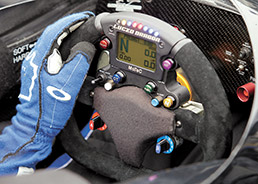 Many automotive innovations, including steering wheel controls, have roots in racing. (Associated Press photo)
But some within the series don’t think the changes are enough to restore the fan following that the race enjoyed before
the IRL was created in a 1996 split with now-defunct Champ Car.
“Indianapolis needs more than a small change to the formula,” said Mike Hull, managing director of Target Chip
Ganassi Racing. “We need to open up the rules. Open it up to big speed.”
That sort of tack could take the Indianapolis 500 back to its roots, when almost anything was allowed and there was a great
entrepreneurial spirit surrounding the race, said Tim Frost, president of Chicago-based Frost Motorsports, a motorsports business
consultancy.
Bernard told IBJ recently that those discussions are in the formative stages, and said a final call will require
the approval of IMS CEO Jeff Belskus.
Bernard shakes tree
One thing is certain. A serious critique of the Indianapolis 500 and Indy Racing League already has begun, driven
largely by the fact that Bernard and Belskus are both new in their positions.
Bernard, series sources said, strongly supports the idea of allowing a wide array of engine and chassis formulas at the Indianapolis
500.
 Bernard
Since he took office March 1, Bernard has shown he’s not afraid to shake things up.
He’s already proposed offering $20 million to any driver who can win the Indianapolis 500 and NASCAR’s Coca-Cola
600, which are held on the same day.
Bernard is proposing moving the start time of the Indianapolis 500 back two hours to 11 a.m. to allow drivers interested
in the prize enough time to fly to Charlotte, N.C., where the NASCAR race is held that evening.
The Indianapolis 500, which now starts just after 1 p.m., for years began at 11 a.m. But race promoters and their television
broadcast partners sought a later start time in 2005 to attract more West Coast TV viewers.
While the biggest changes aren’t anticipated until 2012, Bernard said he anticipates some announcements about the IRL’s
future, possibly as soon as the end of this month.
“[Bernard] has to ratchet up the marketing hype for this series, and May—when lots of people are focused on the
Indianapolis 500—is the perfect time to do it,” Frost said.
Bernard has formed an advisory committee composed of a league representative, team owner, engine expert, promoter and racing
engineer to recommend 2012 engine and chassis formulas.
He said the committee is looking at a broad range of strategies to increase the visibility of the series and the 500. The
committee is set to unveil its first set of recommendations late next month. Among the changes being discussed is ditching
the IRL name in favor of IndyCar Series. But the new equipment rules would be the biggest change.
“Wherever you can create story lines, there’s opportunity,” Bernard said. “Look at the ’40s
and ’50s with the turbine engine. Those were great story lines, and we have to create those kinds of story lines.”
Bernard’s 15-year run with the PBR proves his marketing moxie, Frost said.
Bernard is a California native who hadn’t attended an IRL race until this year. But he also had little rodeo/bull riding
experience when he became founding CEO of PBR at age 28, helping it become a nationally televised attraction on Fox, NBC and
Versus.
He started with a handful of bull riders who agreed to pony up $1,000 each and turned it into a multimillion-dollar sport,
which saw television-ratings increases of 30 percent last year and 23 percent this year, according to New York-based Nielsen
Media Research.
Belskus protects tradition
Belskus, the former IMS chief financial officer who took over for Tony George as head of the Speedway last July,
has been with IMS 23 years, and doesn’t take major change to the Indianapolis 500 lightly.
“The Indianapolis 500 is clearly the crown jewel event of the Indy Racing League, so we want to respect its heritage
and tradition,” Belskus said.
Despite compressing the month of May as a cost-savings move, Belskus stressed that the Indianapolis 500 is still a successful
and profitable venture for the Speedway.
But he didn’t discount the possibility of big changes in the next few years.
“If there’s a compelling reason to make a change, we’ll make a change,” he said.
 Belskus
Belskus confirmed that the idea of opening up the engine and chassis formulas and allowing more innovation at Indianapolis
has been bandied about, but added the idea “would need more in-depth discussion” before it is adopted.
Addressing safety issues and the expense to teams is essential, he said, adding that the changes would also require input
from series partners such as chassis maker Dallara and engine maker Honda.
Dallara’s deal with the IRL is year-to-year and Honda’s deal runs through 2011, making 2012 an ideal year to
launch new regulations.
Catering to car buyers
The Indianapolis 500 has a history of fostering innovation, including the first rearview mirror in 1911, disc brakes
in 1948, and the fuel-injection engine in 1949. Ganassi’s Hull would like to see the race again become a showcase for
automobile manufacturers.
“Changes need to be made in IndyCar to make it relevant with what people in the automotive industry are talking about
today—green technology; smaller, more efficient engines; fuel use and performance; and lighter cars and engines,”
Hull said.
 “Everybody is so caught up in what the car will look like,” he said. “Instead,
we should be creating an avenue for car manufacturers to get back in this series with the technology they can provide. We
have to have a fresh approach. We can no longer think in a shoe box.”
Dennis Reinbold, a local car dealer who co-owns an IRL team, said aligning more closely with the mainstream automotive industry
“makes a lot of sense.”
“Becoming relevant to the car industry is how the Speedway began,” Reinbold said. “Getting in line with
that could open up some serious doors.”
Reinbold said the IRL must get in tune with mainstream auto consumers, too.
“We have an eight-horsepower pig engine and a race-specific chassis,” Reinbold said. “We have to start
talking the same language as the auto industry. They used to say 500 miles on the track is worth 50,000 miles on the highway.
I think there’s still merit in that.”
But team owners think opening up regulations governing car types at Indianapolis could ratchet up the price per car by as
much as $1 million.
Formula One has had some success in attracting a worldwide audience by letting teams spend big bucks on innovation. But with
the cost to operate a team eclipsing $70 million annually, F1 is trying to limit those costs to assure it has an adequate
car count.
When George broke away from Champ Car and formed the IRL in 1996, one of his major objectives was making the series’
on-track racing more competitive by setting tight engine and chassis formulas and capping costs. George reasoned that, by
making open-wheel racing more price-friendly for teams, he would open it to more American racers.
With only a handful of full-time American drivers in the IRL this year, George’s critics said that tactic hasn’t
worked.
The IRL has succeeded in capping expenses, with a typical budget ranging from $4 million to $10 million per car annually.
But some fans say the 8-year-old car formula the series is using has become outdated and boring.
“Many people who follow auto racing want innovation,” Frost said. “They come to the track to get a peek
at tomorrow’s technology.”
New technology is welcome provided the series can guarantee that teams remain competitive, Reinbold said. Teams that aren’t
competitive can’t keep sponsors, he said. “So many of these sponsors become involved in the sport to gain exposure
at Indianapolis.”
Reinbold said his team lost its primary sponsor, Purex, when its Chevrolet engine couldn’t compete with Toyota and
Honda in 2003.
“It’s an impossible thing to explain to sponsors,” Reinbold said.
Even the series’ wealthiest teams have concerns.
“If you open up all the rules, the difference between the haves and have-nots would be so great,” said Team Penske
President Tim Cindric. “Whether that would be interesting or not, only time would tell.”•
Please enable JavaScript to view this content.
Editor's note: You can comment on IBJ stories by signing in to your IBJ account. If you have not registered, please sign up for a free account now. Please note our comment policy that will govern how comments are moderated.