
Subscriber Benefit
As a subscriber you can listen to articles at work, in the car, or while you work out. Subscribe NowCity leaders promoting a 50-year lease of Indianapolis’ parking meters have taken pains to point out the differences between their proposal and a 75-year parking meter lease in Chicago.
For good reason: Chicago’s pact has been so universally reviled that some residents there have said it will negatively define Mayor Richard Daley’s legacy.
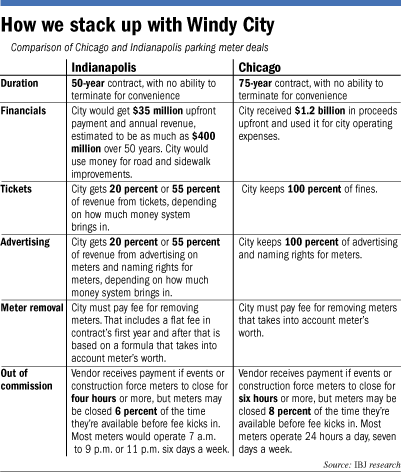
But a closer look at contracts for both deals shows that Indianapolis’ agreement largely uses the Chicago lease’s template.
There are some striking similarities in the contracts, including:
• Both are long-term leases that greatly restrict the cities’ abilities to break the agreements.
• Both require the cities to pay steep fees for removing meters.
• Both require the city or others to pay fees when meters are shut down for festivals, construction or other events.
And in some instances, Indianapolis’ contract is even more favorable to the vendor than the Chicago agreement.
The Chicago-style restrictions have caused some policy experts and local elected officials to conclude that Indianapolis would take on too much risk—and limit its ability to respond to changing conditions—by entering into its proposed agreement with Dallas-based Affiliated Computer Services Inc.
 Renn
RennThe private company would get 80 percent of annual meter revenue to the city’s 20 percent up to $8.4 million, and the city would keep 55 percent above that point.
For its part, Indianapolis would get $35 million upfront and as much as $400 million over the 50 years of ACS ownership—money that would be spent on roads and sidewalks.
An IBJ analysis last month estimated the deal could generate as much as $1.2 billion in revenue for the vendor over the five-decade term of the contract. The city’s financial advisers estimate ACS might earn $177 million–$265 million in profit over the life of the contract.
The proposal also calls for doubling meter rates over two years in some areas, extending hours into the evening, and adding high-tech meters that accept credit cards.
Officials in Mayor Greg Ballard’s administration point out that Indianapolis has averted a flaw that has helped drive the anxiety about Chicago’s deal: Chicago took all its cash—$1.2 billion—for the meters upfront to spend on running the city.
Still, some experts question whether Indianapolis leaders drove a tough enough bargain in creating their contract.
“It’s reasonable for people to wonder how the two parties are sharing the risk here and whether too much risk hasn’t been placed on the shoulders of the city,” said Sergio Fernandez, an assistant professor who studies contracting and privatization at Indiana University’s School of Public and Environmental Affairs in Bloomington. “It seems a little one-sided.”
Fenced in?
 Others worry that ways in which Indianapolis’ agreement resembles Chicago’s could bring negative consequences to Indianapolis.
Aaron Renn is an urban policy observer and blogger who highlighted the contractual similarities in a recent blog analysis of the contracts.
He said the most obvious resemblance between the two deals—the length of the leases and the difficulty of breaking them—is the one that causes him the most consternation.
Indianapolis’ agreement doesn’t give the city the right to terminate the contract unless ACS doesn’t hold up its end of the bargain. Chicago’s lease also has tough restrictions on breaking the contract.
City leaders say having the ability to terminate more easily would dampen companies’ incentives to put up money. They point to other deals, such as the Indiana Toll Road lease, which involved a larger upfront payment but didn’t give the state an easy right to terminate.
“There’s no precedent for it in these kinds of transactions,” said Michael Huber, the city’s deputy mayor for economic development.
But such limited flexibility, some say, could pigeonhole the city from adapting as Indianapolis’ landscape changes along with technology.
“I think it’s going to hurt the city in the way it’s hurt Chicago,” Renn said. “I applaud that they tried to learn some lessons, but using that contract was the root of the issue.”
The city’s flexibility would be limited in other ways.
If Indianapolis wanted to increase the number of meters by more than 10 percent and ACS determined those additional meters were not economically viable, the city would foot the bill to install the meters. Indianapolis also would get a higher share—75 percent—of the revenue than it would with existing meters.
And, as in Chicago, removing meters—to replace them with electric car-charging stations or to build a mass transit line, for example—would come with a price.
Under the contract, Indianapolis would pay a flat fee up to $15,400 for each meter removed in the first year of the deal. After that, the fee would be based on a complicated formula that takes into account the amount of revenue the meter generates.
Chicago’s removal fee is based on a similar type of formula.
Chicago Alderman Scott Waguespack, a vocal critic of his city’s parking deal, said that policy restricts his ability to do long-term planning.
“The underlying value of a meter is that it’s an urban planning tool,” Waguespack said. “The company that valued the meters for the city looked at it as a revenue tool.”
And in certain respects, Indianapolis’ deal provides the vendor a more generous revenue tool than Chicago’s.
Chicago’s agreement would let the city keep all revenue if a company were to buy naming rights for the parking system or advertise on the meter boxes. It also gives Chicago 100 percent of revenue from parking tickets.
In Indianapolis, money from those sources would be shared with ACS.
‘Obvious’ differences
The city disputes that the deal will cause challenges like those in Chicago, where criticism has centered on the financial structure of the city’s arrangement.
Chicago reaped an upfront payment from the lease but cut off its future revenue stream. The city has spent most of that money in about 1-1/2 years since the deal was inked.
By contrast, Indianapolis would take a smaller upfront payment and continue getting revenue throughout the 50 years of ACS’ ownership. None of that money would go toward the city’s general operating budget.
 Huber
Huber“The contract does in some respects resemble Chicago,” Huber said. “But [it] bears no resemblance to Chicago in terms of how we handle the money. We hope the ways in which it’s different are obvious.”
Striking a deal in the 50-year range, city leaders said, was necessary to attract the kinds of firms that could help the city get a sizable upfront payment and significant revenue from the lease.
And while there’s no current fee for removing meters, the city still loses the revenue from meters that are removed. City leaders acknowledge the cost to remove meters under the deal will be higher than it is now, but they say that’s only logical. Higher rates mean the meters would generate more revenue.
They also contend ACS is taking on lots of risk in the deal. If parking revenue decreases, the company still has to pay the cost of operating the system.
But City-County Council Democrat Jackie Nytes said she thinks the city could handle its parking operations in-house by creating a stand-alone, government-run parking authority that would have the ability to issue bonds to pay for putting in the new high-tech meters.
City leaders have balked at that notion, in part because they’d have to increase rates initially and would incur additional expenses for operating the system.
Nytes is worried that certain contract provisions would restrict the city too much.
“We have to have the ability to respond to changes in our community,” Nytes said. “All of those things—that are so locked in and have such huge penalties if we change them—absolutely concern me.”
But Ryan Vaughn, the council’s Republican president, said he thinks the proposal allows enough room for the city to do community planning.
“The council would reserve the right to decide if we want to add or remove meters,” Vaughn said. “There’s a lot of built-in flexibility.”
Both sides of those issues will be vetted in coming weeks as the council publicly reviews the issue. The city is expected to hold additional public meetings, including a council committee hearing, before the full council votes on the proposal. It’s uncertain when that vote will be, but it’s not expected this month.•
Please enable JavaScript to view this content.
Editor's note: You can comment on IBJ stories by signing in to your IBJ account. If you have not registered, please sign up for a free account now. Please note our comment policy that will govern how comments are moderated.