
Subscriber Benefit
As a subscriber you can listen to articles at work, in the car, or while you work out. Subscribe Now
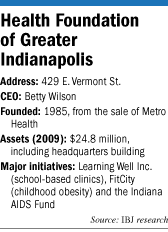 The Health Foundation of Greater Indianapolis is an aggressive supporter of charities that serve people with HIV and AIDS, but that aggression—in the form of a risky investment strategy and big payouts—almost led to its demise.
The $21 million foundation was the first to back AIDS-related causes in the early 1990s, a time most organizations still wouldn’t discuss it, said Tom Bartenbach, executive director of the Damien Center in Indianapolis. “They’ve had a very strong commitment.”
Foundation trustees have been just as unflinching when investing its assets, placing around 90 percent of the portfolio in stocks. That strategy—which the foundation’s longtime adviser acknowledges is questionable—sent the assets as high as $46 million in 2000 and dropped them to $18.5 million in 2008.
Through the ups and downs, the trustees kept spending at a high rate.
“We made a conscious decision to invest in a way that would create more resources, so we could be a better resource in our community,” CEO Betty Wilson said.
In the wake of the most recent crash, trustees considered whether to give away their remaining charitable dollars and go out of business, said Chris Cooke, managing director of investments at Wells Fargo Advisors and part of the Cooke Financial Group in Indianapolis.
The Cooke group, led by Chris’ father, John Cooke, advised the health foundation on its investments from 1985 until early this year, when the trustees replaced it with Bernstein Global Wealth Management.
At the rate the health foundation was spending, models presented in 2009 showed it would take a relatively short time, perhaps five to seven years, to run through the remaining assets, Cooke said.
The trustees ultimately decided to keep the health foundation going in perpetuity. The question now is how they’ll do that.
Wilson said the change in financial consultants wasn’t performance-related, and the foundation’s strategy under Bernstein won’t be radically different than in the past.
Yet the foundation appears to be heading in a different direction. A new generation of trustees has joined the board, and they may decide on a less expensive set of grant-making priorities, though they won’t abandon HIV and AIDS, Wilson said.
Until a few years ago, trustees served under lifetime appointments, Chairman Thomas J. Feeney said.
The foundation was established in 1985 with proceeds from the sale of the state’s first health maintenance organization, MetroHealth. Four of the founding trustees, including Feeney, remain on the 12-member board, but with newly imposed term limits, they will roll off after this year, he said.
Wilson and Feeney declined to discuss the foundation’s current finances. The foundation had $20.7 million in marketable assets in 2009, and $18 million of that was in stocks. Excluding cash on hand, that’s 92 percent in stocks.
The foundation also owns an office building, the former St. Mary’s Academy in historic Lockerbie, which is valued at $3.9 million. The building, acquired in 2005, is a break-even enterprise, Wilson said. In any case, financial planners don’t consider so-called “hard” assets in diversification strategies.
“You would question a 90/10 allocation. Anybody would,” said Brian Cooke, also a managing director of investments at Wells Fargo.
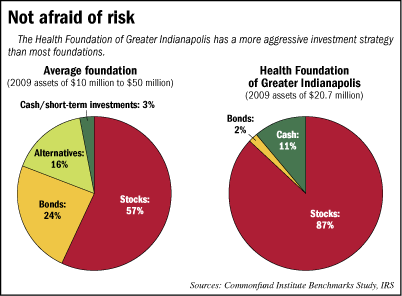 The trustees insisted on the heavy stock allocation because they wanted enough of a return to cover spending that at times exceeded 10 percent of assets, which is far above the minimum 5 percent the IRS requires for foundations to stay tax-exempt, Brian Cooke said.
“It did work, but if you isolate the last couple of years, you question it a tad,” he said.
The foundation lost about 42 percent of its investment value in 2008. The stock-heavy portfolio worth $32 million at the end of 2007 dropped to $18.6 million a year later, tax returns show. Its 2010 returns aren’t available yet.
On a mission
Wilson defends the investing strategy, saying it benefited the foundation’s mission of helping the medically disadvantaged. For example, she said, the foundation gave $1 million a year from 2003 through 2008 to Learning Well Inc., a not-for-profit that grew out of the foundation’s initiative in school-based health clinics.
The foundation’s grants to Learning Well in turn attracted funding from much larger foundations, the Nina Mason Pulliam Charitable Trust and Richard M. Fairbanks Foundation, she said.
“Without progressive thinking and aggressive investing, we would never have been able to do that,” Wilson said.
The health foundation is not alone in shrugging off conventional thinking about diversification. A prominent example is the $5.3 billion Lilly Endowment Inc., which has 91 percent of its holdings in Eli Lilly and Co. stock.
Even so, experts said the health foundation’s strategy is unusual.
“I’d say it’s pretty severe,” said John Griswold, executive director of the Commonfund Institute, a financial consultant to not-for-profits in Wilton, Conn.
Commonfund’s most recent benchmarking survey found that foundations with $10 million to $50 million in assets kept an average 24 percent of their portfolios in fixed income, or bonds. Another 16 percent was in alternatives, a category that includes hedge funds.
Foundations with less than $25 million aren’t eligible to invest in many types of alternatives, which leaves one like the health foundation with a choice of stocks or bonds, Griswold said. Most end up allocating 60 percent to 70 percent to stocks.
Griswold had never heard of a case like the health foundation.
Independent wealth manager Paul Coan found the scenario surprising, too.
“Would I personally put a foundation 90 percent in equities? No way. That’s very excessive,” said Coan, owner of Wealth Planning and Management in Indianapolis.
Coan said advisers who owe a fiduciary duty to their clients would have asked the health foundation to sign a waiver showing it ignored advice, or walked away from the account.
Others, like the Cooke group at Wells Fargo, operate under a standard of “suitability,” which doesn’t give them quite the same level of responsibility, he said.
“I would argue in some instances, it is not suitable for an investor to incur a certain level of risk,” said Brad Skolnik, a former Indiana securities commissioner and attorney. An elderly person, for example, should not have his entire net worth in stocks, but Skolnik said he couldn’t assess the health foundation allocation.
Big spender
Thanks to the historic bull market of the late 1980s, the foundation saw its initial base of $12.5 million double in the first five years of its life.
That supported a high rate of spending, which continued even in down years. The foundation’s spending rate was as high as 13 percent in 2008, and it ranged from 9 percent to 10 percent in the four preceding years, a tax return shows.
“It was more important for us to maintain services for clients in need than it was to build a huge asset base,” Wilson said.
Though still recovering, the foundation last year gave $1 million for the new Wishard Hospital building as a show of support for public health, Wilson said.
The foundation was in business only a few years before the trustees decided broad-based grants weren’t making enough of an impact, Wilson said. They began looking for underserved causes and dispatched her to find out what could be done.
That led to the creation of school-based health clinics. Soon after, the foundation began learning about AIDS, and with the state Department of Health, co-founded the Indiana AIDS Fund.
Bartenbach at the Damien Center said the health foundation is valuable as much for its ability to convene different constituents as for its grants.
“It’s one of those organizations, I don’t know what we’d do without them,” he said.
One way to keep the foundation in business would be to dial back expenses and change its investment strategy, Coan said.
The foundation gave away $1.9 million in 2009, and it spent another $1.3 million on its operations. In addition to staff salaries and investment fees, among other items, the foundation paid $9,300 in stipends to trustees. Feeney, who was secretary that year, received $2,000.
The foundation’s initial base of $12.5 million in 1985 would be $25.6 million in today’s dollars.
“They’ve basically maintained,” Coan said. Given the foundation’s history of spending, he said, “It won’t last another 25 years would be my guess.”•
Please enable JavaScript to view this content.
Editor's note: You can comment on IBJ stories by signing in to your IBJ account. If you have not registered, please sign up for a free account now. Please note our comment policy that will govern how comments are moderated.