
IBJNews

Growth in farmers' markets continues into winter months

Back to TopCommentsE-mailPrint

It’s hard to pinpoint the smells swirling inside the Indy Winter Farmers’ Market. Dozens of vendors fill the downtown market with their goods—herbs, spices, meats, cheeses, cider and candy—and the melting pot’s aroma fills the air.

The diverse fragrances mesh well with the market itself, described by owner Laura Henderson as “a destination” for residents looking to eat local.
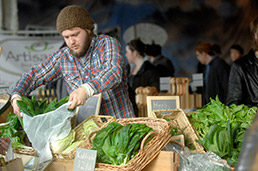
markets Joeseph Monroe, owner of Harvestland Farm of Anderson, helps a customer at the Indy Winter Farmers’ Market at 530 E. Ohio St. Winter markets are increasingly common. (IBJ Photo/ Perry Reichanadter)

“It makes an impression on visitors to find something like this,” said Henderson, 32.

Open from 9 a.m. to 12:30 p.m. Saturdays at The Maxwell apartment building downtown, the Indy Winter Farmers’ Market has more than 60 approved vendors.

While fields of most commercial farms lie bare, smaller producers have spurred growth of farmers’ markets nationwide. The U.S. Department of Agriculture says there are about 900 winter farmers’ markets in operation—a 17-percent increase over the past two years.

IBJ.COM EXTRA
For more photos of the Indy Winter Farmers’ Market, click here

Winter markets are increasingly common thanks to the growing popularity of organic food and the eat-local movement. Still, they are by no means considered mainstream.

Former landlord Larry Jones, in fact, didn’t know what to expect three years ago when he first allowed the Indy Winter Farmers’ Market to take space in another property he owns at 25th Street and Central Avenue. But he learned quickly.

“The first day, we had 400 people at the door,” said Jones, president of Teagen Properties.

The next year, when the market moved to his Chatham Center property along East Street, more than 1,000 customers showed up each week. Attendance is just as strong at The Maxwell and shoppers say the reason is simple.

“It’s the freshest, best food you can buy,” said Anne Sweeney, a 59-year-old Indianapolis resident who has been a regular since 2008.

Vendor Darby Simpson, 36, sells beef, eggs, pork and poultry at the Maxwell. Simpson, who hails from Martinsville, said it is the strongest market he’s participated in, including summer ventures. The winter market keeps him from needing to get a part-time job.

“It gives us an opportunity to sell year-round,” he said. “Without this market, I really wouldn’t have any hope of being able to farm full time.”
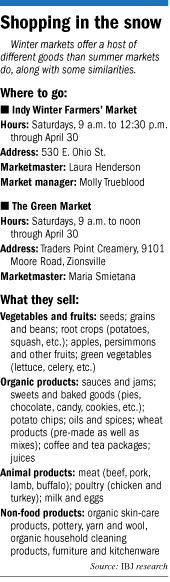
market factboxAlthough not all vendors participate every week, Henderson said the market has benefited those involved. For the season, she expects vendors to bring in a total of about $414,000, based on an average of $400 in transactions per vendor each week.

Full-season vendors pay $440 to set up shop all 23 weeks, while half-season vendors pay half that amount and occasional vendors hand over $25 a week. Henderson’s business grosses $15,000-$20,000 each season, depending on vendor participation.

Winter markets began catching on about four years ago, said Annie Schmelzer, the Indiana State Department of Agriculture’s program manager for entrepreneurship and diversified agriculture. She expects the growth to continue here, as more small farms sprout around the state.

From 2002 to 2007, the number of small farms nearly doubled in Indiana, according to the most recent data available. All told, the state has about 9,700 farms smaller than 10 acres.

It follows that that trend coincides with the increase in farmers’ markets.

“Ten acres is not a lot to grow major corn and soybean crops on, so a lot of those farms are working on things that would go in the farmers’ markets, or specialty crops,” Schmelzer said.

Indeed, Maria Smietana, marketmaster for the year-round Green Market at Traders Point Creamery in Zionsville, has noticed a growth in specialty crop agriculture.

“As market farming becomes more lucrative and farmers realize they can get a higher price for their goods, farmers are shifting production,” said Smietana, 51, who also owns Valentine Hill Farm in Zionsville.

A recent poll of vendors at The Green Market found 80 percent were involved in careers unrelated to agriculture before they began farming, she said.

Smietana estimates summer market attendance has grown as much as 50 percent in the past five years, and winter market attendance is up about 20 percent.

This agricultural trend also could inspire cultural and social change in the Indianapolis area, explained Molly Trueblood, market manager of the Indy Winter Farmers’ Market.

“It’s still very grass-roots,” Trueblood said of the support for local and organic produce, “but I think the culture in Indianapolis is at least becoming more aware of that.”

Much of that awareness has come as a result of media attention for the eat-local movement, Smietana said. Authors such as Barbara Kingsolver (“Animal, Vegetable, Miracle”) and Michael Pollan (“In Defense of Food: An Eater’s Manifesto”) have become authoritative voices for what previously was an effort fueled by “foodies.”

Kingsolver’s book describes her family’s experiment eating only food produced through its own efforts. Pollan argues today’s consumption and production practices have changed food into “edible food-like substances” that cause health problems.

“We have these gurus, these national gurus, that seem to be striking a chord with people,” Smietana said. “These are mainstream people that aren’t satisfied with the food they’re getting and want an alternative.”

Winter markets typically sell different products than their warm-weather counterparts, but the surge in demand has spurred more similarities. Although root vegetables such as potatoes and products with long shelf lives are still predominant, green vegetables are beginning to crop up in winter markets as well, Smietana said.

The additional revenue from winter markets has allowed local farmers to explore technology that extends growing seasons, she said.

“You can certainly have income year-round,” Smietana explained. “That, in turn, encourages farmers to try new, cold-weather growing technologies.”

The main logistical limit for continued development in the specialty foods sector, ISDA’s Schmelzer said, is finding a place for growers to both produce and sell their goods. Smietana agreed, noting the rapid increase in interest from vendors seeking space at The Green Market.

However, both women see the space issue as a reason for optimism, not concern.

“It’s a good problem to have,” Smietana said.

Henderson said she wasn’t looking to start a business when she started Indy Winter Farmers’ Market. Her efforts, she joked, were more about making Indianapolis into a place she wanted to live.

But on that first day at 25th and Central, with people lined up outside the door, she realized her goals were similar to those of many others in the community. Her market and others like it, she explained, are about more than food.

“It’s not just about the market,” she said. “We should be proud to be Indiana, the Heartland, a farm state.”•

ADVERTISEMENT

  • Changed my life
    The summer and winter farmer markets have literally changed my life. It is so easy to eat only fresh from the farm meat and produce year around now. I also now eat less meat (since I don't buy from supermarkets) - which is better for me and for the environment.
  • Picture
    Just for clarity sake. Joseph Monroe is not the owner of Harvestland farm. Far from it, just a worker. The Farm is owned by Aspire Indiana Mental Health Institution.
  • vetting
    Sara, I had this happen also when I first starting going to the farmer's markets. I have found the best thing to do is talk to the vendors. I have never met any vendor who wasn't willing to openly discuss all of the items they have to help me understand if their products met my personal criteria.
  • vendors
    Vetting vendors is very important. It's very disheartening to discover being misled about the origin of item. It happen to me at one of the local markets I used to patronize. I later learned what I brought was not made by the vendor.
    • Property owner correction
      We are so grateful for this well written article about winter markets. There is one important correction regarding the current IWFM location. The Maxwell is owned by Milhaus Development and the Gene B. Glick Co. Larry Jones of Teagen Properties owned the first two IWFM locations.
      Thank you!

    Post a comment to this story

    COMMENTS POLICY
    We reserve the right to remove any post that we feel is obscene, profane, vulgar, racist, sexually explicit, abusive, or hateful.
     
    You are legally responsible for what you post and your anonymity is not guaranteed.
     
    Posts that insult, defame, threaten, harass or abuse other readers or people mentioned in IBJ editorial content are also subject to removal. Please respect the privacy of individuals and refrain from posting personal information.
     
    No solicitations, spamming or advertisements are allowed. Readers may post links to other informational websites that are relevant to the topic at hand, but please do not link to objectionable material.
     
    We may remove messages that are unrelated to the topic, encourage illegal activity, use all capital letters or are unreadable.
     

    Messages that are flagged by readers as objectionable will be reviewed and may or may not be removed. Please do not flag a post simply because you disagree with it.

    Sponsored by
    ADVERTISEMENT

    facebook - twitter on Facebook & Twitter

    Follow on TwitterFollow IBJ on Facebook:
    Follow on TwitterFollow IBJ's Tweets on these topics:
     
    Subscribe to IBJ
    1. liek the rest of America

    2. These quaint,obsessed musings by the stalkers are certainly entertaining, but I'm trying to figure out what, if anything, all the yelping below has to do with Zak Brown.

    3. It's evident that Moffett was pushing the right buttons and corporate America is now trying to squash him. He just wanted to withdraw the free pilot services provided to the company by the pilots to try and put some pressure on a company that has not been interested in negotiating a contract in over 5 years. The company does not provide a contract because not having one has saved them a bundle of money. Shame on any Republic pilots not standing behind their union leader just because things are getting tough, can you not see such strategic moves by the company as putting the last union president in a corporate position and into THEIR pocket. Do you really believe the last union president is so appalled at the attempts by Moffett, do you not remember his oppositions to the company? We stood behind him. It has been proven over and over again for thousands of years without fail, a man cannot serve two masters. Anyone that believes people vote contrary to their paycheck and livelihood deserve to be taken advantage of, the recent statements by the former union president are laughable as he denounces the current union president from his new corporate position. Have you ever seen a drafted sports player score points for his previous team, it cannot be done, he is not on the pilots side anymore, he gets his money a different way now than you and I do, and he should not be allowed to remain on the seniority list. A drafted player brings strength, credibility, tactical knowledge, and a strategic advantage to his NEW team, he would not be drafted or paid were it otherwise. We are all forced to choose only one side to play for and support, not doing so has many references in life such as insider trading and shaving points, all illegal for good reason. This basic fact is why corporate moguls, scientist, and engineers all sign non-discloser agreements and non-compete clauses, as protection in case they are lured into switching sides as our former union president has done. No NFL coach ever drafted a player so that both teams could benefit and better understand each other, they are recruited to win the game against that former team, period. Likewise the company does not recruit the former union president by accident or mutual understanding, its strategy. Don't confuse playing the game with good sportsman-like conduct in support of common business and prosperity goals, with the requirement to only play for one side. Good men we all love and favor fall subject to this manipulation, often without their knowledge, and it is not a betrayal of their friendship to oppose them when they switch sides. If we did not love and trust them, they would not have been chosen and lured to the other side in the first place. The deception by the drafted player is not made at a conscious level, it's just human nature and it's all about money and power which corrupts our ability to be objective and loyal to two masters. This is why our court system created the defense attorney, and why our military created counter intelligence. Its strategy and its propaganda, and it works, and that's why the "powers to be" manipulate the chess pieces by sometimes changing their colors. Some players know they are being manipulated when their color is changed, but it brings them more money and power so they do not care. The rest have good intentions but do not even realize they are being manipulated. This tactic is also known by another name, Divide and Conquer. In battle sending an imperfect message with an imperfect team is obviously not ideal, but it's still being sent by YOUR team, your union leader, a leader that has common goals and common rewards with you, they are the best, because we have elected them to do a job for us. If you are not backing Moffett but believing the spin by those that have recently switched sides, you are taking food out of your own mouth. Showing unity and backing an imperfect situation still results in taking just as much ground, it's about unity and bargaining power. It's not necessary to wait around for that perfect attack because it will never come, the company will spin and attempt to destroy anyone that gets in their way. Ultimately it's not about any specific attack anyway, ASAP or whatever it makes no difference, it is and always has been only about power. If this company cared about safety it would not build pairings with 8 hour overnights, come on, are you that naive? Besides, do you really think Hoffa cares, no, he got a call from corporate America and was squeezed into denouncing Moffett. If he didn't they would spin the safety card against him and the Teamsters National with implication for truckers, future contracts, insurance rates etc...saying something like the Teamsters use safety as a bargaining chip, blah blah blah... Do you really think any pilot is going to do something unsafe for the contract, absolutely not, the only ones threatening safety here is the company with reduced rest, fatigue, and poverty. Do you not find it odd that Hoffa and the Teamsters are opposing a Teamster president publicly? Would the Teamsters National not normally support and work with one of their own? Why did they not sit down and help him strategize, correct any mistakes, and charge ahead? Would the Teamsters National not normally support and leverage a contract for all those pilots that have been paying Teamster dues, isn't that why we have all been paying Teamster dues in the first place? I sure haven't been paying dues so that the Teamsters National could come along and write this kind of an article undercutting our union leader and our unity. Whose side is the Teamsters National really on, it's obviously not the Republic pilots side.

    4. No matter what Moffatt does the company is going to spin it like he is the terrorist and brainwash people like you into believing it, wake up, back your players that are trying to change things for you and your livelihood. Where has Hoffa been for the last 6 years, except collecting our dues. Seriously, do you really think an FO going for upgrade, signed off by a checkairman ready for the upgrade, who then fails, is not even capable of returning as a First Officer.

    5. whoa!

    ADVERTISEMENT