
Subscriber Benefit
As a subscriber you can listen to articles at work, in the car, or while you work out. Subscribe NowJust a decade ago, RealMed Corp. was considered Indiana’s next big thing. Flush with tens of millions of dollars
in venture capital, the maker of health care claims processing software talked openly about an initial public offering, brokered
hefty government incentives, and promised to add 1,800 jobs.
RealMed’s work force peaked at 210 before falling
as low as 91 during the decade’s first recession. After being acquired by a group of Blue Cross Blue Shield plans half
a decade ago, RealMed fell off the radar.
The company maintained its low profile until 16 months ago, when it hired
a new CEO, Phil Christianson, an attorney with an MBA whose last job was as a vice president of Minnetonka, Minn.-based UnitedHealth
Group.
Once again, RealMed is signing up physicians by the thousands to use its system, and employment is up to
145. The clients are attracted to RealMed’s easy implementation and its ability to speed up the medical bill payment
cycle—which helps doctors make ends meet during the economic downturn.
RealMed enjoys a nearly 99-percent
renewal rate among its current customers and attracted 4,000 new doctors this year, Christianson said, taking its user count
to 27,000.
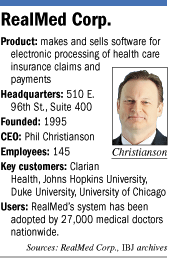 Some hail from small practices with only a handful of physicians. Others are attached to huge hospital
systems, like Clarian Health or Johns Hopkins University. Christianson said RealMed expects to add another 4,000 to 6,000
docs next year.
“We’re going to have our best year in 2009 in the company’s history,” he
said. “The company was quiet for a few years because it was hunkering down and perfecting the application. …
In the last year, 14 or 15 months, we’ve been more aggressive.”
Organic growth is taking RealMed places
speculative venture capital never did. And even the threat of a major lawsuit hasn’t slowed the company down. In July,
Salt Lake City-based competitor NetDeposit LLC slapped RealMed and four other companies with a complaint alleging infringement
on NetDeposit’s patent for “electronic creation, submission, adjudication and payment of health insurance claims,”
according to federal court records in Delaware.
But in early November, Delaware court records show NetDeposit withdrew
the suit. Ian Forrest, NetDeposit’s legal counsel, said his company made an internal decision not to pursue the matter,
but he wouldn’t elaborate why.
Just 10 days later, RealMed filed a countersuit in federal court here asserting
it hasn’t infringed on NetDeposit’s patent.
RealMed General Counsel Scott Herbst said his firm won’t
comment on the legal tussle, except to characterize it as “very minor.” RealMed would rather focus on the ground
it has gained since hiring Christianson.
Industry experts are again starting to notice RealMed. For example, in
June, Utah-based KLAS Research ranked RealMed No. 1 among 15 providers of claims-processing software it studied.
The study, which didn’t include NetDeposit, noted that other firms, such as Nashville, Tenn.-based Emdeon and Atlanta-based
RealyHealth, still hold much larger market shares.
“RealMed delivers a superior client experience in terms
of service, responsiveness and tools provided. Every respondent in this research had a positive outlook on RealMed,”
wrote the KLAS report’s author, Mark Wagner. “Bottom line: RealMed is a small but growing vendor that handles
growth pains very well.”•
Please enable JavaScript to view this content.
Editor's note: You can comment on IBJ stories by signing in to your IBJ account. If you have not registered, please sign up for a free account now. Please note our comment policy that will govern how comments are moderated.