
Subscriber Benefit
As a subscriber you can listen to articles at work, in the car, or while you work out. Subscribe NowThis week, IBJ Style columnist Gabrielle Poshadlo joined me on a trip to the Barbie exhibit at the Children’s Museum of Indianapolis. Our reactions differed.
__________
LH: I truly believe I went in to “Barbie: The Fashion Experience” with an open mind. It was my heart, however, that sank when I saw how willfully The Children’s Museum has turned major gallery space into what looks like an FAO Schwartz showroom. With Mattel and Barbie branding everywhere, I had trouble finding merit amongst the pink-itude. Yes, it’s fun for kids to play dress up. But do we really need this esteemed institution pushing such a consume-consume-consume show?
GP: Barbie is a toy that you can buy, so therefore it’s inevitable there should be a certain element of that. But when I was in that space, which is admittedly very pink, I didn’t feel compelled to buy anything. Rather, I was filled with the giddiness that comes with Barbie. The Barbie fantasyland I was standing in is a celebration of how Barbie makes girls feel, which is beautiful. And she’s been making girls feel pretty for generations, making them excited about becoming a woman. There’s nothing wrong with the silliness or the “pinkitude,” because those are big parts of girlhood. I’m 24 years old, and, frankly, I didn’t want to leave.
LH: It’s difficult not to address the consumerism when a prominently displayed quote at the exhibition states “Barbie needs to wear great shoes because every girl needs to wear great shoes.” The two words that really turned my stomach there are “every” and “needs.” There’s nothing here to contradict the idea that one of Barbie’s messages is that we have to buy more and more clothes in order to feel beautiful.
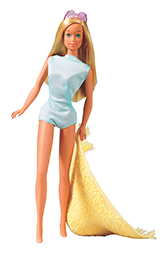 “Barbie: The Fashion Experience” at The Children’s Museum through 2011, features items from the Mattel archive, as well as homemade adaptations. (Photo Courtesy Mattel)
GP: I’ll admit that quote is dumb and the perfect example of why fashion people get a bad rap. But that quote isn’t representative of the thoughtfulness involved in the exhibit. The displays of homemade Barbie clothes made by an Indiana woman’s grandmother show a part of Barbie history that is very human, and widespread. My grandma wouldn’t buy Barbie clothes for my mom because she thought they were too expensive and poorly made. So every outfit my mom played with (outfits later passed down to me) were pieces of a vast rebellion against the consumerism you’re referring to. I think it’s cool to involve that in the exhibit, since the homemade clothes and the implicit mother-daughter bonding are as much a part of the Barbie institution as the little plastic high heels.
LH: I’m not sure how you found the homemade clothes in the midst of all the mass-produced stuff. Honestly: Is there ever a reason for a boxed “Barbie as Heidi Klum” doll to be under glass in a museum? And shouldn’t a thoughtful museum show include something about the alternate views of Barbie? If this were a G.I. Joe exhibition, I would expect something addressing the debate over whether violent toys have an impact on young boys. I didn’t find anything here that looked at how young girls have been affected by this impossible-figure icon.
GP: Let’s not forget the venue, here. The Egypt exhibit across the hall doesn’t mention the country’s political unrest. There are only photos of women in headscarves smiling politely, and a mock-marketplace that looks more like a set from “Aladdin” than an actual desert bazaar. If the Barbie exhibit were at the Indianapolis Museum of Art, I’d expect a video loop of some psychiatrist commenting on how girls are disappointed when they don’t end up with a body like Barbie’s. But this is a place for kids. It’s a place for little girls to play dress up and strut their stuff on the runway, and learn how Barbie is a big deal everywhere, not just in their playroom. For Barbie’s 50th birthday this year, Fashion week had a Barbie runway show, where designers like Betsy Johnson designed Barbie clothing for live models. It solidified the doll’s place in fashion history, which is fascinating.
LH: OK, so I shouldn’t expect Children’s Museum shows to always address the downside of a subject. And there’s clearly been more thought put in to the fun factor here than in the lame “Star Wars: The Clone Wars” exhibition that occupies a corner of the basement. Perhaps I’d object less if the show were more temporary. The fact that Barbie is staying put until 2011 makes it feel like a permanent part of the museum. And for a single consumer product to be so dominant in this beloved space feels excessive. Sure, Lego was here first. But that had a shorter stay—and felt more about creativity than about acquiring the right stuff.
GP: I think I’ve been to the Children’s Museum about five times this year, and had the Barbie exhibit been there during those visits, I’m pretty sure I’d have walked through each time. I am that delighted with it. Sure, the dress-up clothes will probably look a little tired by the end of the whole thing, but I think your disappointment in the museum’s choice has a lot to do with your gender. No offense, Lou, but you’re not supposed to be thrilled with writing down your “favorite Barbie memory” while perched on a little pink stool. This exhibit is filled with stuff that girls won’t get sick of. For two years there will be something for little sis to look forward to while she’s being dragged around the Dinosphere for the 20th time.
LH: Can’t argue when the gender card has been played, so let’s end it here. See you in the gift shop (although that would feel redundant).
Readers: Feel free to join our debate, which continues on Lou Harry’s A&E blog. Find it at here.•
__________
This column appears weekly. Send information on upcoming arts and entertainment events to [email protected].
Please enable JavaScript to view this content.