
IBJNews

NCAA plans to battle counterfeiters during the men's Final Four

Back to TopCommentsE-mailPrint

They aren’t as obvious as the stereotypical thug in trench coat and sunglasses who unloads stolen jewelry and wristwatches on unsuspecting tourists, but the NCAA considers them as unscrupulous.

They’re the legions of counterfeiters who travel to large sporting events in hopes of scoring on the lucrative market for sports apparel.

The NCAA will field a posse of police and hired hands to watch for unlicensed hats, T-shirts and other merchandise when Indianapolis hosts the men’s Final Four basketball championship here April 3-5.

“Recognizing it’s not murder or drug dealing, it’s paramount to what we do,” said Michael Drucker, a lawyer at Atlanta-based Collegiate Licensing Co. “It’s vital to be able to control your [trade]marks and the revenue they generate.”

The NCAA contracts with Collegiate Licensing to grant licenses to companies wanting to sell legitimate NCAA apparel and help enforce the licenses and collect royalties.
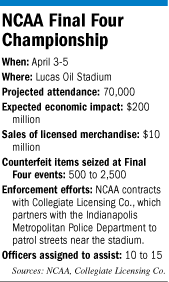
NCAACollege Licensing works with local law enforcement to patrol streets near the venue hosting the event, almost like they’d sniff out drug dealers.

For the Final Four, Drucker expects 20 employees to join a dozen Indianapolis police officers to put the squeeze on unlawful vendors skulking around Lucas Oil Stadium.

U.S. Immigration and Customs Enforcement, which manages the National Intellectual Property Rights Coordination Center, estimates sales of legitimate products during the Final Four exceed $10 million, making the tournament an attractive target for counterfeiters.

In fact, Collegiate Licensing and police typically confiscate 500 to 2,500 counterfeit items at a Final Four tournament. The 2010 BCS National Championship football game between the University of Texas Longhorns and University of Alabama Crimson Tide resulted in an even larger bounty—about 3,800 pieces from 65 vendors, Drucker said.

The NCAA is preparing for the threat in Indianapolis like a coach for a big game.

“We do tend to see most of the [infringement] activity during the men’s basketball tournament, just because of the high exposure of the event,” said Jay Rossello, NCAA director of legal affairs.

Organized crime element

Indianapolis cops will begin searching for illegal transactions about a week before the Final Four games begin and conclude the day after the championship game, Drucker said.

Their full-court press will include hotels where the four teams stay and Indianapolis International Airport.

Penalties are weak. Anyone caught peddling counterfeits simply might be instructed to surrender their cache. Or they could be cited for trespassing or vending without a permit.

Those familiar with the seedier side of selling sports apparel realize it’s often not relegated to a few enterprising entrepreneurs looking to make a quick buck but, rather, to a much more serious threat—organized crime.

Counterfeiting is just as lucrative as the drug trade, without the attention and threat of steep prison sentences, said Karl Manders, owner of the Indianapolis-based Continental Enterprises Inc. intellectual property consulting firm.

“It’s one of those things that is a bigger problem than it seems to be,” Manders said. “It’s so lucrative; the profit is huge.”

Knockoffs are fairly simple to detect. All licensed merchandise sports a hologram label authenticating it as NCAA-approved. The logo of the manufacturer, such as Nike or Adidas, must be visible as well.

In contrast, bootleg items usually are laden with defects. Shoddy screen prints and substandard embroidery are the most obvious tip-offs. Other times—believe it or not—a word might be misspelled.

Counterfeiters often buy what’s known as “seconds” from distributors. These are plain T-shirts that have slight imperfections and cannot be sold to consumers in traditional retail outlets. The tags usually have been cut off, or are missing, to indicate their worthless value.

Most unlicensed vendors carry 10 to 15 T-shirts with them at a time. If their faulty merchandise fails to raise red flags, their sales methods should, Drucker said.

“Traditionally,” he said, “licensed merchandise is not sold by people running through parking lots with backpacks.”

‘Whac-A-Mole’

Overall, it’s estimated that $200 billion to $250 billion of fake merchandise is sold in the United States annually.

The NCAA has about 50 trademarks and slogans protected, including Final Four, Elite Eight and Frozen Four, the men’s hockey championship.

Colleges and universities are responsible for protecting their own trademarks, and many also contract with Collegiate Licensing for those services. The company counts 165 colleges and universities as clients, including Purdue University and the University of Notre Dame, as well as several college conferences and the Heisman Trophy.

But if the Butler Bulldogs, for instance, were to advance to the Final Four, Collegiate Licensing could enforce any infringements to the logo, even though it doesn’t represent Butler, because the team is participating in an NCAA-sanctioned event.

A deep run in the tournament undoubtedly would bring more exposure to Butler, whose main threat of infringement comes from student groups oblivious to the legal ramifications, said Lindsay Martin, Butler’s manager of sports marketing and promotions.

“Schools that don’t have their trademarks protected don’t have a legal leg to stand on if something were to come up,” Martin said.

The bright spotlight shone on the Final Four arguably heightens the risk of trademark infringement to the NCAA and to participating teams. But the NCAA’s efforts to protect its rights extend beyond the tournament.

Infringement policies prevalent among all sports organizations are meant to protect authorized sponsors and advertisers who pay big money to be affiliated with a league, or a particular team.

Sponsorship agreements often range in the hundreds of thousands of dollars and can reach into the millions.

Any unlicensed company insinuating a partnership with the NCAA is first hit with a cease-and-desist letter, said the NCAA’s Rossello. Often, a letter persuades offenders to stop.

“It’s certainly important for us to make sure our partners receive the value they intended to get when they made the investment,” Rossello said. “The other part is that we don’t want to tarnish the NCAA.”

To be sure, lack of enforcement could jeopardize the NCAA brand, said Michael Swift, a lawyer at the local Maginot Moore & Beck LLP intellectual property boutique.

The hard part, however, is stopping infringement that occurs over the Internet, which can run rampant on Web sites such as eBay.

“That’s like a game of Whac-A-Mole,” Swift said. “Once you hit one, another pops up.”•

ADVERTISEMENT

Post a comment to this story

COMMENTS POLICY
We reserve the right to remove any post that we feel is obscene, profane, vulgar, racist, sexually explicit, abusive, or hateful.
 
You are legally responsible for what you post and your anonymity is not guaranteed.
 
Posts that insult, defame, threaten, harass or abuse other readers or people mentioned in IBJ editorial content are also subject to removal. Please respect the privacy of individuals and refrain from posting personal information.
 
No solicitations, spamming or advertisements are allowed. Readers may post links to other informational websites that are relevant to the topic at hand, but please do not link to objectionable material.
 
We may remove messages that are unrelated to the topic, encourage illegal activity, use all capital letters or are unreadable.
 

Messages that are flagged by readers as objectionable will be reviewed and may or may not be removed. Please do not flag a post simply because you disagree with it.

Sponsored by
ADVERTISEMENT

facebook - twitter on Facebook & Twitter

Follow on TwitterFollow IBJ on Facebook:
Follow on TwitterFollow IBJ's Tweets on these topics:
 
Subscribe to IBJ
  1. liek the rest of America

  2. These quaint,obsessed musings by the stalkers are certainly entertaining, but I'm trying to figure out what, if anything, all the yelping below has to do with Zak Brown.

  3. It's evident that Moffett was pushing the right buttons and corporate America is now trying to squash him. He just wanted to withdraw the free pilot services provided to the company by the pilots to try and put some pressure on a company that has not been interested in negotiating a contract in over 5 years. The company does not provide a contract because not having one has saved them a bundle of money. Shame on any Republic pilots not standing behind their union leader just because things are getting tough, can you not see such strategic moves by the company as putting the last union president in a corporate position and into THEIR pocket. Do you really believe the last union president is so appalled at the attempts by Moffett, do you not remember his oppositions to the company? We stood behind him. It has been proven over and over again for thousands of years without fail, a man cannot serve two masters. Anyone that believes people vote contrary to their paycheck and livelihood deserve to be taken advantage of, the recent statements by the former union president are laughable as he denounces the current union president from his new corporate position. Have you ever seen a drafted sports player score points for his previous team, it cannot be done, he is not on the pilots side anymore, he gets his money a different way now than you and I do, and he should not be allowed to remain on the seniority list. A drafted player brings strength, credibility, tactical knowledge, and a strategic advantage to his NEW team, he would not be drafted or paid were it otherwise. We are all forced to choose only one side to play for and support, not doing so has many references in life such as insider trading and shaving points, all illegal for good reason. This basic fact is why corporate moguls, scientist, and engineers all sign non-discloser agreements and non-compete clauses, as protection in case they are lured into switching sides as our former union president has done. No NFL coach ever drafted a player so that both teams could benefit and better understand each other, they are recruited to win the game against that former team, period. Likewise the company does not recruit the former union president by accident or mutual understanding, its strategy. Don't confuse playing the game with good sportsman-like conduct in support of common business and prosperity goals, with the requirement to only play for one side. Good men we all love and favor fall subject to this manipulation, often without their knowledge, and it is not a betrayal of their friendship to oppose them when they switch sides. If we did not love and trust them, they would not have been chosen and lured to the other side in the first place. The deception by the drafted player is not made at a conscious level, it's just human nature and it's all about money and power which corrupts our ability to be objective and loyal to two masters. This is why our court system created the defense attorney, and why our military created counter intelligence. Its strategy and its propaganda, and it works, and that's why the "powers to be" manipulate the chess pieces by sometimes changing their colors. Some players know they are being manipulated when their color is changed, but it brings them more money and power so they do not care. The rest have good intentions but do not even realize they are being manipulated. This tactic is also known by another name, Divide and Conquer. In battle sending an imperfect message with an imperfect team is obviously not ideal, but it's still being sent by YOUR team, your union leader, a leader that has common goals and common rewards with you, they are the best, because we have elected them to do a job for us. If you are not backing Moffett but believing the spin by those that have recently switched sides, you are taking food out of your own mouth. Showing unity and backing an imperfect situation still results in taking just as much ground, it's about unity and bargaining power. It's not necessary to wait around for that perfect attack because it will never come, the company will spin and attempt to destroy anyone that gets in their way. Ultimately it's not about any specific attack anyway, ASAP or whatever it makes no difference, it is and always has been only about power. If this company cared about safety it would not build pairings with 8 hour overnights, come on, are you that naive? Besides, do you really think Hoffa cares, no, he got a call from corporate America and was squeezed into denouncing Moffett. If he didn't they would spin the safety card against him and the Teamsters National with implication for truckers, future contracts, insurance rates etc...saying something like the Teamsters use safety as a bargaining chip, blah blah blah... Do you really think any pilot is going to do something unsafe for the contract, absolutely not, the only ones threatening safety here is the company with reduced rest, fatigue, and poverty. Do you not find it odd that Hoffa and the Teamsters are opposing a Teamster president publicly? Would the Teamsters National not normally support and work with one of their own? Why did they not sit down and help him strategize, correct any mistakes, and charge ahead? Would the Teamsters National not normally support and leverage a contract for all those pilots that have been paying Teamster dues, isn't that why we have all been paying Teamster dues in the first place? I sure haven't been paying dues so that the Teamsters National could come along and write this kind of an article undercutting our union leader and our unity. Whose side is the Teamsters National really on, it's obviously not the Republic pilots side.

  4. No matter what Moffatt does the company is going to spin it like he is the terrorist and brainwash people like you into believing it, wake up, back your players that are trying to change things for you and your livelihood. Where has Hoffa been for the last 6 years, except collecting our dues. Seriously, do you really think an FO going for upgrade, signed off by a checkairman ready for the upgrade, who then fails, is not even capable of returning as a First Officer.

  5. whoa!

ADVERTISEMENT