
Subscriber Benefit
As a subscriber you can listen to articles at work, in the car, or while you work out. Subscribe NowBloomington—Mayor Mark Kruzan believes this beloved college town loses a bit of its identity every time a national
chain sets up shop.
Already, the first block of Kirkwood Avenue outside Indiana University’s Sample Gates
hosts as many franchises as any strip center. Urban Outfitters, Dunkin Donuts, Noodles & Co. and Panda Express operate
alongside Nick’s English Hut and other longtime local fixtures.
Kruzan, 49, hopes to stop the chains in their
tracks. He’s contemplating an ordinance similar to those adopted by tourism-heavy communities such as Nantucket, Mass.,
and Ojai, Calif. The mayor has not yet floated a formal proposal, but he’s focusing on Kirkwood from the IU campus,
west to the B-Line trail and storefronts facing the courthouse square.
Kruzan, a Democrat, insists that his initiative
is a matter of economic survival, rather than elitism.
“This was my slogan six years ago,” he said.
“Community character is synonymous with community commerce. For Bloomington, uniqueness is our strength.”
No organized opposition has emerged yet, but real estate professionals are expressing their concerns to Eric Stolberg, a
downtown developer whom the mayor appointed to a study committee on the issue.
“I’m hearing from a
lot of people that are scratching their heads and saying, ‘Why do we even need this?’” Stolberg said.
Chain stores have been around for years downtown. Chipotle in 2004 replaced the McDonald’s that drew so much
ire when it opened in the 1980s. Kruzan said he became concerned recently when plans emerged to redevelop two key sites on
Kirkwood.
One is the former Linnemeier building, 422 E. Kirkwood, which housed a dentist’s office and independently
owned balloon shop. The building was demolished over the summer, and the site is slated to become luxury apartments with street-level
retail. The other is the former Ladyman’s Cafe at Kirkwood and Washington Street, where a developer is planning condos
with ground-floor retail.
Then last month, the owners of Smith-Holden Music announced they would close their store
at 222 W. Kirkwood. The family that owns the business declined to comment. Kruzan said would-be developers are hovering around
the building, which sits between the Irish Lion pub and the B-Line trail.
A chain-store ordinance wouldn’t
affect the properties in transition because Kruzan doesn’t intend to put a formal proposal before the city plan commission
until spring.
Kruzan predicts that by next summer, chain stores will be occupying at least two of the high-profile
sites.
“Then I think people will feel the balance will be tipped,” he said. “The number is low,
but the psychological impact will be high.”
Legal challenge
Every
city that tries to exclude chains, or “formula” stores, from certain areas grapples with the same questions. The
first is, what constitutes a chain in the first place?
In Bloomington, Kruzan is letting a study committee tackle
those issues. Its members include Stolberg and Julie Thomas, a Democrat on the Monroe County council who owns a Cartridge
World store downtown.
“I want to get as many things on the table as we can, prior to the formal process beginning,”
Kruzan said. The committee has met once and will meet at least twice more before spring.
San Francisco decided
in 2004 that any franchise with 12 or more outlets posed a threat to its neighborhood business districts. The chains are excluded
completely from two of those districts. In others, chains can’t open new outlets without first obtaining a conditional
use permit.
Local governments have been telling business where to go, so to speak, for decades.
In a
way, the anti-chain laws are no different from restricting factories to a certain part of town, said Richard Schragger, a
University of Virginia law professor who has studied the issue.
“Courts are not likely to strike down these
ordinances if they’re expressed through the land-use authority of the local government,” he said.
Yet
the 11th Circuit Court of Appeals in 2008 invalidated legislation adopted by the Florida Keys community of Islamorada that
said national retail stores could occupy no more than 2,000 square feet of space with 50 feet of frontage. The court noted
that Islamorada’s measure wasn’t protecting any historic district or buildings, and the city hadn’t shown
that “it has any small-town character to preserve.”
The suit was brought by a family that had tried
to sell its store site to Walgreens. The deal fell through because of the local ordinance.
With the Islamorada
case in mind, Kruzan is careful to say Bloomington won’t necessarily “ban” chain stores downtown. The city
might take the less extreme route of restricting signage, he said.
Asked whether a set of rules about the size
of corporate logos would satisfy him, Kruzan said, “Personally? No.”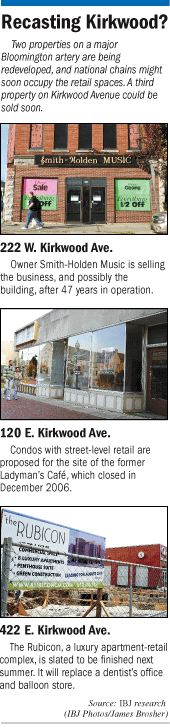
The debate might boil down
to whether Bloomington is a tourist town, or something else. Michael Eaton, co-owner of Rubicon, the
developer that acquired the Linnemeier building last summer, thinks the city needs certain chain stores.
“The city of Bloomington wants more people to live downtown,” he said. “However,
there’s not that many grocery stores. And there’s not enough locations for people to come
in and buy clothes, and get their goods and services fulfilled.”
Rents climbing
When rents are rising, national chains have an advantage. Eaton said that over the last
three years, rates for retail space on Kirkwood have risen from $18 to $20 per square foot annually to the high $20s
or low $30s.
Eaton would not disclose the rate he’s seeking for his 4,450 square feet. If rent were as high
as $30 per square foot, a single shop or restaurant tenant would have to pay $133,500 a year.
Despite the daunting
overhead, all the restaurants that have expressed an interest in the space are local, Eaton said.
“The stronger,
more established entities have already identified it,” he said.
Bloomington residents might embrace local
flavor, but they also like conveniences. Rhiannon Vaughn, a waitress at the “locavore” haven Farm, said she would
prefer more local businesses downtown, but she wouldn’t be disappointed about another chain “if it fits a niche
that we need.”
Another Farm employee, Alfred Pigliacelli, seconded the idea.
“If it’s
something we don’t already have one of.” He said Noodles & Co. was an example of a chain that had no other
locations in town, and no close competitors.
When Lyle Feigenbaum opened the Scholar’s Inn restaurant in
1998, he competed with very few chains downtown. Now Scholar’s Inn is a group of restaurants and bakery-cafes, including
a location near College Mall.
Feigenbaum is protective of downtown, which is a magnet for parents, alumni and tourists.
“I think there is value, economically, in having an area, or the heart of it, where it’s completely unique,”
he said.•
Please enable JavaScript to view this content.
Editor's note: You can comment on IBJ stories by signing in to your IBJ account. If you have not registered, please sign up for a free account now. Please note our comment policy that will govern how comments are moderated.