
Subscriber Benefit
As a subscriber you can listen to articles at work, in the car, or while you work out. Subscribe Now
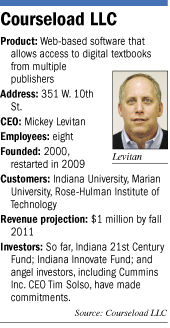 Mickey Levitan spent nearly 30 years running development groups in impoverished countries and human resources departments in U.S. corporations. He got just a week to decide if he wanted to be an entrepreneur.
Turns out he did. He is now running a startup, Courseload LLC, that aims to transform the world of college textbooks.
The Indianapolis company has developed Web-based software that allows college students to read and electronically mark up all kinds of college course materials—textbooks, articles, chapters of books, etc. It also has a business model that Levitan is convinced will make more money for publishers and slash students’ textbook costs—which average $1,200 a year—in half.
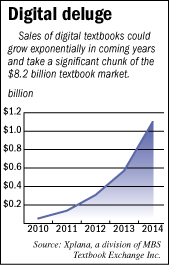 His timing is good. The 2010 boom in digital reading devices, especially Apple’s iPad, could juice digital textbook sales in the United States from a modest $54 million this year to more than $1 billion by 2014, according to an analysis by Xplana, a division of the textbook wholesaler MBS Textbook Exchange Inc.
Levitan has funding commitments from multiple sources—including the Indiana 21st Century Fund, the Indiana Innovate Fund and angel investors, including Cummins CEO Tim Solso. He declined to say how much those investments will bring in, saying none of them are finalized.
“There is a sense of inevitability on college campuses that this is going to happen,” Levitan said of digital textbooks. Most of the major textbook publishers’ catalogs are accessible through Courseload’s software.
The chance for Levitan, 53, to launch his own company came in March 2009 via Brad Wheeler, the chief information officer at Indiana University, who wanted to sponsor pilot projects to try out ways of using digital course materials in IU classrooms.
Wheeler and Levitan had crossed paths nearly a decade earlier, when Levitan and his co-founder, Alan Dennis, first explored the Courseload idea. Wheeler was an IU business professor pioneering digital technologies in his classroom.
Fresh off a stint at Apple Inc., Levitan was trying to invent something like the iTunes model for digital textbooks—something that greatly reduced the incentive for piracy while still making money for publishers.
He hooked interest from a couple of universities and investors in Indiana, but one of the investors got skittish, and Levitan decided the timing wasn’t right. He shelved the idea and instead took a job as human resources director at Indianapolis-based radio operator Emmis Communications Corp.
Wheeler remembered the Courseload idea when he was looking to run several pilot projects aimed at getting digital textbooks into IU classrooms. He talked to Dennis, who is also an IU business professor, saying he would need something in action by August—just six months away.
“We had a week to decide if we were going to do it,” said Levitan, sitting in a conference room in the Indiana University Emerging Technologies Center, where Courseload now has an office and eight employees.
Levitan and Dennis pulled it off. Now, Courseload is providing its service to Marian University and Rose-Hulman Institute of Technology and is talking to other schools, including Park Tudor High School and DePauw University.
The latest challenge
Levitan is a man who likes challenges. A Philadelphia native, he spent the first 13 years of his working life in Senegal, Bangladesh and Thailand, working for the Peace Corps and Save the Children. He speaks four languages.
He took two years off to earn an MBA at Stanford Business School in order to run those organizations better.
He shifted into the corporate world to help those organizations run better, starting as executive assistant to Solso at Columbus-based Cummins.
Now, he thinks he’s got a business model that will stop the textbook publishing industry from going through the same piracy nightmares the music and film industries have.
“We’ve talked to all the major publishers, and nobody has come up with a better model,” Levitan claimed.
Still, Courseload has plenty of competition. IU’s Wheeler has tried out other digital textbook companies, including New York-based Flat World Knowledge Inc. and Houston-based Connexions. Other commercial competitors to Courseload include VitalSource and CafeScribe, as well as a company formed by major publishers called CourseSmart.
However, Wheeler likes what Courseload is doing because, instead of having each student buy textbooks on a retail basis, Courseload’s universal-access software allows IU to negotiate prices with the major book publishers first on behalf of its 109,000 students.
Then the students pay a course materials fee along with their tuition.
“We’re between the now and the not yet of moving to digital textbooks. But the model has not been discerned,” Wheeler said, adding, “The Courseload model, or any company that allows us to negotiate with the gravitas of the university, I think that’s one of the core tools of reducing the cost of textbooks.”
Lower prices, higher profits
The reason the major textbook publishers, including Pearson, John Wiley and McGraw-Hill, are willing to deal is this: By making book fees paid along with tuition, IU guarantees that 100 percent of students will buy the materials.
That means publishers actually generate more sales because students don’t have a used book market to turn to, they can’t borrow a textbook from a friend who used it last semester, and they can’t check out a copy from a library.
Also, with a much lower price, students have little reason to take advantage of the textbook pirates—many operating out of China—who scan in popular textbooks and sell cheap PDF versions over the Internet.
“They price with inventory shrinkage built in,” Wheeler said of textbook publishers. “It’s just like when we go to Macy’s; we’re all paying for shoplifting.”
Levitan estimates a publisher could sell three times as many copies of its digital textbook through Courseload as it does a traditional printed textbook during its three-year life cycle.
Levitan pulls up a slideshow for investors on his computer monitor—which is propped up by a copy of Jim Collins’ “Good to Great.” According to the presentation, even after Courseload and IU take a cut, the book publishers can drop their prices 80 percent and still make 10 percent higher profits.
In one example provided by Wheeler, a textbook titled “Employment Law for Human Resource Practice” costs $216 new in the IU Bookstore. A used copy can be had for at least $132 from Amazon. A digital copy for an eReader runs $106. But Courseload’s price is $70.
If students want to have a printed copy, Courseload will generate one for about $20 extra.
Digital textbooks still have an uphill climb. A survey released in October by the National Association of College Stores found that 76 percent of students would prefer a print textbook over a digital one.
Even in IU’s research of its students using Courseload materials, 78 percent said printed texts are easier to read. But the special tools that go with digital textbooks—like the ability of professors and students to make notes and highlights in key passages and share them with the rest of the class—get high marks.
But above all other factors, it’s the price advantage of digital books that will drive explosive growth, according to Rob Reynolds, director of research and product design at Xplana, who wrote a 2010 research report on the market.
“Overall,” he concluded, “we expect prices for digital textbooks to remain significantly lower than their print counterparts, which will continue to stimulate the sales of digital textbooks.”•
Please enable JavaScript to view this content.
Editor's note: You can comment on IBJ stories by signing in to your IBJ account. If you have not registered, please sign up for a free account now. Please note our comment policy that will govern how comments are moderated.