
Subscriber Benefit
As a subscriber you can listen to articles at work, in the car, or while you work out. Subscribe NowA consultant’s report filed as part of a water rate case takes the city’s Department of Waterworks to task
for lax oversight of the French company that operates the city’s water utility.
The city too often relied
on the Department of Waterworks’ board, on consultants and on the private operator, Veolia Water, rather than on the
department’s own staff “to ensure safe and efficient operation, maintenance and management” of Indianapolis
Water.
That’s one of several critical findings of a consultant hired by the department and filed as part
of a 35-percent rate-hike request pending before the Indiana Utility Regulatory Commission.
The proposed rate hike,
which would fund $111 million in capital improvements, is on top of an 11-percent emergency rate hike the commission approved
earlier this year. In the emergency case, ratepayers are being tapped to pay more than $25 million in additional debt-servicing
costs stemming from the utility’s inordinate amount of variable-rate bond debt.
While past practices of the
Indianapolis Bond Bank drew much of the blame for the bond fiasco, the waterworks department and its board are squarely at
issue in the latest rate case.
The department, which owns the city water system and supervises Veolia, filed the
critical assessments as it tries to convince skeptical regulators it is working under new leadership to fix a flawed institutional
structure.
“The Department understands that the commission is concerned about its supervision of Veolia and
its ability to ‘stand up’ on behalf of ratepayers,” wrote Matthew T. Klein, whom the city tapped to take
over the Department of Waterworks last March. Klein is the former head of enforcement at the Indiana Department of Environmental
Management.
Klein took over from James Steele, a consultant who was interim head of the department following the
departure of longtime waterworks head Carlton Curry, in late 2007.
The city under former Mayor Bart Peterson acquired
Indianapolis Water from NiSource, the Merrillville-based gas and electric utility, in 2002. Veolia was hired to operate it
under a 20-year, $1 billion contract.
Problems from start
“In general, the management
structure of the department was not fully developed following the city’s acquisition,” said Alan Ispass, an executive
of Englewood, Colo.-based utility consulting firm CH2M Hill, in testimony filed with the IURC.
“Thus,
although the department took ownership of the physical waterworks assets, it never developed an internal
institutional structure sufficient to maintain direct accountability for the management, financial and
technical capacity that is essential for long-term ownership and operation of a utility,” Ispass
said.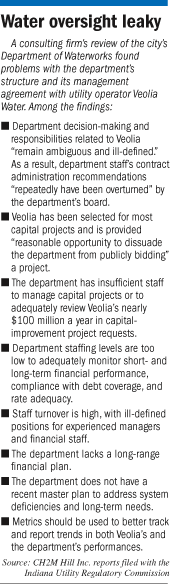
The consulting firm said the department, with seven full-time employees at last count,
lacked staff to adequately monitor the utility’s financial performance or to adequately review Veolia’s
capital requests, which often approach $100 million a year.
“Staffing levels are also too low to provide
adequate monitoring of short- and long-term financial performance, compliance with debt covenants and rate adequacy.”
The consulting firm called it “incumbent on the department to provide an increased level of scrutiny and
professional judgment as to the extent and magnitude of the capital program,” balanced with the department’s available
funding and water service needs.
Responsibilities of department staff regarding matters related to Veolia are often
ambiguous and ill-defined, said CH2M, adding that contract-administration recommendations made by staff “repeatedly
have been overturned” in Veolia’s favor by the department’s seven-member volunteer board.
As
for the city’s management agreement with Veolia, CH2M Hill found the department was allowed to award capital
projects exclusively to Veolia. An amendment to the agreement in 2007 does not guarantee or assure Veolia will win projects,
yet “it has been selected for almost all capital projects to date.”
It suggested the department could
seek additional cost savings by broadening contract opportunities.
“Ultimately the current absence of competitive
bids creates a lack of transparency and clarity in the capital project process … Greater control over the capital project
process may allow the department to develop creative shared cost-savings measures to provide a mutual benefit for all parties,”
the report said.
Changes under way
While airing its dirty laundry to the commission,
the water department outlined steps it’s taken in recent months to correct the department’s problems. The chairman
of the waterworks board, Marvin Scott, noted in testimony with the IURC that the department has sought to limit capital projects,
paring Veolia’s recommended $640 million, five-year capital plan to $214 million for only “highest priority”
projects over three years.
Scott and Klein said the department also plans to address other issues raised by the
consultant, included hiring additional staff, such as a professional engineer and a hydrogeologist.
“I do
not believe the department currently possesses the correct number and type of staff to support its obligations under the management
agreement,” Klein told the commission.
After joining the department, Klein terminated an administrative assistant,
a contract analyst and the chief financial officer. He replaced the CFO with Ronald J. Miller, an accountant who will be pressed
to conduct more thorough long-term financial planning and performance benchmarking.
In 2005, the department, in
trying to free up $45 million in additional money for capital projects, converted fixed-rate bonds to variable-rate debt with
abandon. Eventually, about 60 percent of its $845 million in outstanding debt was in variable-rate instruments. Bond swaps
intended to mitigate the risk of interest-rate variations failed to backstop the risk as financial firms involved in the deals
failed or saw credit ratings plunge.
Klein told the commission the department has now converted all its variable-rate
debt to fixed, and was considering legal action against unnamed defendants involved in its past bond financing.
“The
department has taken significant steps to improve upon the management of the system and to be the active and interested owner
of the system that the commission expects it to be,” Klein said.
“I guess given the close oversight
that the commission continues to exercise since the emergency rate case … they don’t want to dig the hole any
deeper,” said Bette J. Dodd, a Lewis & Kappes attorney representing industrial water customers.
But the
department’s very existence could be in question under scenarios Mayor Greg Ballard is considering for the utility.
This summer, he solicited proposals from companies interested in operating waterworks. One included an offer from Indianapolis
natural gas utility Citizens Energy Group to acquire Indianapolis Water for up to $1.6 billion.•
Please enable JavaScript to view this content.
Editor's note: You can comment on IBJ stories by signing in to your IBJ account. If you have not registered, please sign up for a free account now. Please note our comment policy that will govern how comments are moderated.