
Subscriber Benefit
As a subscriber you can listen to articles at work, in the car, or while you work out. Subscribe NowThe Indianapolis Cultural Trail and the downtown Conrad Indianapolis hotel were on a collision course as soon as trail planners announced three years ago that the route would travel along the north side of heavily traveled Washington Street.
Conrad officials didn't want the trail because it would interrupt the hotel's valet operation, and they argued the bike and pedestrian path should be moved to another street or the other side of Washington Street.
"We had to find something that would maintain the trail and still work for the Conrad," said Brian Payne, president of the Central Indiana Community Foundation and the trail's champion. "It was a very challenging set of negotiations that went on for more than a year."
The Conrad question, he said, has been the most challenging planning dilemma for the entire 8-mile trail.
The end result of the negotiations: A brick-paved "intersection plaza" in front of the high-end hotel, bookended by traffic bollards and signs warning pedestrians to use caution and bicyclists to walk. The plaza is finished but the rest of the trail along Washington Street remains under construction.
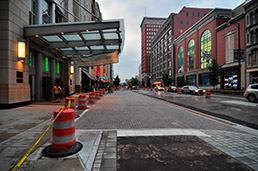 A brick "intersection plaza" will warn pedestrians to use caution and bikers to walk their bikes in front of the Conrad. (Photo courtesy Curtis Ailes)
The pavers in front of the Conrad are distinct from the rest of the trail, essentially creating a pause in the path. Payne said he fought to use the same pavers as the rest of the trail, while allowing space for the Conrad to handle parking and check-in, but hotel officials disagreed.
The compromise is designed for the safety of both hotel guests and Cultural Trail users, said Greg Tinsley, Conrad's general manager.
The hotel's valet staff will keep fewer cars parked in front of the hotel and will no longer park cars at an angle, opting instead for parallel parking to keep an opening for trail users, Tinsley said.
"We certainly embrace the opportunity to have the trail come in front of the Conrad," Tinsley said. "We think it's great for the city and hope it gets a lot of use."
The hotel has even ordered six beach-cruiser bikes to loan out to hotel guests.
But the compromise doesn't sit well with urban planners and bicycling enthusiasts like Curt Ailes, who writes for the Urban Indy blog.
Ailes sees the stretch of the trail in front of the Conrad as a blemish on an otherwise world-class project, a short-sighted move to prioritize service for cars over pedestrians and bicyclists.
Where else in the city is a business allowed to park cars on a sidewalk? he asked.
"In terms of increasing alternative forms of mobility, I felt like we lost a battle," Ailes said. "I don't see the big need to keep a bunch of luxury cars parked out on the sidewalk. Ten years from now, they're going to think they should've gotten out of the way of progress. Maybe their guests will want to use the trail, and wonder why all the cars are there."
Ailes also is miffed at the rapid speed of construction for the portion of the trail in front of the Conrad, while work on the stretch in Fountain Square has dragged on for months, dealing a blow to smaller, less influential businesses.
Payne, who dreamed up the idea for the trail, admits the Conrad solution is not ideal. But he says the hotel is the most significant spot where the trail "affects a business in an ongoing nature."
He's seen much "more challenging" moments along trails he's biked all over the world.
"It compromises someone's experience for about 10 seconds, and it doesn't ruin the experience," Payne said of the Conrad portion of the Trail. "It's a minor inconvenience on the best urban trail in the world."
Please enable JavaScript to view this content.
Editor's note: You can comment on IBJ stories by signing in to your IBJ account. If you have not registered, please sign up for a free account now. Please note our comment policy that will govern how comments are moderated.