
Subscriber Benefit
As a subscriber you can listen to articles at work, in the car, or while you work out. Subscribe Now
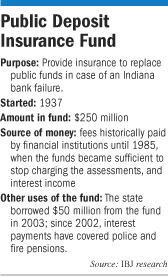 A little-known bank insurance fund that’s holding about $250 million could be an answer for state lawmakers looking for ways to plug budget gaps next year.
Elected officials—including Gov. Mitch Daniels—have started eyeing the so-called public deposit insurance fund, or PDIF, as a potential revenue source.
The state launched the PDIF in the aftermath of the Great Depression to replenish money invested by schools, cities and other public entities in the event a bank holding those funds failed and the Federal Deposit Insurance Corp. didn’t cover the full losses.
But with new state regulations providing another form of backup insurance, Daniels said tapping the fund for other state expenses is “a perfectly appropriate suggestion.”
“That fund has outlived its usefulness, and we do have needs in other areas,” Daniels said. “It would be perfectly legitimate to consider applying that money to other uses such as education or something else more current.”
Efforts to dip into the fund, however, will face resistance from the banking industry. Indiana financial institutions contend the money—which accumulated from fees paid by banks, plus interest—belongs to them, not the state.
And even after a new form of collateral-based insurance goes into effect next year, they say doing away with the backstop would put public funds at risk at a time of financial instability.
 DeHaven
“I believe the reasons for the fund are just as important today as they were in 1937” when the PDIF launched, said S. Joe DeHaven, CEO of the Indiana Bankers Association. “This would be one of the worst times to make the argument to take this [money].”
But the temptation inside the Statehouse to tap the fund may never have been greater. Lawmakers preparing to craft the next two-year budget anticipate a gap between the state’s revenue and expenses of $1 billion. Daniels and other lawmakers say that figure includes the need to build up reserves by $500 million.
And Daniels has pledged to craft a balanced budget without raising taxes or using budgetary gimmicks, such as skipping pension fund payments.
Cashing in
Legislators say they’re keeping in mind banks’ concerns as they probe the PDIF as a funding source.
Sen. Luke Kenley, R-Noblesville, a key budget architect, said he’s discussed the idea of tapping the PDIF with Daniels and other lawmakers.
 Kenley
But he thinks such a proposal, which would require a change in state law, should come with some sweeteners for banks.
Those could include lowering the income tax for financial institutions from the current level of 8.5 percent. He doesn’t perceive that hurting state revenue because he anticipates more banks would establish charters in Indiana—and therefore pay income taxes—if the rate weren’t prohibitively high.
“I don’t think we ought to take the PDIF monies … without some kind of a compensating arrangement,” Kenley said. “The money does not belong to the state. If it belongs to anybody, it belongs to the banks.”
Banks paid fees into the fund until 1985, when an actuarial study deemed it had adequate balances.
Since then, the fund, which is overseen by the state’s board for depositories that is chaired by Daniels, has grown as it collected interest. In its recent history, the PDIF paid out a total of $2.7 million in 1987, 1991 and 1992 to cover uninsured deposits at banks that failed.
But it’s also been a target for other purposes. In 2002, the Legislature redirected its interest earnings toward paying local police and fire pensions. The following year, the state borrowed $50 million from it that has yet to be repaid. And in 2006, the state’s high-tech trade group talked about using it for venture capital, an effort that failed to gain traction.
DeHaven said his group has fought efforts to tap it almost every recent year. However, the combination of the state’s budget crunch and the passage this year of a different form of deposit insurance could set the stage for the biggest battle yet in 2011.
The new insurance program that goes into effect in February requires banks holding public funds that have higher risk ratings to back up those funds with collateral. Banks on the lower end of the zero-to-99 scale must pledge half of the public funds invested in them. Those at the bottom must provide collateral securing 100 percent of public money.
State Treasurer Richard Mourdock said about 70 of the 197 approved public depositories will be required to ramp up collateral under the new rules. That collateral will amount to about 40 percent—or $4.9 billion—of the $12.3 billion in public funds held in Indiana institutions.
The new system is similar to the collateral programs used by other states. Daniels argues the approach provides better protection and dilutes the need for the PDIF.
He said it’s unlikely—if the fund were to be tapped—that the fees on banks would be reinstated to replenish it, although state law allows for that.
“We are the only state in America with such a fund,” Daniels said, “and it isn’t much protection.”
Weighing the risk
But the banking industry—which was hammered during the financial crisis and continues to struggle—says the PDIF is still needed.
More than 300 banks have failed since the beginning of 2008, including one in Indiana—Columbus-based Irwin Union Bank & Trust Co. The FDIC still has 860 institutions on its problem-bank list, but won’t identify them publicly.
In most cases, the banks at the greatest risk of failing are those with higher risk ratings. But that formula is not foolproof.
The ratings, for instance, won’t pick up on danger signs if a bank official is committing fraud, but public funds, nonetheless, would be jeopardized in such a case.
“Without the fund backing that up, it would make me very nervous,” DeHaven said. “There are freakish things that happen out there, and that’s why you have insurance—to guard against freakish things.”
The FDIC alone doesn’t provide enough protection, the banking industry says, because it insures only up to $250,000 per account.
Even so, in recent bank failures, depositors with larger accounts generally have avoided losses because the government brokered deals for other financial institutions to take over their accounts. There’s no guarantee that will continue, however, FDIC spokesman David Barr said in an e-mail.
Some lawmakers say that if they allow the state to tap the PDIF, they should simultaneously devise new safeguards for public funds. Those could include requiring all banks—even those deemed healthiest—to put up collateral.
“I think it’s pretty risky not to have some sort of insurance built into that money,” said Rep. Jeb Bardon, the ranking Democrat on the House’s financial institutions committee. “What’s a healthy bank one day could be an unhealthy bank the next day.”
But imposing additional collateral requirements comes with a price. Bankers say it ties up money that otherwise could be used for lending—or for paying better interest rates on deposits.
It also would discourage smaller institutions from holding public funds, Mourdock said, thereby forcing some government units to invest outside their communities.
Bardon shares those concerns but says it would be “worth having a discussion” about tapping the fund, particularly if it could benefit certain educational programs.
“We’re in a situation right now financially where we need to have an honest discussion about every alternative,” Bardon said. “We need to look at funding priorities and what makes sense.”•
Please enable JavaScript to view this content.
Editor's note: You can comment on IBJ stories by signing in to your IBJ account. If you have not registered, please sign up for a free account now. Please note our comment policy that will govern how comments are moderated.