
Subscriber Benefit
As a subscriber you can listen to articles at work, in the car, or while you work out. Subscribe NowThe water clock, the polar bear, the carousel, the mirror maze, the giant Transformer, the jelly bean reproductions of famous works of art, the massive glass sculpture at the core. It’s impossible for those of us who have raised kids with the Children’s Museum of Indianapolis to imagine what it’s like to enter it, as a child, for the first time.
I’ve been critical in the past of some of its specific special exhibitions, but none of that diminishes my appreciation for the place itself—and for its continued creative and honest efforts to improve and freshen itself.
The latest such effort, “National Geographic Treasures of the Earth,” launched June 11, taking over the space formerly populated by the “What If” gallery. That fun hodgepodge took visitors under the sea, inside a pyramid, and to a hands-on dig while this new one, well, this one takes visitors under the sea, inside a pyramid, and to a hands-on dig.
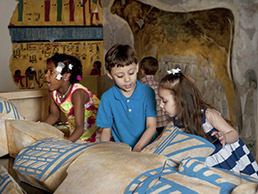 Children explore the tomb of Seti I (Photo/Sandro Vannini)
What’s different is focus. Where the former resident exhibition was fairly free-form, the new one builds interactive activity out of three distinct discovery stories. There’s an area devoted to the exploration of the tomb of Seti I, (considered the most ornate of the crypts in Egypt’s Valley of the Kings), another to the amazing Terra Cotta Warriors of Chinese emperor Qin Shi Huangdi, and, between them,
the undersea discovery of Captain Kidd’s “Cara Merchant” ship. The common denominator is the exploration and uncovering of long-hidden treasures. And it’s all mercifully free of pop cultural connections. No Nickelodeon sponsorships. No “Pirates of the Caribbean” connections.
How you enter “Treasures of the Earth” matters. You can get in through the first floor, but I strongly recommend taking the modified elevator from the second, which takes a slow drop and incorporates sound effects and smells to effectively immerse young explorers in the world of the exhibition. A video intro en route is short, fun and effective.
I visited at a time when the costumed interpreters (who frequent the exhibition and answer questions from the curious) were on a break. So I didn’t get the full “Treasures of the Earth” experience. But what I did see once the elevator door opened was impressive enough.
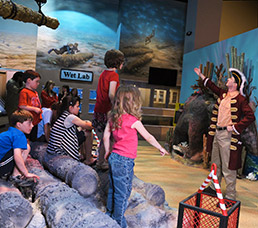 Captain Kidd’s “Cara Merchant” ship. (Photo Courtesy Children’s Museum of Indianapolis)
Kid archeologists carefully extracted antiquities from a dig site and then tried to rebuild fragmented warrior statues. Pirate-garbed junior buccaneers stood atop a pile of cannons while others asked smart questions to helpful staffers. Other tykes teamed up to piece together the broken pieces of a sarcophagus—and were joyfully surprised at what happened once the final piece was placed (I won’t tell here).
High-tech effects are used in “Treasures of the Earth”—such as creative sensors on the deliberately distressed tomb walls—but the technology doesn’t dominate. There’s a clever 90-second video explaining the story of Captain Kidd and a cool machine for exploring how minerals were used to create color pigments, but the real action happens as visitors try to assemble the warriors, learn (by doing) that broken coral can be reattached, and help clear the rubble out of an underground burial site. For those wanting to learn more, artifacts are artfully included, behind glass, in the walls. Clothes are provided so you can dress the part.
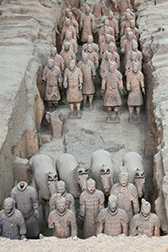 Terra cotta warriors (Photo Courtesy Children’s Museum of Indianapolis)
There are more artifacts and information up in what used to be the coat check area on the second floor. And this spot offers a view of all three pieces of the show. But it’s not as effective as the rest of the exhibit. The bird’s-eye view may be great if you are trying to track down a stray child, but it takes some of the mystery and excitement out of taking the plunge in the lift/elevator. Feel free to check it out after you’ve exhausted the rest of the exhibit. And that could take a while. As with most of the better Children’s Museum exhibitions, permanent or temporary, it’s the attention span of the parents, not the kids, that is most likely to limit playtime. It’s the parents, not the kids, who usually feel the need to move things along—to get the most for their money by seeing everything.
My Children’s Museum advice hasn’t changed: Pick your spots, settle in, and let your kids dictate how long you stay. Bring a paperback book if you must but try never, ever, to tell your adventurous child, “Come on, let’s go, we’ve got other things to see.” One of the things to treasure about being in a city with the world’s best children’s museum is that you can always come back to see the rest.•
__________
This column appears weekly. Send information on upcoming arts and entertainment events to [email protected].
Please enable JavaScript to view this content.
Editor's note: You can comment on IBJ stories by signing in to your IBJ account. If you have not registered, please sign up for a free account now. Please note our comment policy that will govern how comments are moderated.