
Subscriber Benefit
As a subscriber you can listen to articles at work, in the car, or while you work out. Subscribe NowA push by credit unions for more leeway with small-business lending is fueling an old fight with their banking rivals.
Credit unions, formed in the United States early in the 1900s mostly to help people with limited resources access loans, have steadily increased business lending over the last decade. Some, including credit unions in Indiana, are near a federally mandated cap on such loans.
And now they’re lobbying Congress to raise that cap from the current 12.5 percent of assets to 27.5 percent. Bills filed in the House and Senate this year would do just that.
It’s a move credit union advocates say would give small businesses, which make up the lion’s share of credit union business borrowers, more choices for securing capital.
“Businesses need access to credit, and they need as many options as possible at the best possible rate,” said John McKenzie, president of the Indiana Credit Union League, who addressed the issue with Indiana’s congressional delegation in a visit to Washington, D.C., on May 5. “Credit unions stand to do more business lending.”
Banks, however, see the push as another move by credit unions to edge into their turf. And they’re doing so, bankers say, with a big advantage.
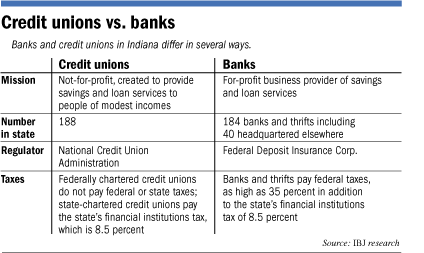
As not-for-profit cooperatives with no shareholders, credit unions are exempt from paying the federal corporate income tax, which tops out at 35 percent.
Expanding business lending would give credit unions another tool to broaden a mission from which bankers say they’ve already strayed.
“They’re not supposed to be equal with banks,” said Joe DeHaven, president of the Indiana Bankers Association, which represents the state’s community banks. “They earned their tax deduction by serving individuals with modest means. They weren’t supposed to be making business loans. They weren’t supposed to be serving high-income individuals.”
In Indiana, DeHaven fears expanding the cap could open the door for some of the state’s 188 credit unions to ratchet up their business-lending game.
And some experts agree that raising the cap would result in more lending—in higher amounts.
“It’s just a question of when, I suspect, more than if,” said Bill Kelly, a former banking professor and economist for the Credit Union National Association, who now consults with banks on credit-union competition in Madison, Wis.
Growing market
Most credit unions entered the business-lending market in the mid-1990s after getting heavily into mortgages in the 1980s.
Kelly said the number of savings accounts was growing faster than loans for many credit unions. Issuing capital to credit union members to run or expand their small businesses became another way to lend. In order to borrow, a business owner must be a credit-union member, but there’s wide access to membership.
Congress set the 12.5-percent loan cap for credit unions in 1998.
The majority of credit union loans are still relatively small—$240,000 on average—and nationwide they provide about 4.5 percent of all business loans. But their market share, both nationally and locally, is growing. In Indiana, credit unions’ business loan volume grew from $988 million in 2007 to $1.5 billion last year.
By contrast, commercial and industrial loans issued by Indiana banks declined from $9 billion in 2007 to $7.5 billion last year.
 Some banks with an Indiana presence have increased small-business lending in recent months as they’ve pushed to capitalize on flickers of resurgent demand.
But the overall decline reflects a recession in which loan demand was sluggish and banks, faced with heightened regulatory scrutiny, were cautious to lend.
Longtime commercial banking lenders also were preoccupied with old problem loans during the recession, said John Reed, a banking industry expert with the local office of Chicago-based investment firm David A. Noyes & Co.
Meanwhile, credit unions, as relative newcomers to the business lending arena, were mostly unencumbered by such loans and therefore able to focus on getting more business loans.
“They’re not dealing with sins past; they’re creating [loans] future,” Reed said.
Higher-cap impact
In Indiana, about 10 credit unions do roughly half the state’s credit-union business lending, and most of them are approaching the cap, McKenzie said.
Among them is Indianapolis-based Forum Credit Union, which forged its way into business lending in 2002, in part to meet a demand among members who already were getting consumer loans from Forum.
A couple of years ago, the credit union came close to capping out with about 11 percent of its assets in business loans. That number has dropped slightly—to 9.75 percent—as deposits have grown and some borrowers have refinanced.
But Andy Mattingly, Forum’s chief marketing and retail officer, said he has to remain vigilant that Forum’s numbers don’t fluctuate.
Lifting the cap, he said, would allow the credit union to continue aggressively going after dual deposit and loan customers—without the pressure of approaching the business loan limit.
“We would do the same thing we have been doing,” Mattingly said. “We’re trying to build a relational approach where we’re getting the deposits and the loans.”
In most cases, Forum, which provides loans primarily in the $750,000 to $2.5 million range, is competing with two or three banks for the business.
That’s precisely what banking advocates such as DeHaven worry about. If the cap were to be lifted, he said, some of the more aggressive unions would follow a similar course.
That wouldn’t expand availability of credit, he said, but would lure customers from banks to credit unions.
The impact “is going to be determined almost market by market,” DeHaven said. “Where there is a larger credit union that’s expansionary-minded, they’ll have the tax advantage to be able to try to attract some of the good business that already exists at banks.”
McKenzie, however, said credit unions’ share of the market is so minuscule that even if it doubled, banks would still dominate 90 percent of it.
Over time, though, that might not be the case, Kelly said. Credit unions now mostly serve a niche of smaller loans for which some banks don’t bother to compete.
But as credit unions get more leeway to lend, they could take on larger business loans, a move that would make them more directly competitive.
“Banks have found that credit unions have been tough competitors with consumers,” Kelly said. “Maybe today they can’t do big loans, but that could change.”•
Please enable JavaScript to view this content.
Editor's note: You can comment on IBJ stories by signing in to your IBJ account. If you have not registered, please sign up for a free account now. Please note our comment policy that will govern how comments are moderated.