
Subscriber Benefit
As a subscriber you can listen to articles at work, in the car, or while you work out. Subscribe NowClarian Health is launching its own health insurance plan, the boldest of several initiatives at Indianapolis hospitals to bypass health insurers and provide health benefits directly to employers.
Officials at Indianapolis’ major private hospital systems say their efforts would change how they are paid in a way that would encourage preventive and parsimonious care. Most health insurance models today encourage hospitals to do as many procedures as they can, the officials say.
But hospitals also see themselves in a position now to challenge the powerful sales proposition of Anthem Blue Cross and Blue Shield that has led it to such a dominating position in the Indianapolis and Indiana markets.
That’s because hospitals can give discounts equal to those they give to Anthem and, they think, process claims through a third-party administration firm for less than what Anthem charges. That would allow them to offer employers health benefits at a lower cost.
Also, the hospitals have built up much larger networks of providers through a string of physician acquisition and affiliation deals. Those networks aren’t nearly as large as Anthem’s, but many observers think they might be large enough to get interest from employers, who are desperate to find some solution that lessens the huge health care cost spikes of the past decade.
“For 20 years, this concept’s been talked about, but we’re finally at the point where the finances are lining up,” said Greg Pemberton, a health care attorney at Ice Miller LLP in Indianapolis.
 Slabosky
Clarian’s new health plan is led by Alex Slabosky, the former CEO of M-Plan Inc., a health maintenance organization in which Clarian held an 86-percent stake. M-Plan folded in 2008, but since then Slabosky has been working for Clarian operating a Medicare Advantage plan for the federal government.
Slabosky declined through a spokeswoman to comment for this story, saying details of Clarian’s new initiative have yet to be approved by Clarian’s board.
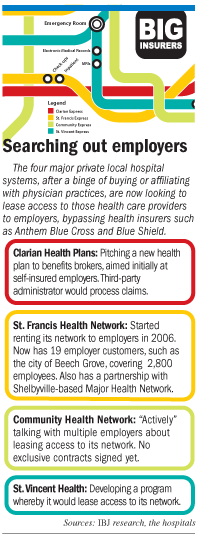
But Clarian officials have been talking to benefits brokers about its plan, pitching it as a new health plan for self-funded employers, which pay health claims out of their own coffers instead of paying premiums to a health insurer.
A third-party administrator will process claims for employers.
Among the details not known is what Clarian will call the plan. The hospital system will change its name to Indiana University Health in the first quarter next year.
Through a series of acquisitions over the past three years, Clarian now operates 16 hospitals throughout the state. Through a joint venture with the Indiana University School of Medicine, Clarian is trying to employ 1,200 to 1,500 physicians through an entity called the Indiana Clinic.
Community, which now has more than 1,000 physicians employed or closely affiliated with its hospitals, is considering starting its own health plan, too, said Tom Fischer, chief financial officer.
 Community’s goal is to move toward a payment system that rewards it for managing the health of patients well before they need hospital care and, it hopes, reduce their need for expensive procedures.
The hospital system hopes to accomplish those goals by having a single electronic record for each patient that can be accessed by every doctor in its system and by rewarding doctors for communicating with their colleagues and with patients.
“We have to get away from episodic care and focus much, much more on preventive health care,” Fischer said. “We will work with anybody, whether they be other providers or employers or insurance companies.”
Not a threat
Anthem officials aren’t too worried by the hospital’s initiatives at this point. The company insures more than 42 percent of all people covered by employer-sponsored health insurance in the Indianapolis area, according to data from Tennessee-based market researcher HealthLeaders-InterStudy.
Anthem’s parent company, Indianapolis-based WellPoint Inc., claims another 13 percent of the employer-sponsored market through out-of-state subsidiaries that insure customers in central Indiana.
The next-largest health insurer in this market is Minnesota-based UnitedHealthcare, which claims 12 percent of the employer-sponsored customers.
Because Anthem has such large volumes of customers, all hospitals and most doctors opt to be part of its provider network, which requires them to offer services at a discount. Anthem is able to command the largest discounts because of its market share.
Employers are drawn to Anthem because its huge network gives its employees the widest choice of providers—a benefit they see as key to attracting and retaining top-notch workers.
“Our customers tell us having that kind of choice is important,” said Tony Felts, spokesman for Anthem’s Indiana plan.
Indeed, limited geographic footprints is one of the biggest challenges hospitals will face in trying to start health plans.
Clarian, which will limit its new health plan to providers in its Clarian Quality Partners program, has medical office buildings on all sides of the city, but its hospitals are in the west, north and downtown areas of Indianapolis.
St. Vincent is concentrated on the city’s north and west sides. St. Francis dominates the south side. Community Health Network covers the northeast, east and south sides.
“If you said, ‘Everybody’s got to go to St. Vincent’s,’ my guess is somebody on the south side would be put off by that,” said Ed Abel, a hospital accountant at Indianapolis-based Blue & Co.
Other options
If both Clarian and Community start their own health plans, they will compete with Advantage Health Solutions, the Indianapolis-based health plan partly owned by the two other major hospitals operating in Indianapolis: St. Vincent Health and St. Francis Hospital & Health Centers.
 Fischer
Advantage covers more than 80,000 Hoosiers, some directly and some by renting its network to other organizations. Such provider-run health plans are more common in other parts of the state, such as Evansville and Fort Wayne, but have been rare in Indianapolis in recent years.
Separately from Advantage, St. Francis started allowing self-funded employers to “rent” access to its network of physicians and facilities in 2006. To date, it has signed up the city of Beech Grove and four other employers.
St. Francis has partnered for even longer with the Envision network run by Major Hospital in Shelbyville and Johnson Memorial Hospital in Franklin. That network is rented by 14 employers, such as Ryobi Die Casting and Shelby Materials.
Major and Johnson refer cases that are too complex for their facilities to St. Francis. Also, when cases are too complex for St. Francis, such as a rare pediatric surgery, it refers patients to Riley Hospital for Children, which is owned by Clarian.
Employers that rent the Envision and St. Francis networks place participating providers in a first tier that includes the lowest expenses for employees, and place Riley or other outside facilities in a second tier, with somewhat higher payments for employees.
Envision started in the early 1990s and, unlike similar efforts by many Indianapolis hospitals, never died off.
“It gives the employer an alternative on Anthem,” said Ryan Claxton, Major’s director of business development. “If the employer has a bad experience, or receives a double-digit, 30-percent increase, they do have another option.”•
Please enable JavaScript to view this content.
Editor's note: You can comment on IBJ stories by signing in to your IBJ account. If you have not registered, please sign up for a free account now. Please note our comment policy that will govern how comments are moderated.