
Subscriber Benefit
As a subscriber you can listen to articles at work, in the car, or while you work out. Subscribe NowA state ethics panel that’s been under fire for allowing a state regulator to take a job with a utility has a long history of lenient decisions.
An IBJ review of 27 rulings by the Indiana State Ethics Commission dating back to 2006 shows the five-member body has not prohibited a state employee from taking a private-sector or not-for-profit job in the last 4-1/2 years.
On only a few occasions has the panel, which advises state employees on ethics laws, required a 365-day “cooling off” period between jobs.
Ethics experts said, in some of the cases, the commission should have more strictly interpreted state law regarding employment restrictions.
The controversy swirling around Indiana Utility Regulatory Commission General Counsel Scott Storms’ move to Duke Energy has prompted state lawmakers and government ethicists to question whether the commission and the ethics laws it interprets are too lenient.
Duke Energy put Storms on leave and Gov. Mitch Daniels fired the IURC chairman in October after the Governor’s Office found Storms was presiding over administrative hearings involving Duke while talking to the company about a job. When Storms sought an opinion from the ethics commission, he reported that he removed himself from involvement in pending Duke matters after submitting his resume.
Some say the current system creates the risk of similar ethical lapses.
 Cyndi Carrasco is director of the Indiana State Ethics Commission.
“We can have a law on the books that requires public officials to do some things,” said Julia Vaughn, policy director for the good-government advocacy group Common Cause Indiana. “But if it’s not enforced and it’s written in such a way that allows for these exceptions, we really don’t have much of a law in place.”
State officials defend the laws and so far have not entertained discussions about changing the way the ethics commission is appointed. Members, three of which can be from the same political party, have been appointed by the governor since the body was created in 1974.
“The governor put a very strong ethics package in place in 2005,” said Jane Jankowski, a spokeswoman for Daniels. “We went from a state that had some of the weakest rules to a state that has among the strongest ethics rules in the country.”
A lenient record
 Indiana House Speaker Pat Bauer says ethics commission needs independence.
The law dictating state employees’ moves to jobs outside state government says they cannot take a job if the employer offered it to influence the employees in their state positions.
The law also stipulates that employees take a 365-day cooling-off period under certain circumstances, such as if state employees accept positions as executive-branch lobbyists or had negotiated or administered contracts with the employer on behalf of the state agency.
The law also bars state employees from working on certain contracts, lawsuits, claims or other matters involving the state if the state employee was “personally and substantially” involved in those issues while with the state.
It’s up to the ethics commission, whose advice employees seek only on a voluntary basis, to interpret whether those laws apply.
The IBJ reviewed 27 reports the commission issued from January 2006 to September regarding the post-employment law.
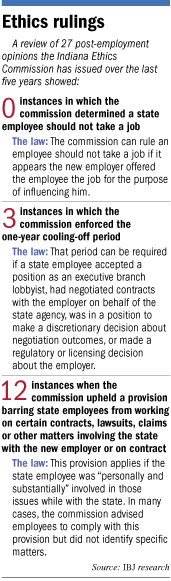 In none did the ethics commission determine an employee should not take a job. In three, commission members enforced the cooling-off period. And in 12 cases, they barred employees from working on certain contracts, lawsuits or other matters.
Government ethicists said in some of those decisions it appears the commission took a lenient approach.
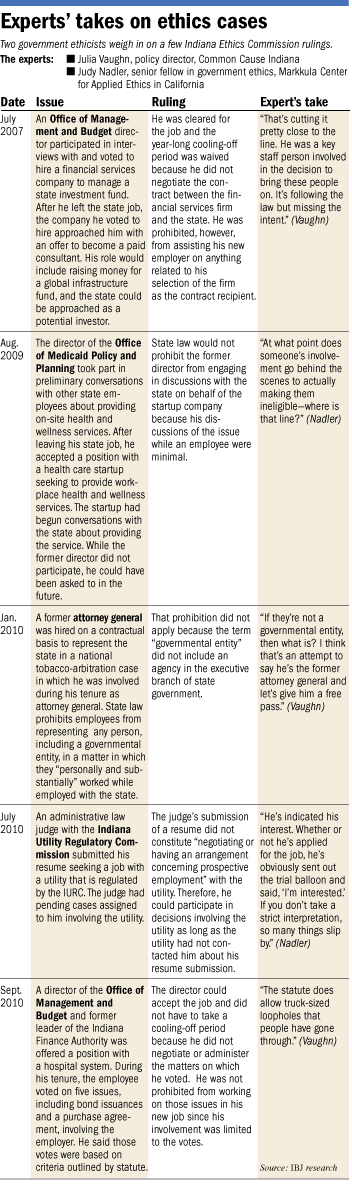
For instance, commissioners waived cooling-off periods for two budget directors who had voted to approve bond issuances, contracts or other agreements involving companies that later offered them jobs. The commission deemed it was permissible because the employees had only voted on the matters, but had not been involved in negotiating or administering them.
They also allowed an IURC lawyer who had submitted his resume for the Duke job that Storms later secured to vote on matters related to Duke so long as he had not been contacted about the job.
Judy Nadler, a senior fellow in government ethics at the Markkula Center for Applied Ethics in California, said it’s important for the public trust that bodies such as the ethics commission take a hard line on their decisions.
“What we owe the public is the right to honestly believe there is no inside track for anyone,” Nadler said. “Unless we are enforcing the law, that will never be true.”
While the commission has not instructed employees not to take jobs since 2006, the group in some cases has limited what the employees can do in those new positions, said Cyndi Carrasco, the commission’s director.
She pointed to 125 restrictions the commission has issued since 2005. Those are broadly calculated to include provisions, such as the one-year restriction on executive-branch lobbying, even if they would not immediately apply to employees in their new jobs but could apply in the future.
That number also includes each of the individual lawsuits, contracts, claims or other matters that employees had been involved with at the state and would be barred from working on in their new positions.
Commission Chairwoman Clare Nuechterlein disagreed with the notion that the commission has been lenient. She said the group’s role is limited to interpreting what is spelled out in state law and making decisions based on the information employees share.
“We are limited to the authority that the Legislature has given us in the statutes,” said Nuechterlein, a law professor at Valparaiso University. “We proceed on a case-by-case basis.”
A need for change?
Some government ethicists agree the way the state ethics laws are written makes it more challenging for the commission to enforce them.
Vaughn, of Common Cause, said the law’s stipulations that employees be involved in negotiating or administering contracts or deeply engaged in certain issues makes it less likely that high-ranking state employees will be subject to it.
To restrict an employee from taking a job, the commission in most cases would have to determine an employer offered the job to influence the state employee.
 But part of the problem also lies in the way the commission operates, she said, and changing the way the panel is appointed could make it more effective. Among her suggestions is making the entity part of the judicial branch and not appointed by elected officials.
“A broader look needs to be taken to figure out how to give [the commission] some teeth and the will to enforce a broader cooling-off period and other ethical guidelines,” Vaughn said. “Very few state-level, top-agency people have been denied the opportunity to go through the revolving door—I thought that was the whole point.”
Indiana House Speaker Pat Bauer, D-South Bend, also would like the group to have more separation from the executive branch—or at least see appointees get approval from state lawmakers.
“We should consider an independent way of picking members,” Bauer said, “to get more confidence restored.”
Most states have ethics commissions, according to the National Conference of State Legislatures. Several have at least some members appointed by the governor, but many also have appointments by other officials, such as the Supreme Court chief justice or members of the Legislature.
But some say statistics about the commission’s approval record do not suggest it’s ineffective.
Jankowski in the Governor’s Office pointed out employees who are confident about whether they would violate ethics laws do not seek the commission’s opinion. And it’s important that the commission continues to be seen as accessible.
“We want state employees to feel comfortable about going before the commission or seeking an informal opinion,” Jankowski said. “We don’t want to send a message, ‘Don’t go if you have a question because you’re concerned about the repercussions.’”
Experts say when states craft laws, it’s important they strike a balance between upholding standards and not tying employees’ hands.
Patricia Harned, president of the Virginia-based Ethics Resource Center, said the fact that a public employee can leave office and get a good private-sector job helps government secure strong leaders.
But, she said, it’s important to make sure the transition doesn’t happen too quickly and that employees aren’t using their influence to secure more lucrative positions.
“On the one hand, you want to be able to recruit the best and brightest from the private sector to lead government organizations, and you want them to go back and have fruitful lives once they’ve left public service,” Harned said. “But it also can create a lot of problems.”•
Please enable JavaScript to view this content.
Editor's note: You can comment on IBJ stories by signing in to your IBJ account. If you have not registered, please sign up for a free account now. Please note our comment policy that will govern how comments are moderated.