
Subscriber Benefit
As a subscriber you can listen to articles at work, in the car, or while you work out. Subscribe Now
They came out of the woodwork over the last few years: upstart energy-efficiency consultants, along with existing companies
introducing “green” building specialties.
The enterprising firms seized on a flurry of new federal grants and tax credits available for efficiency and renewable energy.
They warned that Congress is scheming to tax carbon emissions, which could drive up electric rates.
One firm in the sector, locally based Performance Services Inc., hit the green jackpot recently, landing a deal with the
city to make more efficient all 28 floors of the high-profile City-County Building.
Yet Performance Services is not a new company. It was a pioneer in the energy savings niche more than a decade before green
became cool or was perceived to be a viable market.
For the last 12 years, PSI has toiled quietly, mostly in public-sector projects involving schools, municipal buildings and
medical facilities. It may be better known elsewhere, such as in the Indiana-Ohio border town of Union City. There, PSI has
quarterbacked the construction of two 1-megawatt wind turbines to power the town and its schools.
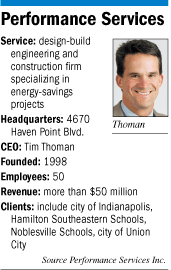
“We’ve done over 100 energy savings projects,” said Tim Thoman, president and founder of PSI.
To those outside the engineering and construction realms, PSI is an animal that’s a bit hard to classify. The 50-employee
firm calls itself a “design-build engineering and construction company.”
In a traditional project, an architect/engineer designs a building first, with a competitive bidding process later to pick
contractors.
Under design-build, PSI essentially handles all aspects of a project itself—competitively bidding equipment and installation.
It is solely responsible for seeing that all elements of a project are completed.
 Design-build has turned out to be an attractive format for energy-savings projects. It allows
PSI to guarantee a set level of savings and building performance.
For example, with the City-County Building project, PSI guarantees that the city will save at least $250,000 a year—or
it has to cut the city a check for the shortfall. So far, among all clients, “we haven’t cut any checks,”
Thoman said.
He thinks the accountability aspect helped land a number of projects, including work for Hamilton Southeastern Schools that
PSI guarantees will save the district $1.1 million a year. Improvements range from rewriting control sequences for HVAC systems
to high-efficiency boilers.
A lot of buildings already have efficient equipment and sophisticated digital controls. But traditionally there’s little
incentive for contractors to set them up most efficiently before heading to the next job.
“[Building owners] are tired of spending a lot of money for a building that doesn’t work well,” Thoman
said.
At their Carmel headquarters off Gray Road near East 96th Street, PSI engineers have the “very methodical and analytical”
task of monitoring clients’ buildings, via an Internet link. They keep precise records of energy consumption. If someone
at the school overrides a building’s HVAC settings, “we know immediately. We can work with the facility to improve
energy efficiency.”
While the nearly 50-year-old City-County Building was well-maintained over the years, the maintenance team wasn’t enabled
to make much in the way of holistic improvements, said PSI’s business development manager, Phil Yuska. He’s been
combing over the building for weeks, marveling at robust features such as welded steel ductwork. “It’s built like
a tank.”
Thoman is banking on a 40-percent improvement to building efficiency.
“They weren’t focused on energy efficiency when they built it,” said Thoman, who worked for HVAC giants
Johnson Controls and Siemens before founding PSI.
One of the solutions will be a geothermal system.
The tower sits on a high water table. Its basement is deluged with thousands of gallons of water daily that must be pumped
out. The geothermal system will strip heat from the 55-degree water for heating in winter. In summer, the water will be used
for cooling.
The project also includes new street lighting on the building’s grounds that will be powered by batteries fed by vertical
wind turbines and photovoltaic cells mounted atop light poles.
The guaranteed annual savings will be about $780,000, but the city’s net savings will be $250,000 a year over the 15-year
life of the project.
“The majority of this savings will be used to pay for the energy conservation measures to make the building more energy-efficient,”
said Karen Haley, the city’s director of sustainability.•
Please enable JavaScript to view this content.
Editor's note: You can comment on IBJ stories by signing in to your IBJ account. If you have not registered, please sign up for a free account now. Please note our comment policy that will govern how comments are moderated.