
Subscriber Benefit
As a subscriber you can listen to articles at work, in the car, or while you work out. Subscribe Now
New state rules designed to protect government cash from bank failures might have an unintended consequence: helping the
biggest banks and hurting the smallest.
Anticipating the new rules, at least one big institution, JPMorgan Chase, already has bulked up collateral in order to continue
qualifying for deposits from state and local government.
But many smaller banks are wrestling with the decision, and the stakes are huge. Adding collateral would be costly, but if
they get out of the government banking business they lose a key source of capital with which to make loans and, ultimately,
a profit.
Perhaps worse, the money would shift to competitors.
“There will be a migration of funds,” said Paul Chrisco, chief financial officer of Community Bank Shares Inc.
in the southern Indiana city of New Albany. “Smaller banks [may] have to go to [government] customers and say, ‘We
don’t have the securities to pledge. Your account’s too large. You’ll have to go elsewhere.’”
The demise of Irwin Financial Corp. in Columbus in September prompted the General Assembly this year to modernize the state’s
public deposit insurance system for the first time since 1937. Fortunately for the state, the bankruptcy sapped no funds from
the Public Deposit Insurance Fund because the FDIC arranged and guaranteed Cincinnati-based First Financial Bancorp’s
takeover of Irwin.
here.
So, in coming months, regulators will augment the fund by forcing banks to accept a sliding risk scale of additional collateral
for every state and local government deposit.
“I will sleep far, far better once all the rules are in place,” said Indiana State Treasurer Richard Mourdock,
one of the reform’s primary architects.
Indiana’s fund picks up where the Federal Deposit Insurance Corp. leaves off at $250,000 per account. The state is
motivated to keep its money safe because the FDIC protects only a fraction of the roughly $12 billion in total state and local
government deposits in Indiana.
Agencies and schools use the bank accounts to park their money and pay bills.
Indiana created the fund during the Great Depression as a backstop against huge losses of government deposits if any bank
failed. Until 1985, Hoosier banks paid annual assessments based on the percentage of public deposits they held.
Details are still being hammered out, but the assessments could be revived if the fund ever needs to be replenished quickly.
As part of its recent reform, the General Assembly granted the Indiana Board for Depositories authority to issue $300 million
in new debt to replenish the fund.
The obscure nine-member board is now developing a sliding-scale system for how much collateral banks must set aside against
public deposits based on their default risk. It will hire a private subscription service to provide data for the analysis,
then later this year assign grades to all 197 financial institutions that hold Hoosier government cash. The strongest banks
may need few, if any, new guarantees. Weaker banks will be forced to dig deep for collateral.
The public has a stake in erring on the side of caution, but the banks have a keen interest, too. State and local deposits
account for 13 percent of all dollars in Indiana banks, and nearly all of the 201 institutions doing business in the state
accept at least some of the money deposits.
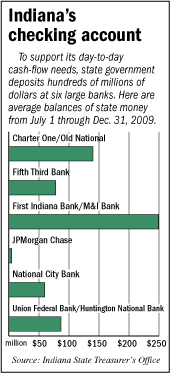 New York-based Chase isn’t waiting for the new collateral rules to be issued. It has
already decided to voluntarily pony up 100 percent.
Maria Quintana, Chase executive vice president and market manager for government, not-for-profit and health care in Indiana,
explained that her bank sets aside collateral specifically for government deposits in 16 other states. So Chase is well-prepared
to do the same here.
“We realized we’d be one of the first banks to step up and say we’re happy to collateralize and address
the Treasurer’s concern of safety and soundness in the system,” Quintana said. “Obviously, having the lion’s
share of that business, we don’t want to lose it.”
Chase has another good reason for embracing reform first. By doing so, it sheds an enormous potential cost. Any bank that
receives the fund’s protection must also accept shared liability for all its peers in the system—including the
weakest.
So if another bank in Indiana goes the way of Irwin Union, Chase won’t have to help clean up the mess.
Weighing options
Every other bank with an Indiana branch is weighing whether to follow Chase down the collateralization path, or
to simply quit doing business with government customers.
“There are still a few banks in Indiana that are struggling,” said Indiana Bankers Association CEO Joe DeHaven.
“I still have concern of what happens to the [PDIF] fund in the event a financial institution fails. We got very lucky
with Irwin Union, in that there was no loss to the fund. I don’t know that we’ll be that lucky twice in a row.”
Community Bank Shares, parent of Your Community Bank in New Albany, saw the biggest jump last year among all banks in Indiana
for the state’s CD business, pulling down $13.4 million in deposits, according to state treasurer’s records.
While Chrisco pointed out that state deposits remain a small part of Community’s $865.7 million in total assets, they’d
be difficult to replace.
“To get an equivalent number of retail dollars, you have to attract a lot more accounts,” he said. “It
can be an efficient way to attract deposits, but you don’t want to have too much concentration, because if they leave,
it can have a big liquidity impact.”
Community has branches in Kentucky—which requires collateral for government deposits. As a result, Chrisco said, his
bank hasn’t pursued them there. He said Community is reluctant to pledge and thus tie up marketable securities it might
want or need to sell. And he expects the administrative burden related to meeting the state’s new collateral requirements
will be the same whether Community’s risk rating requires it to set aside 25 percent or 100 percent.
Chrisco will watch to see how the new risk rating and collateral system unfolds. But he anticipates it could create an advantage
for the biggest banks. He notes the state fund’s $250 million would be far more and collateralization might not be necessary
if the General Assembly hadn’t decided to divert all its interest since 2003 toward shoring up underfunded police and
firefighter pensions.
But Mourdock, the state treasurer, said the reforms will establish an even playing field for all banks to compete for public
deposits.
Government officials must prioritize safety, liquidity and interest yield—in that order, he said. It’s up to
the banks to prove they meet the state’s standards, or decide to concentrate instead on their other customers.
And Mourdock noted the government is likely going to give up some interest revenue in exchange for a safer overall deposit
system.
“We’ve considered changes to the PDIF to make it so banks are in a position to make the best business decision
for themselves if they want to be in the business of holding public funds,” Mourdock said. “Ironically, if banks
are required to post collateral, it will mean government will receive a lower level of interest. But that’s a decision
in the interest of safety.”•
Please enable JavaScript to view this content.
Editor's note: You can comment on IBJ stories by signing in to your IBJ account. If you have not registered, please sign up for a free account now. Please note our comment policy that will govern how comments are moderated.