
Charters and vouchers may have sparked the loudest education-related protests before the Legislature this year, but changes
to teacher evaluations are likely to have the biggest impact on Indiana’s public schools.
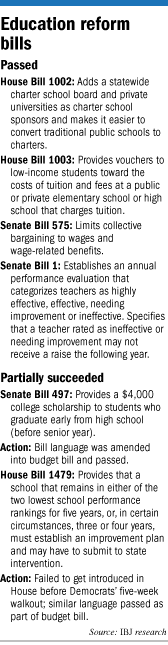
Senate Bill 1 and Senate Bill 575 rewrite the rules for how teachers will be judged, paid, promoted and fired. They limit
teachers’ collective bargaining rights and require, for the first time, that teacher pay and promotions be linked to
quantified measures of student performance.
“Those two will change education more than any two bills in education in recent history,” said Steve Baker, principal
of Bluffton High School near Fort Wayne and president of the Indiana Association of School Principals. “Yeah, it’s
a game changer.”
Supporters predict the new laws will improve existing teachers, get rid of really bad teachers, and help public schools snag
more of the top-performing college graduates that now favor more lucrative careers.
Critics think the legislation is a pretext for cutting costs and limiting teacher input, and that it could lead schools back
to the pre-union days of arbitrary firings, political favorites and low pay.
Whether these changes improve the academic achievement of Indiana students is unclear. Recent studies of performance-based
teacher pay in other states have shown no such benefit. But what is clear is that the bills will transform teaching from a
steady-work, modest-pay career into one with higher risks and rewards.
In many ways, the new laws will make Indiana’s public schools more like charter schools, where unions have no power
and pay raises aren’t automatic.
Instead of career-long job security, teachers—no matter how old or how successful—will be two subpar years or
a budget cut away from the possibility of dismissal. And instead of regular raises, they could find themselves stuck at the
same level for years. On the other hand, classroom stars stand a chance of rising more rapidly in pay, perhaps even earning
a bonus.
“I’m very concerned about the future of the profession. I don’t know that people will want to teach,”
said Teresa Meredith, an elementary teacher in Shelbyville who also is vice president of the Indiana State Teachers Association.
Local school districts must implement the new system of evaluations and pay—key parts of which must still be fleshed
out by the State Board of Education—in the 2012-2013 school year.
SB 575 limits teachers unions to bargaining only about wages and benefits—but blocks them from negotiating the way
the pay is determined.
SB 1, meanwhile, requires that a teacher’s annual pay increase be based on a mixture of students’ scores and
year-to-year growth on tests, in-class observations by a trained evaluator, as well as a teacher’s seniority, education
and work as a school leader.
Teachers rated as ineffective or needing improvement cannot receive a pay increase.
It’s a big change from current law, which said a teacher’s pay and wages could be based on only two things: years
of experience and amount of graduate schooling. Current law also allowed unions to negotiate hours and working conditions.
Win-loss records
The laws affecting teacher pay and work hours have not applied to Indiana’s 62 charter schools, which receive public
funds but operate independently of many state and school district rules.
Perhaps as a result, charters employ younger teachers with less experience, spending an average of 23 percent less on salaries,
according to data from the Indiana Department of Education.

Charter schools also have their teachers work more days and, in some cases, longer days.
Indianapolis Metropolitan High School, a charter school, adopted a year-round calendar last summer that requires its teachers
to work 225 days—far more than the 185 averaged by traditional public schools.
It gave its teachers a 10-percent raise this year. Starting pay at Indy Met is $38,500, compared with $34,000 at Indianapolis
Public Schools, the traditional public school district that surrounds Indy Met.
Indy Met also instituted a merit pay system this year, setting aside $100,000 from a grant to reward its most effective teachers.
Depending on the number of eligible educators, Superintendent Scott Bess said, bonuses could be as high as $10,000.
Teachers’ performance will be evaluated based on frequent observations of their classroom work: preparing lesson plans,
managing classrooms, differentiating instruction methods for individual students.
But student outcomes—test scores, attendance and retention rates, graduation rates, college enrollment—also will
be factored in. While the test scores can be tied to specific teachers, the other measures are schoolwide, thus apply to all
teachers.
Bess said teachers should be treated somewhat like basketball coaches, assessed both on how well they prepare players for
games and on their win-loss records.
“I believe you need to do both,” he said.
Evaluating merit pay
Merit pay draws a range of responses from teachers, even within a charter school like Indy Met.
Chad Miller, a second-year algebra teacher, thinks performance-based evaluations and pay will improve teachers and their
prestige.
“It makes teaching more like a profession, and it will be able to attract better talent,” he said, sitting in
a plastic student’s chair after the end of a school day.
Dennis Swender, a family and consumer sciences teacher,
fears that if bonuses are too large, teachers might start focusing more on money and less on teaching. But modest bonuses
tied to regular and meaningful evaluations would be good, he said.
“I like the challenge. I like the feedback,” he said. “I don’t think anybody who works here is here
because they think they might get a giant bonus.”
However, Indy Met English teacher Shanna Bohdan said merit pay is acceptable only for bonuses. She does not like the idea
of tying teachers’ base pay to student performance.
“It’s like judging dentists on the health of their patients’ teeth,” she said, adding that such an
approach is particularly ill-suited for an urban school, where many students struggle with problems outside of school that
affect their performance on tests. “I will never agree that it’s OK to judge people on that.”
Even among teachers open to the idea of performance-based pay, many worry that state regulators will come up with a measurement
system that makes unfair comparisons between teachers.
“How can you fairly compare even a chemistry teacher to a PE teacher? That’s where I have a problem,” said
Julius Kish, a chemistry teacher at Morton High School in Hammond.
High schools face particular problems because students take classes from seven or more teachers each year. And the state
has developed standardized tests in only three high school subjects: algebra, biology and sophomore English.
That’s why state regulators are considering combinations of schoolwide measures and locally developed tests as ways
to rate teachers.
Kish takes a hopeful view, even though he knows whatever system the state creates will have problems.
“If it’s man-made, it’s not perfect,” he said. “I think there’s going to be unintended
consequences.”
Some teachers even fear cash-strapped school districts will rate nearly all their teachers as less-than-effective in order
to keep salary expenditures from growing.
“It would be a hot day in January if I ever saw any of that money in my pocket,” said Beverly Ransdell, a science
teacher at the Arsenal Technical Magnet Academy, part of Indianapolis Public Schools.
“This is going to pull money away from teachers in the classroom, and instead we’re going to add more top-heavy
administration,” she said. “I don’t see how they’re going to fund it.”
Improving educators
Indiana Gov. Mitch Daniels and Indiana public schools chief Tony Bennett have insisted these bills aim to improve the quality
of teachers.
Data from the 2009 National Assessment of Educational Progress—known as the nation’s report card—show Indiana’s
fourth- and eighth-graders ranking No. 18 in math and as high as No. 21 in reading. Indiana has been improving in both areas
since 2005, but it’s still a ways from being top-notch.
And folks like Bennett are quick to point out that Hoosier students, if they hope to be economically competitive, need to
be educated to a level competitive with students in such countries as Korea, Finland, Singapore and Canada—who currently
outpace American students on international tests.
Indiana is one of several states experimenting with performance-based evaluations and pay as a way to reach that goal.
Years of research have demonstrated that having a quality teacher makes a bigger difference on student performance than any
other factor at the school, including the size of the class or the level of funding.
Other research has shown that having a really poor teacher three years in a row can put a student so far behind his peers
that he will never catch up.
Going even further, Stanford University researcher Eric Hanushek has argued that removing the worst 8 percent of American
teachers would boost the performance of American public school students from ranking No. 14 among developed nations to No.
1.
Taking this research to heart, Bennett and his staff at the Indiana Department of Education designed the new evaluation system,
in large part, to make it easier to fire teachers for poor performance.
Fewer than 0.62 percent of teachers are dismissed each year for performance reasons, according to data from Bennett’s
agency.
Hanushek said evaluation systems like SB 1 are helpful, but they will work only if there is also a change in school culture.
“Schools themselves need to do a lot more in terms of developing and using evaluation systems. Right now, many schools
are reluctant to fire ineffective teachers even when they know exactly who must be replaced,” he wrote in an e-mail
response to questions.
The other goal of SB 1 is to motivate teachers to improve their students’ performance. But that also has proven to
be an elusive goal in other states.
In three rigorous experiments in Chicago, Nashville and New York City—the results of which have been released in the
past year—no system of giving “merit pay” to public schoolteachers judged to be the highest performers has
led to higher student achievement.
Matthew Springer, one of the authors of the Nashville study, said merit pay has been an idea of education leaders since the
1860s, but no one has yet hit on the right incentives to make it work.
“We know that the current way in which we compensate teachers, in the U.S. K-12 public school system, is incredibly
inefficient,” said Springer, director of the National Center on Performance Incentives at Vanderbilt University. “The
difficulty is, we don’t know another way.”•


IBJ Conversations
45 Comments
Add Comment
The state needs a scoring system the rewards an effective teacher not a perfect teacher. I taught bfor 40 years and never used a scoring system that required perfection to reward my top students
At other jobs, what you put into your report, project, presentation, etc... shows at the end and is a direct reflection of your skills.
In teaching, we are often evaluated by how others (children!) perform. They may be hungry, tired, angry, abused, or neglected on testing day, but thir scores are supposed to reflect our teaching.
I hope the evaluation process is well-rounded and does not take the easy way out of % of students who passed a test.
A computer should be used only when the child
needs are done first. Also, judging a student by taling in the teachers lounge about a student who misbehaves and letting the other teacher know that that child would probably be in her/his grade the following year. I belive teachers, not all should not discuss private matters about a student in public. There are teachers that also show favoratism to a child being friend, or a relative of a student. We also need the teachers to state to the students from the beginning of the school year, to be addressed as Mr.xx instead of by first names, as if they are buddies. You show respect you get respect. We need clarification by the school system on rules, favoratism, gossiping, being in the classroom by the time student comes to the classroom. A child picks up right away whether a teacher is caring or not. All students should be treated equally, whether, poor, fat, skinny,yellow,white,black,brown or inbetween. Also, the Principals should walk the ailes and visit the classrooms unespectetly. Volunteer an hr. after school to assit a child who does not have a parent at home due to both parents have to work nowdays. If you relly care for your profferssion, prove it! loving is caring.
First grade through Seniors.
Test students at the beginning of the school year and place them accordingly. If they can't read and do simple math, by the time they get to Jr. Hi, they won't even try.
Tutor those who need tutoring and let those who are ahead, keep moving ahead.
No reason to have a "reward" system.
Test the teachers as well, and let them teach the grade best suited for them.
It is so unfair to the students to put them all in the same class room and expect all of
them to learn at the same pace. Won't happen.
Sounds right about trying to change the Union benefits. As usual, Unions have pushed
the envelope a little too far, not only for
teachers, but in other areas as well.
Whatever happened to the old days of
reading, writing and arithmetic...
Too much pampering kids and not enough rules that are enforced...start with uniforms.
The article says that we will continue to derive some of our pay from seniority and how many college credits we have. I know the school district I work for is saying that we will no longer get any raises for having additional years of experience. I believe this will accomplish two things. Teachers that now make a lot of money because they have so many years of experience will get fired. Administrators will find an excuse to evaluate them poorly to save money. Evaluations are not objective like years and units are. Newer teachers that don't yet have enough experience to be great will be gone because they won't do as well as they eventually would on the evaluation. If they are not gone, they will be kept at a low wage because this law started when they were still low on the pay scale.
Most people don't think teachers work very hard or that many hours, which is definitely not the case for the vast majority of teachers. I know that I work 60-70 hours a week during the school year. Also, between planning for next year and going to conferences, I have hardly had any days off this summer.
I believe this law and the lawmakers that made it are aiming to get rid of public school and public school teachers. They would like to privatize education to make it a money making venture and it should not be. The lawmakers want to quit putting money in education so they can free it up for other means. They want us to have larger class sizes and no money to for resources, but somehow still improve our test scores and student performances every year.
This law is going to discourage people from becoming teachers and discourage good teachers from staying in the field.
I agree also that everyone is so quick to blame the children. Mind you they are watching everything and listening to how much education is being targeted by increasing cuts in funding, and everything else. For a lot of children the interest of school is not there. Could this be a reason some students simply don't care when it comes to classroom performance?
I just completed a parent interview early this week. The parent is from Trinidad & Tobago and in comparison says that they used a more structured format in reading, writing, and math and it worked very well. They use their own ability to think independently of what they know and not what they learn. The teacher - student had a better relationship there because teachers live in the same communities and are considered generals in the army of education, on the Frontline and structure within the classroom - control. Over the years though the format has fallen trying to model after the U.S. with students exposed to more technology, kids acting out because they see it hear in the states, the laws in education as far as what a teacher can and cannot do in the classroom.
When did education become so complicated? Who defined education as business? This is whatâââ‰â¢s wrong with our society and where it went wrong. Those at the top calling the shots are thinking in terms of how much they can profit from this? You canâââ‰â¢t put a price tag on a childâââ‰â¢s education.
Parent involvement or the lack thereof is a BIG issue because after ECED. If the teacher-family partnership is developed at the child development stage I believe alot of issues children have with school would not be. Yes there are alot of social issues children bring to school but when it comes to them seeing the school social worker what are the results? What is the social worker's responsibility at that point, and are they effective or just warming a chair?
Finally, thereâââ‰â¢s a topic I know well and thatâââ‰â¢s teachers who do not know how to interact with diverse students. If you cannot relate nor communicate with diversity then how effective will you become? Every child deserves a good and viable education to grow and thrive to become they desire to be!
Daniel nailed it, too, as did Desperado and others (you know who you are). Kudos. Seeing others profess reason amid chaos gives me some comfort.
Those who suggest ultimately ousting the unwilling or disruptive students (as we would do in business or as we DO do in post-secondary schools) are on to something, I think.
I suppose Chile has in a roundabout way, created a sort of "alternative school." By "creaming" Chile schools can effectively weed out problems, just like we might do in business. I see many problems with the method of selection of students the Chile model offers, however. Long before I read of Chile's plight, I predicted a parallel outcome for Indiana. I am no sooth sayer - I think the prediction was relatively easy. After reading the Chile article, I realize no prediction is necessary. There is precedent. I am dismayed by our zeal to follow a bad lead.
I suppose the final result will be that we will have a healthy body of elite students again, but we won't be culling the herd by eliminating only problem students - so what if some good, but resource-poor fall by the wayside?
I can document many recent cases (even without SB575's effect) in local districts where excellent teachers have fallen victim to arbitrary firing (well, actually, one case was because an administrator wanted a position for a buddy), favoritism, shifts in political winds, etc. I am aware of administrators altering the grading scale, the transparent effect being the manipulation of their own incentive awards. Trust me, no one I care about, over whom I have any influence, will be thinking of becoming a K-12 educator.
There is something inherently wrong with the State subsidizing for-profit schools, while we have compulsory attendance laws, and we as taxpayers have no choice but to contribute.
Read the Chile article. You will see the future of Indiana education.
Please share which states do value teachers. I'm from Idaho and it seems even worse here than Indiana...they have now implemented a system where students and parents will now evaluate teachers--along with a "pay for performance" measure. I want out. Period. I used to love my job...not anymore. Can anyone please tell me how a parent can effectively evaluate any teacher without spending significant time in a classroom?? Will it be based on the hearsay of students etc...what a joke. AND I am a parent myself with kids in school!
If teachers who teach these types of students are not paid well or don't receive raises each year because they work in a low-performing school in a bad area of town, there won't be a desire for teachers to work there. These are the kids that need the best teachers. Money makes people greedy and I truly believe that teachers will flee away from these types of districts leaving the children who already don't have much of chance to fall even further into the cracks.
While I believe that something should be done to improve school performance, this is not the answer and only the beginning of even more complicated problems. I am truly, truly sad for teachers who don't receive the respect they deserve and students who are ignored.
Unfortunately, I am afraid this latest round of education reforms will turn out to be just another grand plan that will not be implemented effectively, and it will simply create even less incentive for smart, talented people to go into teaching. Why bother going through the great expense and effort of going to college and graduate school, and passing a series of licensing exams all so you can go into a fairly low paying job in a profession that is generally not well-respected in our society (despite the lip-service about the "importance" of teachers)?
I would never be a teacher. I make far more money than any teacher ever would. Even for the best teachers, these new reforms will only moderately increase their pay. The main advantages the teaching profession used to enjoy was job security and decent pension benefits. Now, it seems those two benefits are being greatly limited. I suspect teaching will remain a profession for the handful of idealists or those who cannot go into another profession, for whatever reason.
* The role of the parents is rarely mentioned when discussing student achievement,but it is probably more important than the role of teacher and that of student.
* I see obvious sexism in the overall treatment of teachers (the profession is about 70-80% female); name me a profession where someone would have the nerve to say that education and experience should not be a major factor of salary. When one considers this administration's odd attacks on Planned Parenthood, Unemployment Benefits, it seems clear that there is a strong anti-female bias at the center of this "new" stale agenda.
* The biggest area of waste and inefficiency that I have seen in education is the textbook, standardized testing, and technology areas. There should be one national standardized test, period. All schools should have equal access to technology and technicians, and this should be a state mandate. An investigation should be conducted on the great textbook scam involving the Texas conservative cabal.
I predict in 3 years, there will be a massive teacher shortage, and Indiana schools will be in worse shape. Daniels and his ilk will continue to earn Indiana it moniker as the most southern state not in the south.
I agree that teachers should be held accountable for presenting material but as a 14 year teacher, I am not working on cars. I am working with human lives. I see students come in and go weekly. If you would like to see how many students that enroll then withdraw from our school because of family situations, I will be happy to give you those numbers. What about those students with varying degrees of learning disabilities? What about that student that we deal with whose father let his friends sexually abuse her and is facing many psychological areas? If it is a business, then we should assess students after so many days in our school and after they've had a chance to learn concepts and objectives that will be assessed. You do not assess an employee in your business if they have not been in your organization long enough to learn their job. In schools, they are still required to take standardized tests even if they enroll in the school the day before testing begins. Tell me how their teachers should be accountable for that. People in education who see it as a business need to come spend a few days in our world and quit assuming they know how it needs to be.
Dr. Bennett is clueless. He had only been a Superintendent of a school for six months when be began seeking the state office. Furthermore, the research he did for his dissertation proved (if in fact he actually carried out the research) that collective bargaining did not impede the removal of ineffective teachers.
If we want American schools to be superior, we need to put more responsibility on parents. When their children become violent, disruptive, or unmotivated, they are called to come to school and sit with them OR they are no longer allowed to attend. Why are the ills of society allowed to be placed in the laps of teachers who are already working with higher standards than ever before, larger class sizes, and constant fear that more budget cuts will result in them losing their livelihood and ability to feed their families.
If you want to truly know why other countries outpace the United States, it is because not all students are allowed to take those tests and not all children are allowed to attend the public schools. These tests DO NOT - measure all of our students against all of their students. For the future of education in this state please DO NOT take what our leaders are trying to do at face value. Before you believe what they say, look at who some of their biggest political contributors are. It is there you will find your answer to why we are facing this ridiculous education reform. I am a fourteen year, Master's level career educator who has already started packing my bags to leave Indiana. Thank God I did not buy a house here and that I kept my certification current in those states that value teachers and their contributions.
No other industrialized country in the world has implemented merit pay, accept Indiana under the Daniels Administration.