IBJNews

St. Vincent seeks growth in transplants

Back to TopCommentsE-mailPrint

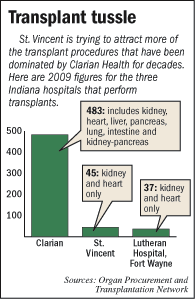
Chart of number of transplants at local hospitalsSt. Vincent Health is moving aggressively to expand its transplant program in a direct challenge to Clarian Health’s dominance in the field.

The Indianapolis-based hospital system, via its 2-year-old partnership with the Cleveland Clinic, filed in July for permission to conduct pancreas transplants in Indianapolis. And down the road, it’s eyeing liver and maybe even lung transplants.

Dr. Paul W. Nelson, director of transplant services at St. Vincent Indianapolis Hospital, said he hopes to begin performing pancreas transplants before the end of the year. Liver transplants will take more time, probably three to five years, he said.

“We’re on an upswing,” he said, adding, “We want to grow our market share.”

Right now, St. Vincent has a paltry share of Indiana’s organ transplant procedures. Only three hospital systems perform such procedures in Indiana: St. Vincent, Clarian and Lutheran Hospital in Fort Wayne.

In 2009, Lutheran performed 37 transplants, St. Vincent 45 and Clarian a whopping 483.

St. Vincent and Lutheran do only heart and kidney transplants, whereas Clarian also performs liver, pancreas, lung and intestine transplants.

Growing in transplants could bring St. Vincent more prestige, which could help it attract patients to the rest of its services, said Ed Abel, a hospital accountant at Indianapolis-based Blue & Co.

“What St. Vincent is trying to do is show that they offer the same services and capabilities that Clarian does,” he said. “They are trying to establish themselves as being able to do anything anybody else can do.”

The competition between St. Vincent and Clarian—Indiana’s two largest hospital systems—always has been vigorous. But it’s become even more heated lately as the two systems have been building up larger networks of hospitals around the state.

Nelson came to St. Vincent in April from Kansas City, where he performed kidney transplants at the University of Missouri School of Medicine. He and his partner, Dr. Alvin Wee, are both technically employed by the Cleveland Clinic.

St. Vincent contracts with the Cleveland Clinic to provide the doctors to perform its transplant surgeries.

Nelson and Wee have been traveling to St. Vincent’s hospitals—including its newest acquisitions in Salem and Bedford—to try to gin up physician referrals to its transplant program.

There are more than 100,000 people nationally waiting for some kind of organ transplant, but only about 28,000 get new organs each year.

That means any new patients St. Vincent attracts, it will have to essentially take from either Clarian or Lutheran.

“We’re trying to compete for patients,” said Nelson, referring specifically to Clarian.

He and Wee are making some progress. Since first offering kidney transplants in 2009, St. Vincent had performed 42 procedures through the end of May. Its share of the kidney market grew from 10 percent last year to 13 percent so far this year.

In heart transplants, which St. Vincent has been doing for more than 20 years, it is the state’s leader. Last year, St. Vincent performed 17 heart transplants—or nearly 43 percent of the state total.

This year, its share is 47 percent.

So far, St. Vincent’s gains have not come at Clarian’s expense. It has held steady in kidney and heart procedures at about 80 percent and 40 percent of the market, respectively. But Lutheran’s market share has declined this year.

Clarian’s transplant program is the oldest in the state, dating to 1965 when transplants nationally started to shift from being experimental to being more routine.

Clarian’s Methodist Hospital performed the state’s first heart transplant in 1982.

The director of Clarian’s transplant program, Dr. Joseph Tector, was out of the country and not available to comment.

He has grown Clarian’s program dramatically since he arrived in 2001. Last year, Clarian ranked as the sixth-busiest transplant center in the country.

Tector and Clarian have developed a reputation for their willingness to take a second look at organs that doctors in other states reject. That has given them more organs to work with. They have been successful—keeping patient survival rates near 90 percent—although they have also been criticized for using the rejected organs in healthier patients in less need than others.

There’s a lot of money in transplant procedures.

Hospitals’ billed charges are, on the low end, $260,000 for a kidney transplant and $275,000 for a pancreas transplant, according to a 2008 report by Milliman Research. On the high end, hospitals bill more than $500,000 for liver transplants and nearly $800,000 for heart transplants.

And for double transplant procedures—such as the heart-kidney transplant done by St. Vincent earlier this summer—charges can top $1 million.

After negotiated discounts and significant costs, the profit margins aren’t huge on most transplants. However, Nelson noted, if a hospital can be more efficient than most transplant centers, it will be rewarded financially.

“Transplants can be very lucrative,” he said.•

ADVERTISEMENT

  • Give ME a Break!
    It is quite obvious from the verbage used in the previous comments that the writers are affiliated with Clarion.
    Do you really feel that it is necesaary to "bash" St. Vincent's? At no time was there ever a comment related to the care offered @ Clarion by Dr. Nelson, just that St. Vincent has planned to grow their transplant program.
    Maybe it is time that there is competition in the area for both patients and doctors to refer their patients. Competition always bodes well for improved customer service, including health care. I would also like to question the author, who commented on the financial aspects of transplantation, but did not speak with the administration of St. Vincent Hospital. Anyone involved in health care knows that while the "charges " sound great, actual payment by insurance companies is no where near the what is charged by the hospitals. St. Vincent Hospital does have a great reputation for both care of patients and maintaining charity care even in these tough economic times.
  • Transplants again?
    The article fails to mention that St. V's just lost a few top-notch pediatric transplant surgeons that they recruited from outside the area in 2005/2006. These surgeons no longer work at St. V's. St. V's promised these talented surgeons that St.V's/Peyton Manning Children's Hospital was going to invest in and build a nationally prominent pediatric transplant program here in Indy. Dismal failure for St. V's....
  • Are You Kidding Me?
    Why would any one go to St. Vincent to get a pancreas transplant when they can go to the #1 program and # 1 surgeon in this type of transplant downtown?

    This line:
    "Tector and Clarian have developed a reputation for their willingness to take a second look at organs that doctors in other states reject. That has given them more organs to work with. They have been successfulââ?¬â??keeping patient survival rates near 90 percentââ?¬â??although they have also been criticized for using the rejected organs in healthier patients in less need than others",
    is not correct and it is unfair to print when Dr. Tector is not available for comment. They never transplant a sub-par organ, they are just more willing to travel, actually DO the surgery and LOOK at the organ before they reject it based on a donor's history ("they were a 'drinker' ") or something like lab values that could be altered due to another co-morbidity.

    The next two statements are very telling however:
    ââ?¬Å?Weââ?¬â?¢re trying to compete for patients,ââ?¬Â? said Nelson.
    ââ?¬Å?Transplants can be very lucrative,ââ?¬Â? he said.

    I've worked at both St. V's and Clarian as an RN. St Vincent doesn't care about , train or treat their staff well and is always concerned about the bottom dollar. Clarian is a state of the art employer with a state of the art facility. They have qualified staff but also cutting edge facilities to train their staff and keep them up to date with changes in health care.

    I worked in and have been hospitalized in both systems. I wouldn't even trust problem with a hang nail to St. V's.

Post a comment to this story

COMMENTS POLICY
We reserve the right to remove any post that we feel is obscene, profane, vulgar, racist, sexually explicit, abusive, or hateful.
 
You are legally responsible for what you post and your anonymity is not guaranteed.
 
Posts that insult, defame, threaten, harass or abuse other readers or people mentioned in IBJ editorial content are also subject to removal. Please respect the privacy of individuals and refrain from posting personal information.
 
No solicitations, spamming or advertisements are allowed. Readers may post links to other informational websites that are relevant to the topic at hand, but please do not link to objectionable material.
 
We may remove messages that are unrelated to the topic, encourage illegal activity, use all capital letters or are unreadable.
 

Messages that are flagged by readers as objectionable will be reviewed and may or may not be removed. Please do not flag a post simply because you disagree with it.

Sponsored by
ADVERTISEMENT

facebook - twitter on Facebook & Twitter

Follow on TwitterFollow IBJ on Facebook:
Follow on TwitterFollow IBJ's Tweets on these topics:
 
Subscribe to IBJ
  1. Saw the Indy Men's Chorus "Music of Gilbert & Sullivan" at the Indiana Historical Society on Sunday evening.

  2. Temporary workers are not "tools" they are people and companies that keep large amounts of temp staff are cheating.

  3. I miss having them around. I hope one of their stores is in the general Meridian/86th Street area. I will make good use of it.

  4. The Fringe! Plus, the simple fact that there are so many local faves in such close proximity to each other.

  5. I remenber, watching the toll road, being built, through South Bend, when I was 10 years old. I believe, back then that it was estimated, that the toll road, would be paid for in 20 years and then it would be free. I am now 71, what happened? Since the power is in the people, by that, I mean that, we the people are in total control of everything. I, suggest that no one ever use the toll road again, let it go broke. We the people can control the price of everything, from groceries to gas, if we would just do it. If we don't pay the asking price, the sellers will lower the price and if we wait awhile, they will lower the price to what we accept as reasonable. I would like to know why a highway like interstate 94, is so well maintained, a much better highway, than the toll road, but has no tolls. I would also like to know why, a sitting governor, with a term limit, maximum of eight years, can lease, public property, for 75 years. Even though I have transponders in both of my trucks and will not be affected by the increase, I have been and will contine to avoid using the toll road. I make many trips from northern Indiana to Chicago, every year, and I prefer the better highway, I94!

ADVERTISEMENT