
Subscriber Benefit
As a subscriber you can listen to articles at work, in the car, or while you work out. Subscribe Now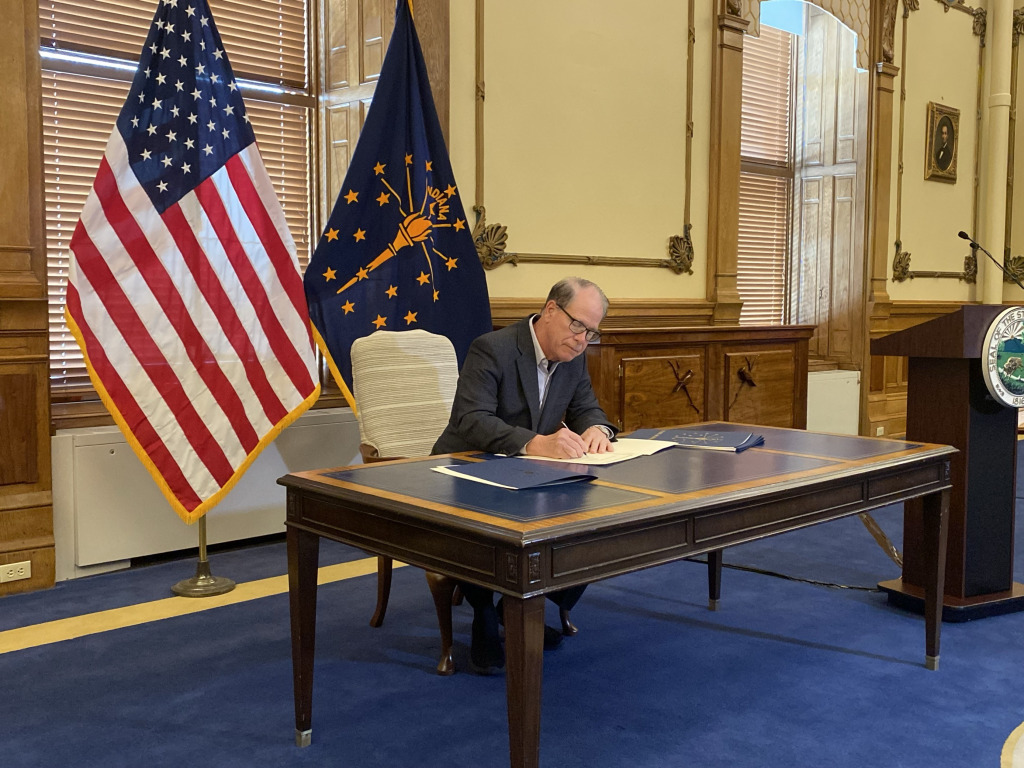
Gov. Mike Braun is requiring the nonprofit fundraising arm of the Indiana Economic Development Corp. to disclose years of missed annual financial reports.
On Tuesday, Braun signed an executive order requiring all state-affiliated nonprofit foundations and corporations to comply with mandated reporting requirements and catch up on all missed reports within the last 10 years, even if they were granted an exemption.
In a news release, the Governor’s Office singled out the Indiana Economic Development Foundation, which supports IEDC travel and business-attraction efforts, for failing to produce transparency reports.
“If organizations like the Indiana Economic Development Foundation were created to assist state agencies with public business, then Hoosiers need full transparency into how these non-profits operate, who funds them, and what they do with the money,” he said in a news release.
IBJ has reached out to the IEDC for comment.
The Indiana Capital Chronicle reported that the foundation received about $2.7 million in private donations from 2020 to 2022, but most donors were granted anonymity. The IEDC website lists 14 companies and entities, including several utilities and developers, as donors.
Braun’s office said the IEDF has not filed a required annual report with the State Budget Committee since 2019. In 2012, it received an exemption from the IRS for future filings of their Form 990, which would include information about donors, fundraising totals and expenses.
Under the executive order, the foundation will need to produce and post online all missed state and IRS forms before the end of the year.
Other nonprofits supporting state agencies include the Healthy Hoosiers Foundation, the Indiana Destination Development Foundation and the Indiana State Museum Foundation.
Retooling economic strategy
Braun also signed a pair of executive orders aimed at reworking the state’s economic development strategy, including designating wage growth and job creation as the state’s primary goals and redrawing economic development regions.
Executive Order 25-44 will require the number of jobs created and their average wages in all project and performance reports. The Governor’s Office said improving wage growth and job creation will now be the state’s “North Star” instead of planned capital investments.
Indiana’s wages largely lag behind those of other states. In 2023, only Marion County’s average wage was above the national average of $70,343.
From 2007 to 2019, Indiana’s median annual earnings increased 0.3% per year, reaching $34,300. In comparison, the national average was 0.6% growth per year, or $36,600.
Secretary of Commerce David Adams will also “start from scratch” to redraw how the state bundles areas to target workforce- and economic development initiatives under Executive Order 25-45. The Department of Workforce Development had previously grouped the state into 11 Economic Growth Regions.
The redrawn clusters will focus on common industry, workforce capabilities, infrastructure and natural resources.
Please enable JavaScript to view this content.
Here come the skeletons
He might want to include his own administration, like who paid for Lt. Gov. Beckwith’s new cyber truck? When asked the response was the classic political BS non-answer to the direct question “who paid for the truck?”
Indiana Hydrogen Ecosystem Initiative
PROJECT SUMMARY:
Over the last two years ESN has completed an extensive Indiana Hydrogen Ecosystem Report that details the economic, environmental, and innovation benefits of building out a hydrogen economy in Indiana. Hydrogen economy strategies and policies are becoming common place across the globe including in a number of US states (TX, OK, CA, etc.). Indiana has an opportunity to help shape and participate in this new energy marketplace drawing on some competitive advantages that exist in the state including a robust trucking and logistics industry and interstate highway network, large number of renewable energy developments (wind and solar) for green hydrogen production, access to an interstate ammonia pipeline, and a number of industrial use cases for hydrogen. Over the next two years ESN will lead the formation and begin the implementation of a hydrogen ecosystem pilot project that will move Indiana into a position of strategic leadership in demonstrating and validating this high growth global market opportunity.
The pilot project will focus on the following objectives:
Recruit and secure commitment from companies that want to part of an Indiana Hydrogen Ecosystem program with the goal of developing a commercial scale green hydrogen production facility (goal of ~50 MW electrolyzer co-located with a solar or wind farm)
Recruit and secure commitment from companies to develop small green ammonia plant on site (hydrogen to anhydrous ammonia)
Hydrogen corridor with H2 fueling station sites located along a major route in Indiana.
ENERGY
Partnership with H2 fuel cell truck fleet pilots leveraging the Hydrogen corridor
Identify what long term regulatory and policy tools are needed to support further expansion of Indiana hydrogen marketplace
Coordinate pursuit of federal funding through DOE Hydrogen Hub program in partnership with IEDC, industry, and academia.
Support Purdue research and analysis around the use of green hydrogen for industrial thermal needs, aviation fuels, and to green fertilizer to reduce CO2 footprint of ethanol.
Proposed Partners
Green Hydrogen Production Site: Cf Industries, Duke Energy, Koch Nitrogen, NuStar Pipeline, Avina, Hoosier Solar, Cummins, Itochu, BIC, Praxair
I-69 Hydrogen Corridor: Itochu, Toyota, Cummins, Avina, ANDRETTI GROUP, BIC
Andretti Apollo SPAC Fund 1 LP buys Wejo:
General Motors sold Hoosier drivers on using OnStar – then sold their data to raise rates – now Attorney General Todd Rokita is driving right through this deceptive collection plan
GM sold Wejo its customers’ Driving Data so that Wejo could sell licenses to other companies for access to the data. Under the agreement, GM authorized Wejo to pursue potential buyers for the Driving Data in other sectors, not just insurers.”
– Tod Rokita, Indiana Attorney General.