
Subscriber Benefit
As a subscriber you can listen to articles at work, in the car, or while you work out. Subscribe Now
While prices for some construction materials have decreased over the past 12 months, Kevin Hunt is confident telling his clients the cost of their projects isn’t likely to go down much more—no matter how much longer they wait.

The CEO of Indianapolis-based Shiel Sexton Co. has been working in the Indianapolis construction industry for more than 40 years. He said Shiel Sexton and other construction management firms across the state have had to have difficult conversations with customers over the past couple of years about coping with increased costs, driven in part by a slew of new development that is creating a shortage of available skilled labor.
And now tariffs—which are likely to impact building materials—are set to aggravate the building prices that had just started moderating.
The labor pinch has affected several developments across Indianapolis, with some builders shuffling projects to accommodate subcontractor availability, a few halting the start of work altogether and others forging ahead after securing additional capital to pay higher prices.
Just last month, the Capital Improvement Board of Marion County authorized spending up to $70 million more—a total of $571 million—on an 800-room Signia by Hilton hotel project, a 37-story tower that’s part of an expansion of the Indiana Convention Center’s footprint at Pan Am Plaza.

The 14% increase is almost entirely tied to labor for skilled trades like electrical, mechanical and plumbing, as well as HVAC, said Andy Mallon, the CIB’s executive director.
And while the Signia’s price hike might be the highest profile (in part because the project is a publicly financed one), other developments are facing similarly rising costs.
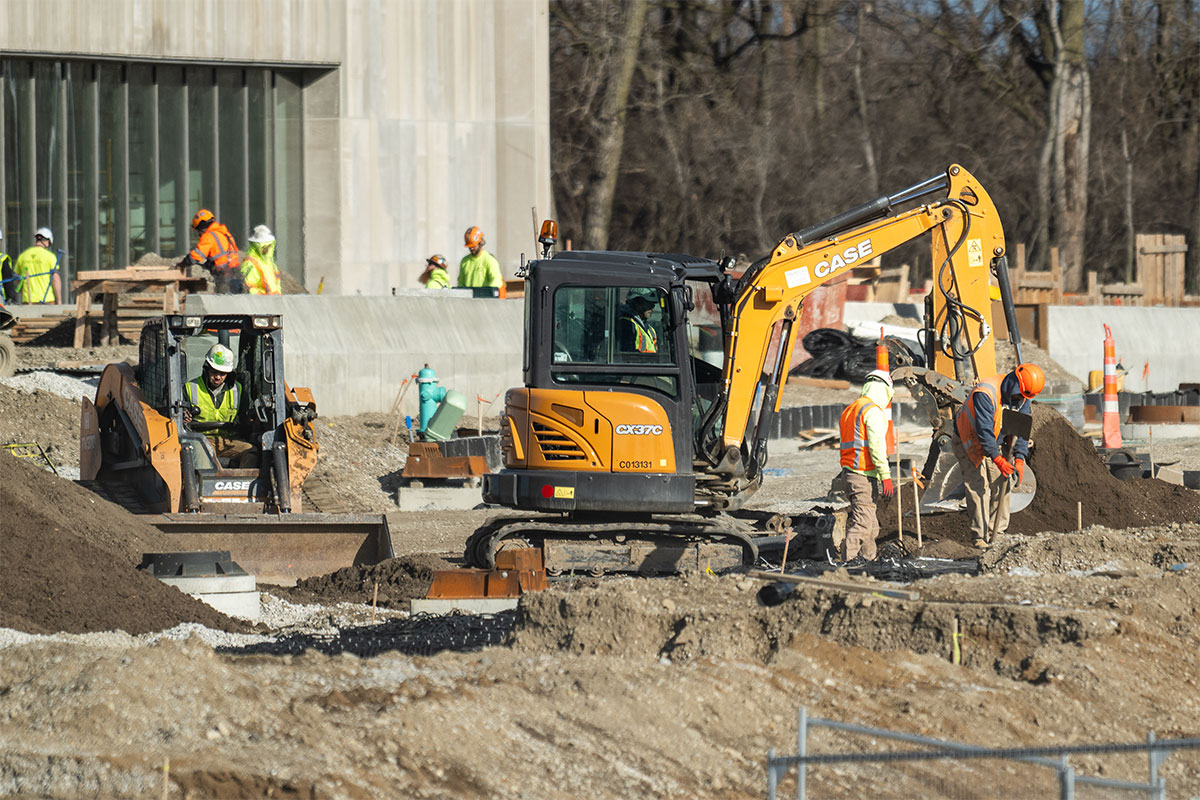
Hunt said most contractors can’t compete for labor with some of the biggest companies and projects underway in central Indiana, including the $7.5 billion battery facilities under construction by a Stellantis NV/Samsung SDI joint venture in Kokomo or Eli Lilly and Co.’s $13 billion campus being built in Boone County.
“They’re pulling so many people to those jobs that while those ones get funded and staffed, it also means the middle or smaller projects don’t have those electricians or drywall finishers, or whatever, available to bid on those jobs,” Hunt said. “So, with that, we are seeing a schedule and price impact on projects for sure.”
Leveling out
Mallon acknowledged those bigger projects played a role in driving up the construction cost of the Signia, which is being managed by Indianapolis-based AECOM Hunt. Mallon said the public bids for subcontractors came in far higher than what had originally been allotted in the construction manager’s guaranteed maximum price.
“We have a lot of a very specific types of work, with a limited capacity of big contractors that can do that kind of work,” Mallon said. “When there’s scarce supply of what you want to buy, it drives the price up, so we’re working through that.”
The CIB plans to cover the hotel’s cost overage through its reserve account, which in early February exceeded $203 million.
Shiel Sexton’s Hunt said he expects more price hikes will come over the next 12 months, particularly as other central Indiana projects get underway and the construction industry overall deals with tariffs on products from Canada, Mexico and China, which went into effect Tuesday.
“We’re starting to see prices eking up a little bit already,” he said. “I think we’re seeing some prices peaking up because of the uncertainty of the market.”
Hunt has seen prices pick up time and again as part of various inflation and labor cycles during his career. And so he knows that even when prices fall a bit, they never return to their starting points. He doesn’t think the current situation to be any different.
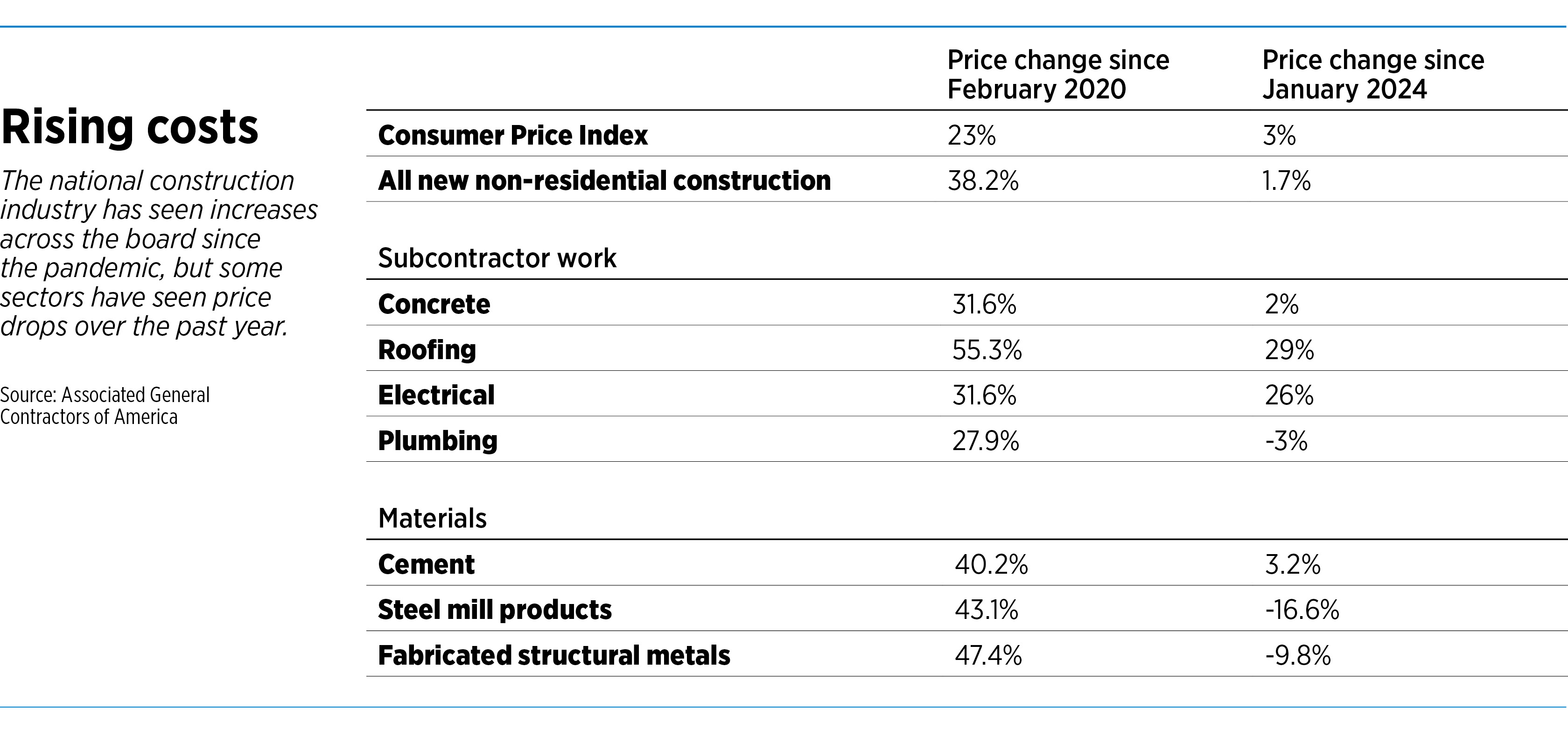
“We are in a little bit of a leveling period now, which is good,” he said, pointing to drops in costs for things like steel and concrete. “But we had some pretty big price hikes there, and once the prices jump up, it doesn’t matter if it’s lumber, drywall or concrete, they don’t come back down. We’ve in the new normal, for sure.”

Chase Smith, vice president of market rate development for Indianapolis-based TWG Development LLC, said while the company has mostly nailed down the costs anticipated for its project at Old City Hall, the conditions in the market have required more creative financing.
On Wednesday, TWG secured a $66 million bonded loan from the Indianapolis Department of Metropolitan Development for the project. That’s in addition to up to $17.9 million in tax-increment financing the city approved for the project in late 2023. The Indiana Economic Development Corp. has also secured $5 million in redevelopment tax credits for the now $249 million overhaul of the historic building and the construction of a new condominium, apartment and hotel tower.
“We feel like we’ve been able to keep a close eye [on price], between our architectural and engineering consultants and marrying that up with what the general contractor is seeing in the market in real time,” Smith said. “We’ll be at a point in the next few months to execute a guaranteed maximum price contract with those contractors, prior to construction start.”
‘Readying for the punch’

Paul Okeson, president of Terre Haute-based Garmong Construction, said manufacturers and suppliers have warned even higher prices are coming.
So far, he said, Garmong’s customers haven’t pushed back about increased costs. But, he added, “maybe they’ve changed what their desired outcome looks like a little bit to create a pathway towards more affordable project that still meets the needs of the community.”
In addition to the labor shortage, interest rates and the Trump administration’s plans for tariffs could drive prices for some materials higher, experts say.
For example, prices for steel and other structural metals have dropped from a year ago, according to data from the Associated General Contractors of America, a trade group representing construction firms. But a large amount of steel is imported from Canada and China, both countries on which President Donald Trump has imposed tariffs, meaning prices are likely to rise.
Andrew Urban, senior vice president of occupier services for the Indianapolis office of Toronto-based Colliers International, said those prices will be most impactful on larger projects about to get underway. “I think there’s a lot of risk out there,” he said. “I know some firms are trying to mitigate around it or stock pile materials—things like that.”
Course correction
While uncertainty remains for some aspects of development, including pricing, some construction managers said Trump’s return to the White House is helping rebalance the appetite for development more broadly.
Jeff Hagerman, chairman of Fishers-based The Hagerman Group, said there’s “more clarity” for construction in the second Trump term than there was after his election in 2016. He expects Trump to push for lower taxes and possibly an extension of an opportunity zone program that helps developers finance projects in areas designated as distressed. In addition, the Federal Reserve is expected to continue to reduce interest rates over time.
All of those changes could boost the construction industry, Hagerman said. But that’s not to say he and others aren’t keeping tabs on the administration’s policy decisions.
“I think our biggest concerns, that we’re keeping a very, very, very close eye on, are the tariffs, because that will have a big impact on our industry,” Hagerman said. “But other than that, we have a pretty clear view of what he’s going to try to accomplish.”
Despite the continued investments in projects across central Indiana, Hagerman expects a lull in new activity over the coming years, in part due to the higher prices from tariffs and labor shortages. That would be the first slowdown in development since the Great Recession, and Hagerman said it’s something that the industry might welcome.
“It’s just been so busy,” Hagerman said. “We need to hit reset. We need to catch our breath, hit reset and get refocused, because this industry has been running hard for [more than a decade] now. Every now and then a reset is a positive thing.”•
Please enable JavaScript to view this content.
Editor's note: You can comment on IBJ stories by signing in to your IBJ account. If you have not registered, please sign up for a free account now. Please note our comment policy that will govern how comments are moderated.