
Subscriber Benefit
As a subscriber you can listen to articles at work, in the car, or while you work out. Subscribe Now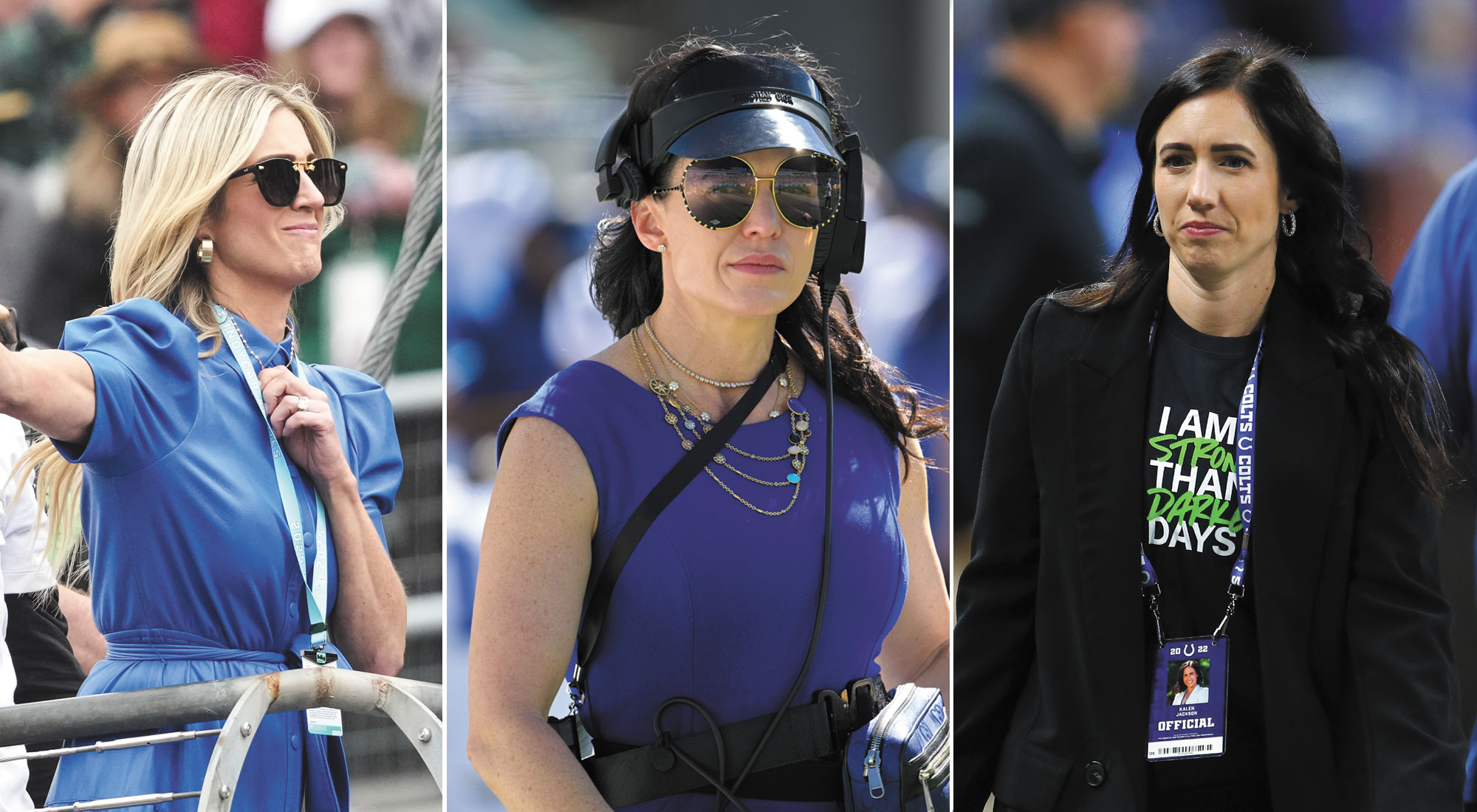
After spending the past decade-plus entrenched in their father’s $4.8 billion enterprise, Jim Irsay’s daughters are taking the helm of the Indianapolis Colts.
It’s a role the three women—Carlie Irsay-Gordon, Casey Foyt and Kalen Jackson—have spent their lives preparing for, but experts say succession in professional sports is always a challenge, regardless of the circumstances.
Irsay-Gordon, 44, is expected to assume her father’s position as controlling owner in the wake of his May 21 death. But Colts officials have so far remained mum about the ownership and leadership transition. A spokesperson for the team declined to comment for this story but said more information will be made public in the coming weeks.

“I don’t think it’s caught any of the daughters by surprise that they’re now thrust into this [new] role,” said John Holden, a sports law professor with the Indiana University Kelley School of Business.
“They obviously would prefer to have their dad there, still running the show. But I think they’ve been prepared for this. Yes, they’ll be doing that through their grief. … But having a familiarity with the other people there—this is a huge operation. It’s not like the whole thing falls on the three of them to run.”
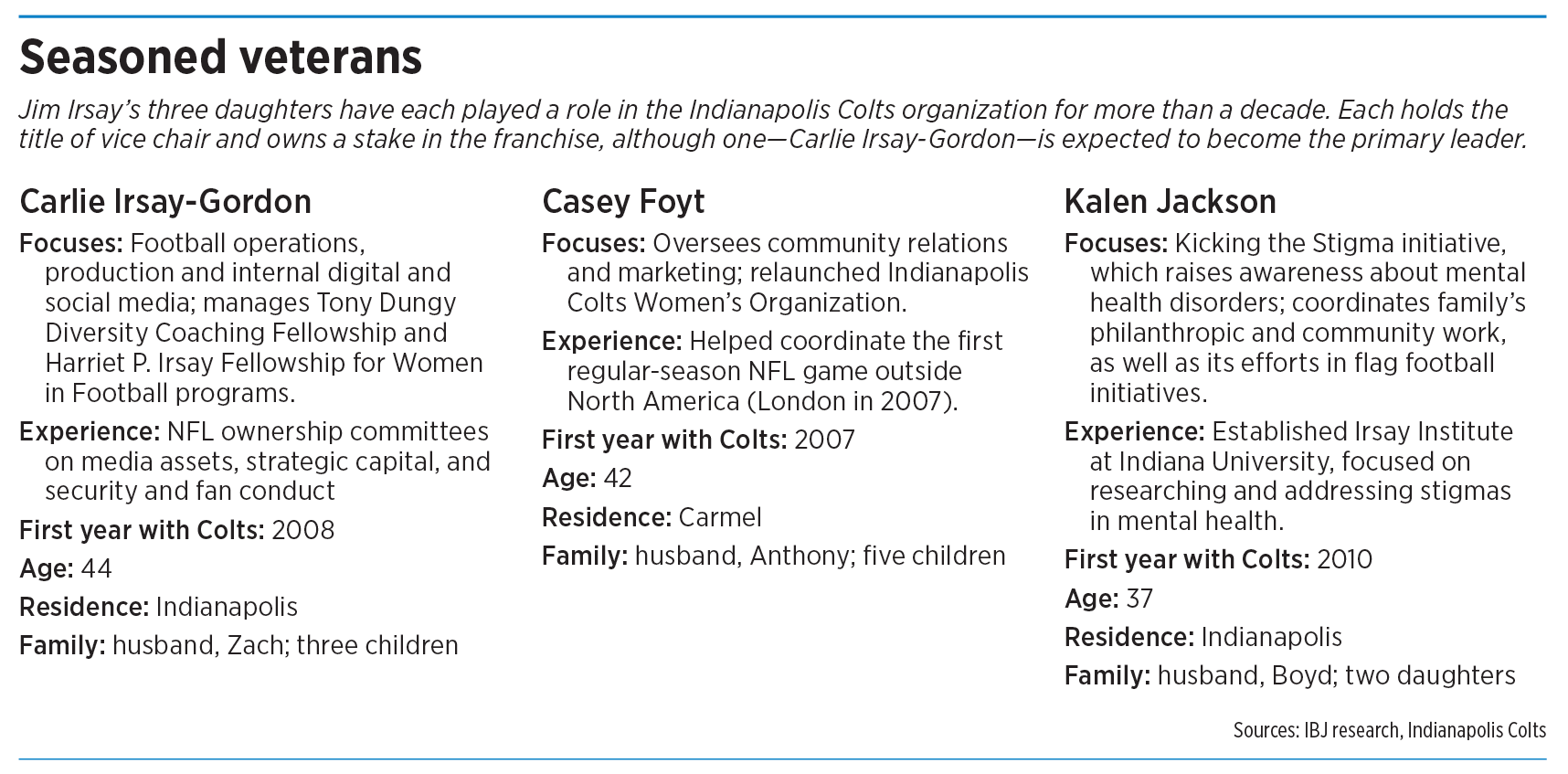
Holden said each sister’s longtime involvement in the team will be beneficial as the threesome moves the team forward. Foyt has had a role since 2007, Irsay-Gordon since 2008 and Jackson since 2010, each gravitating to different areas within the organization.
In addition to working on football operations, Irsay-Gordon is active in the team’s social media and internal production strategy and sits on multiple NFL ownership committees.
Jackson, 37, coordinates the family’s philanthropic and community work, and she leads the Kicking the Stigma initiative that raises awareness about mental health disorders.
Foyt, 42, manages community relations and marketing for the Colts.
The three grew up around the franchise. Jim Irsay began working for the Colts at age 23 in 1982, the year after he became a father and 10 years after his own father, Robert Irsay, bought the Baltimore Colts. In 1984, the Colts moved to Indianapolis, and in 1997, Jim Irsay became sole owner and CEO upon his father’s death.
Third-generation owners are a rarity across North American professional sports. The Colts now join only four other NFL teams—the Chicago Bears, New York Giants, Pittsburgh Steelers and Arizona Cardinals—and one NHL team, the Chicago Blackhawks, with ownership that has twice been passed down.
The Kansas City Chiefs and Detroit Lions are each in their second generation of ownership, with third-generation family members heavily involved in and expected to eventually take over those operations.
Marc Ganis, a sports business expert and principal of Chicago-based sports agency Sportscorp Ltd., said a family ownership legacy can be daunting, even in cases in which the family has been considered a good steward of a franchise.
“It’s actually quite difficult to be third-generation owners in sports, and it’s a thing that doesn’t happen very often,” he said.
For the Irsay family, he said, “it’s a challenge because they want to both recognize and be true to the legacy that their father left, and they want to be great partners in the NFL. But they are also going to want to make their own mark.”
Taking the wheel
Although Irsay remained the official head of the Colts organization until his death, his health problems in recent years have meant Irsay-Gordon and her sisters have already been taking on more responsibility.
In fact, Irsay-Gordon temporarily took over for her father in 2014 after he was suspended by the league following an arrest for driving while intoxicated. She’s also stepped in during other health crises that incapacitated her dad.
Because of that experience, Ganis said he expects a smooth transition, especially given that every NFL team is required to have a plan on file in the league’s offices.
Those plans are updated annually and, in instances where the team is being transferred to a family member, can be executed without a formal league vote. Owners can alternatively choose to place their team in a temporary trust until ownership is settled or have the team put up for sale.
While the documents are not made public by the league—and are generally kept private by the teams themselves—it’s widely assumed that Irsay-Gordon will step in to the leadership vacuum while her sisters remain on as team executives.

Katie Charleston, an Indianapolis-based succession planning attorney, said there’s “always potential for conflict” anytime multiple adult children are involved in succession discussions but the NFL’s approach and each of the daughters’ longtime team involvement will likely dissipate any drama for the Colts.
She said she expects the Colts and Irsay took great care in establishing an estate plan for his daughters, as well as a path forward for the franchise, including making Irsay-Gordon controlling owner. (While specific ownership shares are not known for each daughter, the NFL requires the controlling owner to own at least 1% of the team.)
“Irsay-Gordon has been likely the most involved and is the oldest, so I do see that carrying on, especially since Jim took the helm from his father,” Charleston said. “I think it is a foregone conclusion that it will be Irsay-Gordon that takes the lead, but I think all of them will continue to carry on in the entity. … I don’t anticipate many fights.”
Ganis added that he doesn’t expect a big shift in the team’s on-field approach or how roster decisions are made. That includes the ongoing matter of finding a long-term quarterback for the Colts—an issue that’s plagued the team since Andrew Luck’s surprise retirement in 2019.
“She’s not going to make the decision around the quarterback question,” Ganis said. “The general manager or the head coach [is] going to make [those] decisions.”
But Irsay-Gordon will make the decisions about team executives, he said. “So the ultimate responsibility will fall on her shoulders, but the best owners don’t” make player decisions, he said. “They hire great people to make those decisions.”
The sisters, experts said, can also lean on longtime team executives, including Pete Ward, who joined the Colts in 1982 and has held a variety of posts with the franchise, including his current role of chief operating officer.
They can also lean on relationships with other team owners, many of whom they’ve formed strong relationships with over the years by serving on committees and attending annual meetings, Ganis said.
Irsay “made sure that they had a lot of understanding [of the business] and the league knows them and they know the league,” he said. “They’re aware of the business; they’re aware of everything around the team. And he made sure they had first-rate executives with the team to help. Jimmy was very thoughtful about that throughout the last half dozen or so years, at least.”
Opportunities, challenges
As a business, the Colts are continuing to find ways to expand their reach. This season, the team has a game in Berlin as part of the NFL’s international series, and it’s mounted a marketing push in the country to begin setting roots for new fans.
Stateside, the team is also set to begin considering major upgrades to Lucas Oil Stadium, although formal discussions have not begun with the Capital Improvement Board of Marion County, which manages the 17-year-old venue.
The Colts are also evaluating their real estate holdings, including property south of the stadium that is generally used for parking on game days.
And team officials have been working with the city of Indianapolis and other local entities to bid on hosting an upcoming NFL Draft, which typically draws hundreds of thousands of visitors over a three-day period.
The family will also have to navigate federal tax codes tied to Irsay’s estate, although it’s unclear what the liability might be. Experts said a standard 40% federal tax on large inheritances means a hefty sum might be coming due for the daughters.
If the elder Irsay’s assets were placed in a trust, they’d be taxed based on the difference in value between when the assets entered the trust and when they’re transferred to his daughters, the attorney Charleston said.
She said the NFL also allows private equity firms to acquire minority stakes—from 3% to 10%—in clubs, which could help generate funds to pay off any estate taxes. Likewise, the family could sell other portions of the company to additional investors.
The Buffalo Bills recently added 10 investors, which the NFL calls limited partners, to its ownership group.
“That would allow for some capital injection for liquidity … if the family doesn’t have sufficient cash flow to pay the taxes,” Charleston said of bringing in others. “There’s also other types of asset structuring and refinancing that could be done, so there are ways around it. I haven’t seen any sign of that being an issue specifically, but it’s definitely a potential option if needed.”
Ganis, the sports consultant, agreed. He said with smaller stakes in clubs now a popular way to raise capital, he wouldn’t be surprised if Irsay’s daughters considered the route. But the Irsays have never expressed any interest publicly in selling the full franchise.
“Whether it’s for tax purposes or otherwise,” he said, selling small ownership shares “is a trend in the league, so it wouldn’t be any real surprise to see the Colts participate in that trend when they feel the time is right.”•
Please enable JavaScript to view this content.
I believe the sisters will do a great job running the team!
sold within 2 years……………
What %? My guess is that they will sell 25%.
They should sell a % to pay a share of the imminent upgrades to LOS that the Colts will demand. If these billionaires are such great corporate citizens, then provide the taxpayers some relief and dedicate a small % of those PSDA dollars to fix downtown’s real problems – the homeless and the roads. This will require changes at the Legislature but no reason it can’t be done.