
Subscriber Benefit
As a subscriber you can listen to articles at work, in the car, or while you work out. Subscribe Now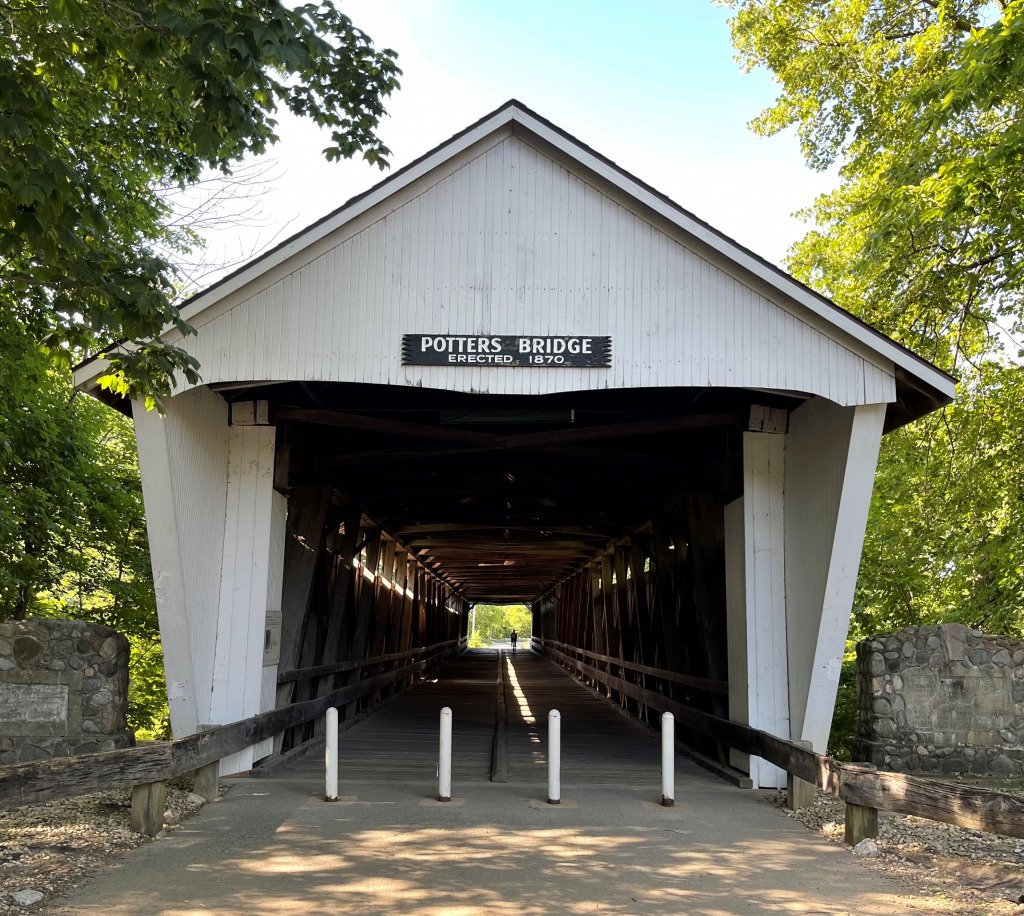
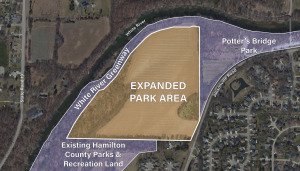
The Hamilton County Parks and Recreation Department plans to expand Potter’s Bridge Park in Noblesville now that it has acquired 50 acres of land where a local firm unsuccessfully sought to dig a gravel pit.
The land acquisition along Allisonville Road, north of East 191st Street, will increase Potter’s Bridge Park to 125 acres and unite the park’s property, which had been disconnected.
The expanded area includes 10 acres of riparian buffer—trees and plants along a waterway—which will be preserved to protect the health of the White River ecosystem and the surrounding environment, according to the county parks department.
The Hamilton County Parks and Recreation Department has not yet developed a timeline for when the property will be available for visitors.
“This is so new that we do not have any solidified plans for this space,” Hamilton County Parks and Recreation Department Resource Development Specialist Erica Foreman said. “There are many possibilities we are currently daydreaming about, but we still need to do more research and decide what amenities will best fit the needs of the community.”
In November, the Hamilton County Council approved a $920,000 appropriation to allow the Hamilton County Parks and Recreation Department to purchase the 50 acres from CAB Real Estate LLC, a firm established by Beaver Materials President Chris Beaver. The parks board approved the land acquisition in November, and the transfer was completed Dec. 9.
CAB Real Estate LLC purchased the property adjacent to the Potter’s Bridge Park in late 2020 for $610,200, according to Hamilton County property records.
Potter’s Bridge Park was established after the Hamilton County Parks and Recreation Department in 1972 purchased the covered bridge that gives the park its name. The 153-year-old structure built during 1870 and 1871 is the last remaining covered bridge in the county. It was restored in 1999.
The park, which contains 3-1/4 miles of the White River Greenway Trail, grew in 1995 after the parks department purchased 30 acres from Emily Morrison and Family, according to the department’s website.
In 2020 and 2022, Noblesville-based Beaver Materials approached the city with plans to dig a gravel pit on the property that will now become part of Potter’s Bridge Park. The company withdrew the plan in 2020 following public opposition, and members of the Noblesville City Council voted 7-2 against the gravel pit proposal in June 2022.
Had the gravel pit plan received approval, Beaver Materials would have immediately donated 10 acres of land to Hamilton County Parks and Recreation. The company would have then spent five years removing gravel from the remaining 40 acres—down from the 10 years that was originally proposed and dropped in 2020.
After five years, the land would have been given to the county parks department and the pit would have been turned into a lake.
However, the plan met opposition from residents who formed the group “Don’t Leave it to Beaver.” Residents expressed concerns about the city’s drinking water, pollution, dust, and increased traffic caused by work trucks moving in and out of the area.
Please enable JavaScript to view this content.
Huge win 👏🏼👏🏼
Beaver gets a 50% profit on land owned for about 4 years. Land it would have donated to the city in another few years if it had been allowed to open the quarry. Central Indiana tax payers and residents will pay higher prices for construction because Beaver can’t dig for sand and gravel near where it’s needed, and so it has to be found in further locations and trucked in…at higher prices.
So tell me who won?
It’s pretty obvious that the immediate community won. I’d wager you would oppose a GSB by your residence despite the potential for a minor cost savings measure.
Keeping a gravel pit away from a residential area was a win for citizen taxpayers who had to remind the City (Noblesville) to stick to the Comprehensive Plan and UDO. And, reasoned Common Councilors affirmed the same 7-2 in 2022.
actually, Murray R., I live in Cherry Tree Meadows and supported the quarry on Cherry Tree Road. So tell me what your wager was, and we can arrange to meet and I’ll collect. I assume your wager was substantial, given your extremely presumputuous attitude. $1000 was it? $5000? Obviously a man of such certainty of belief wouldn’t enter into such a wager for a paltry sum…
a short-term, Pyrrhic victory. NIMBYISM at its finest. These are the folks who will likely scream loudest when the costs of repaving roads, installing and fixing sidewals, doing anything that requires concrete or asphalt, causes their property taxes to rise…
There’s a reason municipal leaders like mayors and planning administrators and department staff keep supporting these efforts. It’s because they look to the future and know the lack of viable sources of basic building materials will mean substantially increased pricing, especially in places like Noblesville where new construction, new streets, new sidewalks, new concrete in buildings, new asphalt for the roads, will call for more and more of these basic materials for years to come. Well past the terms of the Council members and Commissioners.
Planning documents are great…but God wasn’t consulted about them before He decided where to put the sand and gravel. He wasn’t part of the planning that put housing where he put the sand and gravel. And He put it there long before the first subdivision was platted.
As was noted on the Cherry Tree project, you can’t dig for sand and gravel where it doesn’t exist. You have to go where the sand and gravel are in the ground. Plan away, but keep those basic facts in mind.
It’s interesting the neighbors protested a five year inconvenience. By the the time 146th and Allisonville is finished, it will be almost that long, but I dont’ recall anyone protesting five years of inconvenience. Or the I-69 project. Or the ongoing project to widen 32 from Noblesville to US 31, that will be back again for the next few years. Or the Pleasant Street Extension.
So yes, I’m more than a bit skeptical about motivations when I hear about inconvenience. More and more, it feels like NIMBY.
still waiting to hear from Murray…
while I’m waiting on Murray R to not welch on his wager, I offer an additional thought…
If the residents of the Potter’s Bridge Park area were the winners, and because of their “win” the rest of Noblesville taxpayers had to pay out almost $1M for the property we’d have gotten for free, can we have a special assessment of those neighborhoods to pay the $1M. Otherwise, the rest of Noblesville are the losers. Why should I pay for land that is set up to benefit only the folks in those neighborhoods? They’ll cost me twice…once for the increased costs of gravel and sand in the future, and now for tax funds to pay for their petulance. I recall that’s a neighborhood of pretty nice housing…they can afford the bill they’ve dropped on all of us…
Now that’s actually not a terrible idea. I was just talking this morning about Noblesville & Westfield residents complaining about their property tax rates but then voting against every possible item that could help reduce them. This is slightly different, but maybe we should offer for those who oppose every kind of development the opportunity to put their money where their mouths are.
There are a few facts absent from Mr. Timothy’s familiarity with the Potter’s Bridge “win”. Safety of water supply was the key issue. American Water’s position in 2020 forced Mr. Beaver to pull his application and secure a hydrology study. In the subsequent hydrology study (2022) it was revealed that if contamination occurred (heavy equipment, industrial products) it could take anywhere from 3-7 years for the contamination to reach American Water’s wells. And if such an event happened (after the donation of land) it would have been American Water that performed the remediation. The cost of such then would have been passed on to all American Water customers. Yes, cost (future costs) was at the center of that project—the risk was too high; a premium was placed on safety. It was a win for all residents, not just a neighborhood.