
Subscriber Benefit
As a subscriber you can listen to articles at work, in the car, or while you work out. Subscribe Now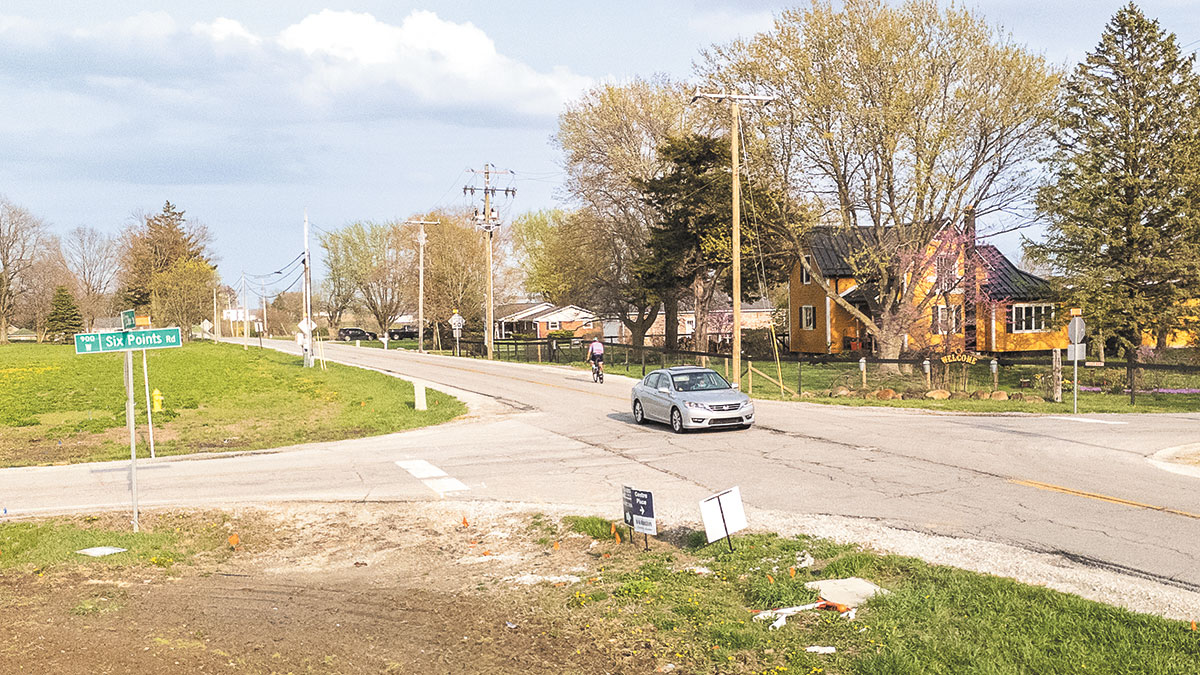
It’s a daunting sight to see a semitruck coming your direction on narrow West 236th Street as you head west toward downtown Sheridan. Can your car and that truck get past each other without scraping?
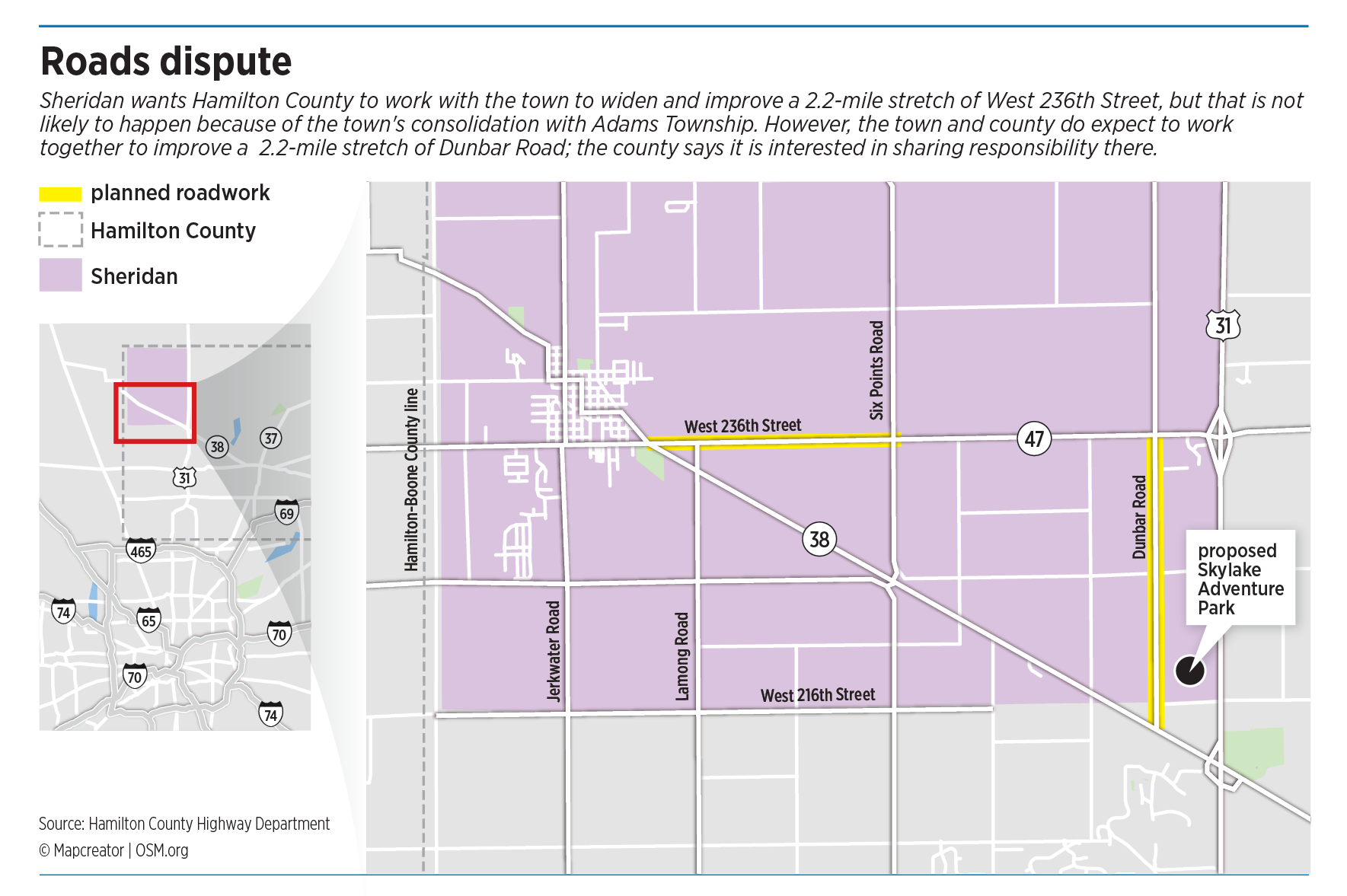
That basic safety question is at the heart of a desire by Sheridan leaders to improve and widen a 2.2-mile stretch of West 236th Street from State Road 38 to just east of Six Points Road.
“It is a very dangerous road,” Sheridan Town Council President Silas DeVaney III said.
But hoping to reconstruct the street and being able to do it are two different things.
Before last November, Hamilton County officials earmarked West 236th Street as one of four road projects in Adams Township that would receive a portion of $23 million in federal road funding the county won after a seven-year application process with the U.S. Department of Transportation.
The county’s plans changed, though, after voters in Sheridan and Adams Township approved a controversial reorganization plan that consolidated the town and township. The change took effect on Jan. 1.
Previously, Sheridan covered about 2 square miles mostly north and west of the intersection of State Road 38 and West 236th Street (which is also State Road 47), while Adams Township comprised 48 square miles—from the northern and western county lines, east to U.S. 31 and south to West 216th Street. Now, that entire area is the town of Sheridan, which makes it the second-largest community geographically in Hamilton County. Carmel is the largest.
Sheridan had about 20 miles of roads under its jurisdiction before the reorganization. Now, it is responsible for maintaining 100 miles of roadways.

“There’s a lot of money involved,” Hamilton County Highway Director Brad Davis said. “The county has spent a lot of money up there every year for the past who knows how long. [Sheridan officials] don’t, I don’t think, have the ability to generate the kind of money that the county has spent there.”
In interviews with IBJ, each of the three Hamilton County commissioners—Christine Altman, Steve Dillinger and Mark Heirbrandt—said they told Sheridan and Adams Township voters as well as town and township leaders that if the merger vote passed, roads incorporated into the consolidated town would no longer be the county’s responsibility.
County officials don’t get involved in city and town road projects unless there is a special circumstance, such as when a project’s potential for economic impact goes beyond the city or town and is positive for a larger part of the county.
Therefore, the commissioners said, the county would not move forward with the four Sheridan projects it had previously earmarked for work.

“It’s not that we don’t want to do it, but it wouldn’t be fair to do their roads when we don’t do Noblesville or Carmel or Fishers,” said Dillinger, who grew up in Sheridan. “I told them right upfront. I said, ‘Look, if you decide you want to do [the consolidation], that’s fine, but I will not support doing your roads because I don’t think that’s fair to the other taxpayers in the county.”
In last November’s election, Sheridan residents voted to merge the town and Adams Township, with a 73% to 27% vote. Voters in Adams Township outside the town limits approved the merger 62% to 38%.
The reorganization gave Sheridan planning and zoning control over an area that was unincorporated and under the jurisdiction of county planners. The town’s population increased from about 3,100 to 5,200.
The expanded town now has two taxing districts. Land inside Sheridan’s current town boundaries is the “town zone.” What was the rest of Adams Township is the “rural zone.”
According to reorganization documents, the town’s property tax rate will increase next year by about 8 cents per $100 of net assessed value (about $160 a year for a house with a $200,000 net assessed value) to cover additional road maintenance costs. The increase affects both taxing districts, but each is different.
The town-zone rate will increase to about $2.91 per $100 of net assessed value, while the rural-zone rate will rise to $1.93 per $100 of net assessed value.
Specific requirements
The county has turned over most of the $23 million in federal road funding to the Indiana Department of Transportation to be redistributed to other road projects around the state.
The county could not simply transfer the dollars to Sheridan because the town would have had to provide matching dollars as the county did in its application. The county committed to a local match of about $16 million for the projects. That is not something town officials said they could afford.
Despite their earlier comments, the county commissioners have proposed to work with the town to widen and reconstruct Dunbar Road, on the east side of town, just west of U.S. 31. That’s one of the projects that had qualified for federal money.
County officials changed their minds because a developer proposed building a $100 million resort waterpark called Skylake Adventure Park along West 216th Street between Dunbar and U.S. 31, which would benefit the entire area. Dunbar Road does not have the capacity to handle the traffic the park would bring.
DeVaney saw a potential opening then for county participation in the West 236th Street project. He said town officials asked commissioners to include the widening of 236th in the Dunbar interlocal agreement, but the commissioners refused.
The town initially offered to pay the matching share for West 236th Street, which Sheridan officials thought was $1.7 million. But the county said the matching share was actually $7.8 million, which DeVaney said was out of the town’s price range.
Next, he said, the town offered to apply for federal funds on its own for the West 236th Street widening so the project could be included in the Dunbar interlocal agreement. Again, he said, the county refused.
“We want to work with the county,” DeVaney said. “We just can’t get them to, and we haven’t asked for anything other than to work with us. We’ve never asked for a handout.”

For Hamilton County to be involved in a road project outside its jurisdiction through an interlocal agreement or a joint application for funding, the county commissioners consider factors like traffic counts, crashes, emissions and economic impact.
Examples of times the county has worked with cities on road projects include the Interstate 69 interchange at East 106th Street in Fishers, the intersection of East 96th Street and Keystone Avenue in Carmel, and roundabouts along East 191st Street near Grand Park Sports Campus in Westfield.
“It’s been strategic on those type of investments because cities and towns, if you have the right population numbers, can generate substantial amount of tax on their own,” said Altman, previously an attorney for Adams Township. “That’s why you’ve got to do the numbers before you annex or consolidate.”
The county has jurisdiction over 146th Street in Carmel, Noblesville and Westfield and Olio Road in Fishers and Noblesville and manages road projects on those thoroughfares.

“We really try to look at the impact and how it’s going to be beneficial to the number of constituents that we have in the county and where it’s best to do [them],” Heirbrandt said. “There’s a lot of thought that goes into it whenever we go after funding.”
DeVaney said he hopes the town and county can still work together on road projects, but he is frustrated that West 236th Street is off the table.
Potential opening
County commissioners remain open to partnering with Sheridan through an interlocal agreement to widen Dunbar Road, a $21 million project that would use some of the federal dollars originally allocated to other Sheridan projects, according to Davis, the county highway director.
The county has an interest in that project because it expects the surrounding area to experience development thanks to the $65 million Hamilton County Regional Utility District under construction along U.S. 31 that could eventually stretch from 216th to 276th streets.
Hamilton County previously widened a different section of West 236th Street west of U.S. 31, which followed the construction of a new highway interchange.
Monarch Ventures LLC, a division of Carmel-based Circle Property Group, wants to build Skylake Adventure Park on 126 acres of agricultural land just west of U.S. 31. A rezoning request for the project received a favorable recommendation last week from the Sheridan Plan Commission, and the request is scheduled to return to the Town Council next month for consideration.
The company describes the adventure park as an “all-season, outdoor, nature-based adventure experience and entertainment destination for all ages” that would feature a 6-acre lake with water slides, an inflatable obstacle course, kayaks, floating cabanas and a splash pad. It would also include a tree-top canopy experience with ropes; mini-golf and disc golf; a 400-foot, year-round tubing hill; and indoor and outdoor activity spaces for private and corporate events. Commercial and retail buildings could also be built along Dunbar Road.
Hamilton County has an interest in Skylake Adventure Park because the park would connect to the utility district, which currently lacks major users, aside from the Indiana National Guard’s Hamilton County Readiness Center under construction at U.S. 31 and East 276th Street.
“Dunbar would be vital for something like that,” Heirbrandt said. “They really would need to have [the Dunbar Road widening] done. That would be a critical piece of infrastructure that will benefit Sheridan significantly.”•
Please enable JavaScript to view this content.
Can someone explain: if 236th St. is SR47, why isn’t the State funding the safety improvement/widening of the road?
Then, can some county commissioner explain how the County contributing significantly to the “local match” for SR37 rebuild in Fishers is any different? (In view of the claim that it isn’t fair to taxpayers in Fishers and Noblesville for the County to contribute to Sheridan SR47 project?)
C’mon Commissioners…get over your petty feud with Sheridan folks and be leaders for the whole county.
I’ve read that INDOT has a cap of the miles of road it can maintain. So at times, they do try to pass roads onto local governments. Keystone north of 96th was a INDOT maintained road until Carmel took it over in 2007.
In looking at the INDOT maps, it appears SR 47 terminates where it meets SR38, which would lead me to think that the proposed project that the IBJ article is talking about is a county-owned and maintained road. To back this up further, you can see a previous INDOT project for SR 47 just east of this area on their website (second link below)
As to your question to the county commissioners about why they aren’t contributing to this project rather than other projects in the County, I think Commissioner Heirbandt’s quote about the county weighing a project’s beneficial use to all county residents is one of their key deciding factors when determining whether to provide county funding or not.
INDOT Map: https://www.in.gov/indot/files/Greenfield-Distict-RP-map2025.pdf
INDOT SR47 Project: https://www.in.gov/indot/about-indot/central-office/welcome-to-the-greenfield-district/sr-38-and-sr-47-improvements-within-the-town-of-sheridan/
The map is incorrect labelling 236th east of Sheridan as SR-47. After entering from the west, SR-47 terminates at the the SR-38 intersection. I don’t know historically if SR-47 extended further east, but it has not in the 15 years I have lived in central Indiana.
The funding situation is similar to Town of Winfield up in Lake Co. Town was established in the early-’90s to ward off possible annexation by Merrillville, but didn’t have means to handle road maintenance, including plowing, in the area of township it annexed and still barely can. That was with an interlocal for assistance from the county.
because the state doesn’t fund roads in and around Marion County and the surrounding counties…that would not comport with the state’s goals of only spending money making certain rural county roads are in great shape, and ignoring the roads in the heavily populated counties. Even in Hamilton County, which votes Republican. Which maybe makes some wonder why Hamilton County votes Republican, if Republicans at the state legislature won’t help support them…
I realize that the county is angry over the Sheridan consolidation. But the right long term move is for the county to take responsibility for 236th St. as a cross-county corridor (perhaps excepting downtown Cicero), the same way it has for 146th St. This is the next major cross-county arterial north of SR 32. As with 146th, the county can leverage taking over responsibility with planning commitments that ensures development along the road is appropriate and doesn’t result in something like the state of Rockville Road in Avon.
The long term challenge is the constraint at Morse Reservoir and Cicero, where the county and town will have to do some long term planning.
This (County should take responsibility for 236th) is especially true since the State put an interchange with US31 at 236th, and the County put in a sewer and water utility to serve the area. Pulling the funding back was a childish maneuver.
146th is a cross-county corridor because it is a county line road. 236th is not.
146th is not a county line.
Both 146th and 236th run all the way across Hamilton County west to east.
I don’t understand how The Commissioners think that the North-South road serving this development is important enough on a county level to get involved with funding improvements, but the East-West road serving it isn’t.
Wasn’t some of the reasoning behind Sheridan’s merger with Adams TWP to get away from annexation by “big, bad Westfield?” Funny how things can have unintended consequences.
This merger was not well thought out or planned. Sheridan doesn’t have the financial resources to make it work. It will be a beggar town for some time to come.