
Subscriber Benefit
As a subscriber you can listen to articles at work, in the car, or while you work out. Subscribe NowIn Indianapolis, Cam O’Connor is a pioneer of placing stand-up comedy in nontraditional settings.
O’Connor has told jokes and produced shows at bars, pizzerias and coffee shops since 2011, when his Rocketship Comedy brand launched a weekly show at the bygone Sinking Ship bar near the intersection of East 49th Street and College Avenue.
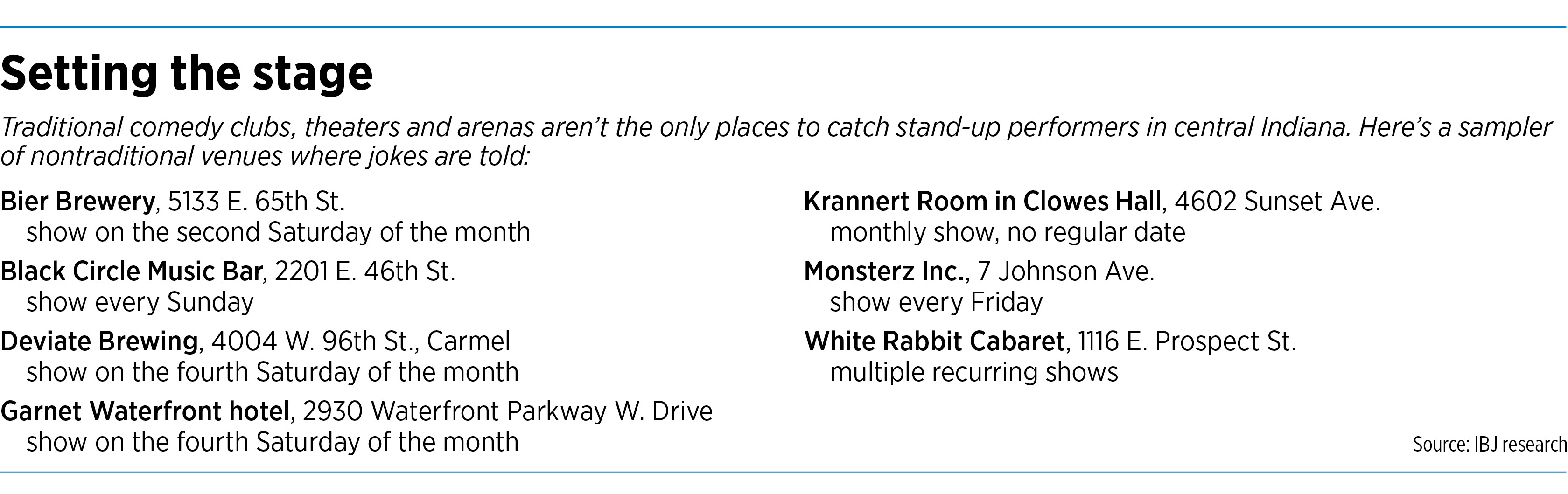
His current roster of shows, including a weekly event at Black Circle Music Bar near the intersection of East 46th Street and Keystone Avenue, offers a contrast to conventional clubs and larger venues.
The local landscape changed in February with the exit of Crackers Comedy Club, a fixture in Indianapolis stand-up comedy since 1982. Helium Comedy Club, 10 W. Georgia St., continues to host high-profile touring acts, and the Comedy Attic in Bloomington is viewed within the industry as one of the best clubs in the United States.
Central Indiana arenas and theaters present the biggest names in stand-up, with comics such as Katt Williams, Jim Gaffigan and Taylor Tomlinson on the way this year. But the comedians who can carry such big shows are just a small part of the comedy scene.
O’Connor is one of several independent producers working outside the context of the two-drink minimums and brick-wall backdrops associated with comedy clubs.
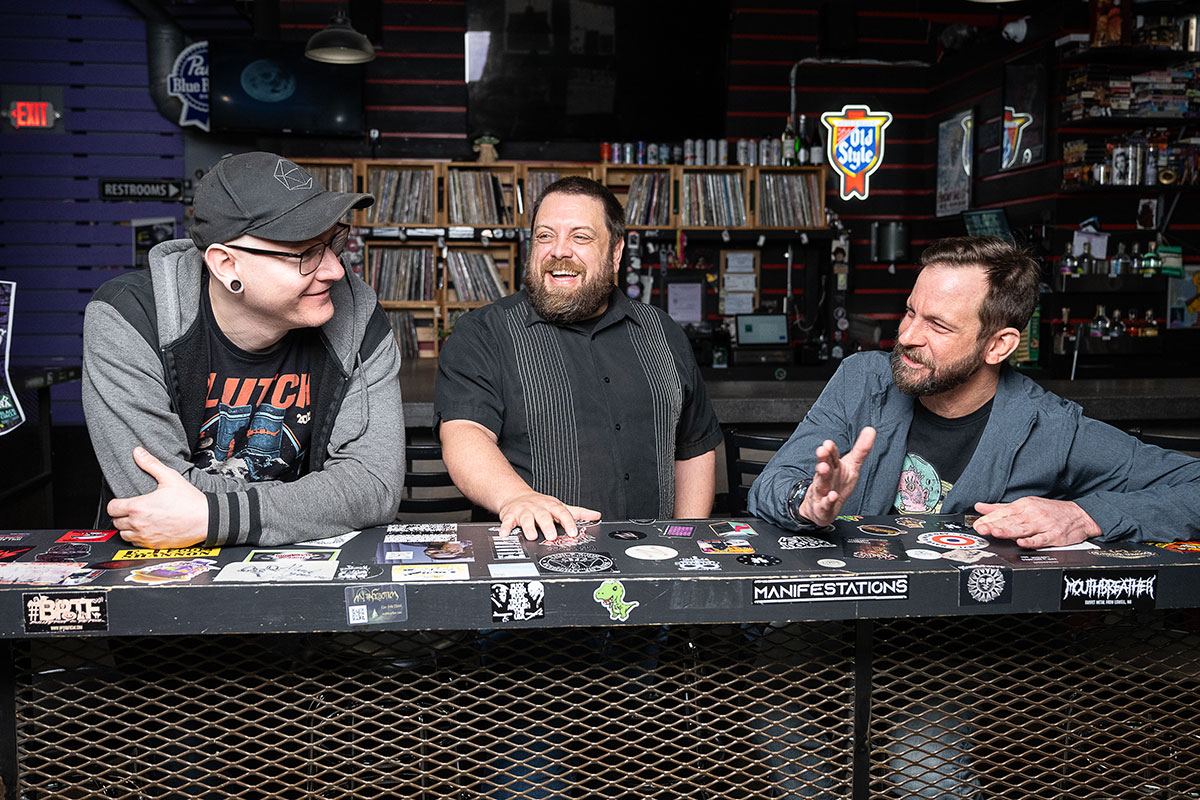
He collaborates with fellow comedians Tyson Cox and Dustin Burkert to organize “The Sunday Show” at Black Circle Music Bar.
“I love convincing a bunch of people to come watch a show, convincing the comics to do the show, and then watching them connect,” O’Connor said. “People will say, ‘So-and-so is next. I can’t wait to see how this goes.’ Watching that is so fun. Honestly, that’s why you do it.”
“The Sunday Show,” which features free admission, could be considered a descendant of Rocketship Comedy’s night at the Sinking Ship. Broad Ripple venues Sabbatical, which closed in 2015, and the Alley Cat also hosted similar Rocketship nights through the years.
O’Connor, who grew up in Valparaiso, said he founded the Sinking Ship show because he wanted to work his way up the structure of a traditional stand-up bill—from host to supporting act to headliner.
“I needed more chances to get on stage and learn how to host, so a club would let me host there,” O’Connor said. “I started my show, where I had some rough hosting spots. But I got thicker skin and became really good at hosting.”
O’Connor eventually left Indianapolis for a few years to work in the management of Go Bananas comedy club in Cincinnati. While O’Connor was away from Indiana, nearly a dozen comics kept the Rocketship name alive by producing recurring shows at several venues.
Today, “The Sunday Show” at Black Circle is regarded highly enough that touring comics contact O’Connor and request spots on the bill.
“‘The Sunday Show’ is not a big payday,” he said. “But if you’re in the area and passing through, it’s worth your time to come hang out and do that show.”
Beer-focused settings
Brent Terhune and Dwight Simmons are two Indianapolis-based comics who hit the road to perform at comedy clubs in other states. When Simmons headlines in central Indiana, he frequently sets up shows at venues that aren’t comedy clubs.
Simmons is scheduled to perform April 18 at Fonseca Theatre Co., 2508 W. Michigan St., followed by an April 19 date at West Fork Whiskey Co. in Westfield.
Although dart games and televised sports are potential competition for an audience’s attention when stand-up is presented in bars, Rocketship works with Black Circle as well as with Bier Brewery, 5133 E. 65th St., where shows happen the second Saturday of every month.
Cox, one of the organizers of “The Sunday Show,” operates Laughing Pint Productions with fellow comedian Cavin Eggleston. As the name suggests, Laughing Pint specializes in comedy presented in beer-focused settings. Deviate Brewing, 4004 W. 96th St., hosts a Laughing Pint show on the fourth Saturday of every month.
Eggleston, who previously worked near Seattle as a high school English teacher, and his wife moved to Indianapolis because of its proximity to comedy clubs in the Midwest, its affordability and its comedy community.
“We have such a fantastic crop of newer comics coming up,” Eggleston said. “The teacher part of me gets really excited about that. I love seeing newer comics find their voice. I would love to see either an independent club or a smaller club open that’s very friendly to locals.”
Fountain Square’s White Rabbit Cabaret isn’t a comedy club, but the venue is known for its support of comedy. White Rabbit, which celebrates its 15th anniversary this month, fills its schedule with a mix of music, burlesque and comedy events.
Co-owner Debra Silveus McGaha said one reason for the rise of independent comedy shows is that Indianapolis is home to more comedians doing higher-quality work than in previous years.
Because White Rabbit Cabaret, 1116 E. Prospect St., attracts a variety of customers, Silveus McGaha said crossover promotion happens naturally.
“We’re servicing different crowds,” she said. “If I have a dance show, people might notice an advertisement for a comedy thing at my venue they might be interested in. Maybe they wouldn’t have necessarily thought that’s something we offer.”
Welcoming stage
Brian Posehn, Rory Scovel, Nick Thune and other touring comics have performed at White Rabbit on bills produced by Indiana-based Let’s Comedy.
White Rabbit also is the site of comedic concept series such as “Mock Trial” and “Monster Monster.”
“It’s a courtroom setting,” Silveus McGaha said of “Mock Trial.” “The audience is the jury, and one of our local comedians, Stephen Vincent Giles, is the judge.”
“Monster Monster” is a Dungeons & Dragons-themed show at White Rabbit that’s organized by Laughing Pint’s Cox.
Cox described “Monster Monster,” presented on the second Tuesday of every month, as an example of collaborative storytelling in which comics pursue irreverent adventures with the help of audience participation.
“My favorite compliment is when people say, ‘I’ve never played D&D, but that seems like so much fun,’” he said.
Cox credits social media for making it possible for underground comics to connect with audiences.
“There used to be a lot of gatekeeping in comedy, where you had to impress one of these three people to get anywhere,” he said. “That’s kind of gone away. With the advent of social media, it’s now so much easier to get seen. That’s the good side of it. The downside is, there’s also so many more people being seen. That provides its own hurdles, but you can now find your own community and build up a fan base.”
Keep it confidential
There’s a secretive side of the independent comedy spectrum, too. Don’t Tell Comedy is a national concept that’s been presented in central Indiana since 2018.

“It’s a pop-up comedy show where the location is kept secret and the lineups are kept secret until the day of the event,” said Peter Ostapowicz, Midwest regional manager for California-based Don’t Tell Comedy.
“If you’re going to a show on Friday, you would see the date and time and that it’s happening in downtown Indianapolis,” he said. “But you wouldn’t know the location until you receive an email, and you wouldn’t know the lineup until you saw them onstage.”
Ostapowicz said the Don’t Tell format is so casual that he’s seen attendees bring pizzas into a show.
“If you’ve been to a comedy club, you know there’s a lot going on in the audience,” he said. “People are talking at tables. They’re ordering drinks and food. Servers are coming around. A Don’t Tell show has more of a DIY feel because it’s in a nontraditional space.”
Past sites of Don’t Tell shows in central Indiana include Cargo Streetwear Boutique in Fountain Square and 317 BBQ in Broad Ripple.
Laughing Pint’s Eggleston serves as the Indianapolis producer for Don’t Tell.
“Part of my job is just going around and seeing places that I think might be interesting,” Eggleston said. “I usually dedicate a day of the week to driving around Indianapolis to find someplace that catches my eye.”
‘A positive direction’
Comedians O’Connor, Cox and Eggleston all said they’re fans of comedy clubs.
“There’s nothing else to compete with the way a comedy club feels,” Eggleston said. “Everyone is there for the same purposes: to laugh, have fun and have a really good show. Comedy club audiences are so easy, generally, to get on board with the idea of comedy. You can’t really walk into a Helium or a Crackers and be surprised that comedy is happening.”
When asked if he would be interested in managing a comedy club, O’Connor said that’s a role he’s spent the last 14 years “accidentally training for.”
“If I had some hand in the creative control or the operations of an independently owned comedy club in Indianapolis, I would feel very good about almost everything in the world,” O’Connor said.
But nontraditional venues have some advantages.
For his Rocketship Comedy shows, O’Connor said he appreciates the flexibility of business models—whether admission is free or ticketed.
“I don’t like the pressure and stress of dealing with tickets,” he said. “I work with people who can give me a good guarantee and a good budget. If people ask me about running a show, I’ll always talk with them. But I let them know that it’s going to be worth my time, and I have to be able to pay people. We can do ticketed, or we can do free.”
Cox said the Indianapolis comedy community is on an upward trajectory, despite the closure of Crackers, a club that hosted performances by Kevin Hart, Garry Shandling, Marc Maron and Paula Poundstone through the years.
“It’s always a shame to lose a stage,” Cox said. “We would have loved to see it turn around and get back to its glory days. We can’t stop that. But what we can do is keep putting on shows that are up to the standards of the communities we live in, working with people we feel help to grow the Indianapolis scene in a positive direction.”•
Please enable JavaScript to view this content.
Editor's note: You can comment on IBJ stories by signing in to your IBJ account. If you have not registered, please sign up for a free account now. Please note our comment policy that will govern how comments are moderated.