
Subscriber Benefit
As a subscriber you can listen to articles at work, in the car, or while you work out. Subscribe Now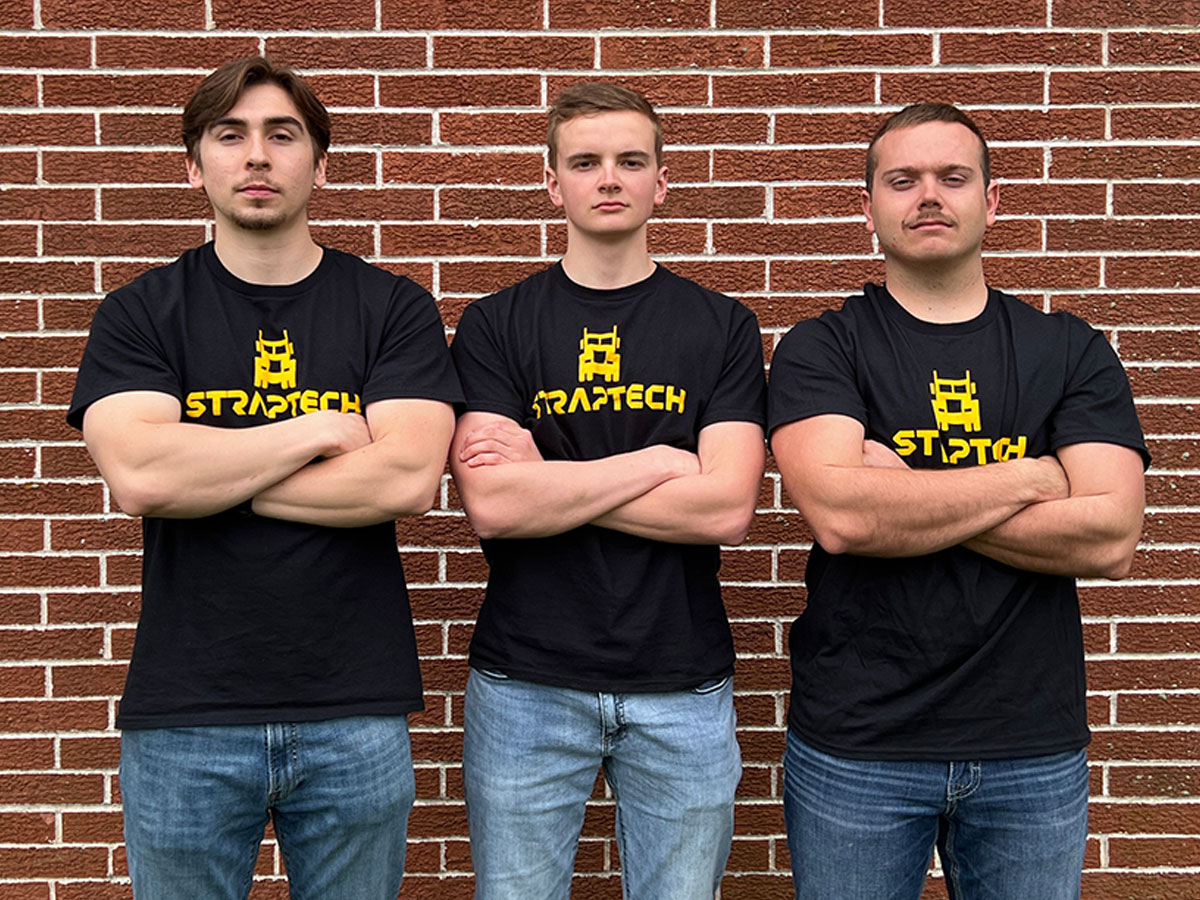
Imagine: You’re driving 60 mph down the interstate behind a truck hauling logs. The thought running through your mind might be: “What happens if those come loose?”
The worry might be the influence of an infamous scene in the 2003 horror film “Final Destination 2,” but highway safety concerns aren’t fantasy.
A trio of young Indiana entrepreneurs has designed a product intended to minimize concern about loose cargo.
Ayden Ayres, one of three Rose-Hulman Institute of Technology alumni who founded StrapTech, laughs at that fear. “I usually speed right past them,” he said of trucks.
StrapTech is a patent-pending wireless device that enables semitruck drivers to monitor the tension in their cargo straps in real time. The device can be attached to existing cargo straps and communicates data via Bluetooth to the driver’s smartphone or tablet. It will alert the driver if it detects a load shift so the driver can check the cargo’s straps.
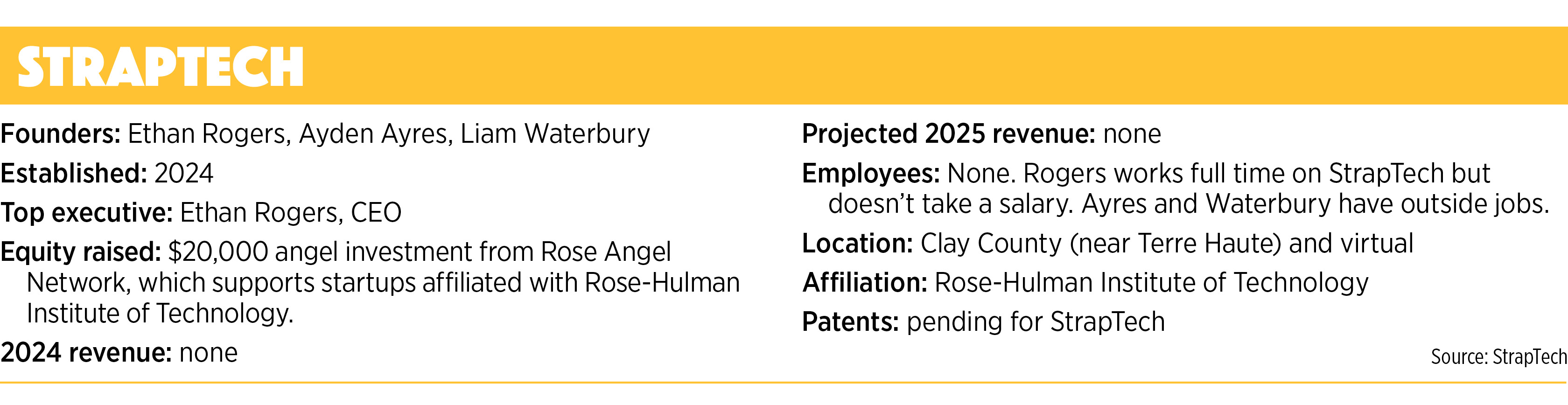
What began as a school project for Ayres and his former classmate, Ethan Rogers, has evolved into a startup. Liam Waterbury, also a Rose-Hulman graduate, eventually joined Rogers and Ayres in their endeavor.
Rogers is from the small town of Cory, near Terre Haute, and Ayres grew up in Flora, near Lafayette. When they needed to test the product prototype last spring, they drove to a Love’s Travel Stop off of U.S. 41 south of Terre Haute and knocked on the doors of truckers taking a break.
“They rolled down their window, started talking down. We said, ‘Hey, you want to test this thing out?’” Ayres said. “And they said, ‘Yeah, sure.’”
Rogers came up with the idea for the device after an internship at Tesla in Nevada. He noticed the ratchet straps used to secure materials to a forklift in the factory and thought about how they haven’t changed in a long time. It reminded him of driving with materials in his truck back home, constantly checking his mirrors and “always nervous about if something were to come loose,” he said.
Rogers knew he would need a senior project, so he first talked to Ayres about a ratchet that tightens automatically. That idea evolved into StrapTech, which advisers at the school liked so much they chose it for one of three senior projects to be presented before the board of trustees.
Advisers also chose Waterbury’s project, which was related to artificial intelligence computer vision, where computers “see” and interpret objects similarly to the way humans do. He liked the StrapTech idea, reached out to the founders, and joined the team that summer.
Waterbury, now a full-time cybersecurity consultant, is based near Indianapolis. Although the group’s communication is mainly through text and occasional Zoom meetings, he said Rogers’ drive and commitment encourage him to work harder on StrapTech.
“I feel that I need to be putting in my maximum effort because he is,” Waterbury said. He works primarily on the software side, while Ayres focuses on product design and development.
Rogers—who quit his first job out of college after six months to focus full time on StrapTech—is the entrepreneurial engine of the group. He learned woodworking in high school and worked with friends to build and sell Adirondack chairs and dining tables. He bought a drone and started doing aerial photography. Even before starting his mechanical engineering degree at Rose-Hulman, he knew he wanted to end college with a product.
“All I could think about toward the end of last year was, ‘When else am I going to have this opportunity?’” Rogers said.

Tom James, a Rose-Hulman professor who focuses on entrepreneurship and was Rogers’ adviser, said only three or four of the 600 students who graduate from the college each year have the entrepreneurial spirit needed to pursue a startup.
“It’s people who have skills who can do it themselves,” James said.
StrapTech has yet to make any money. Currently, it costs $150 to make the device, and the group sells it for about the same price.
So far, the company’s only funding has come from an angel investment from the Rose Angel Network, which supports startups affiliated with Rose-Hulman.
StrapTech has launched a pilot program in which trucking companies can sign up to use the device for a discounted fee. That will generate the company’s first real revenue.
“That’ll kind of be a big moment for us, crossing that chasm,” Rogers said.
At the Love’s Travel Stop, truckers from Maverick Transportation and CMC Trucking were willing participants in the group’s initial testing.
Ayres said StrapTech has maintained a relationship with Maverick since and demonstrated the technology for executives at CMC Trucking.
But those companies have thousands of trucks, and StrapTech is equipped currently to provide just a few prototypes to individual drivers, Ayres said.
That’s why the pilot program is so important. Kent Booe Trucking in Clay City, which has about a dozen trucks that haul logs and other materials, has already joined.
And the founders are identifying additional benefits to the device.
In addition to measuring whether straps have become loose, the device measures when they might be too tight, which can damage certain materials.
Rogers has also launched conversations with insurance companies about whether the product might lower trucker claims, thus lowering insurance rates for trucking companies.
“Initially, we were just going for giving peace of mind to truck drivers,” he said. “Since then, we found that we’re actually solving several different problems with these devices.”•
Please enable JavaScript to view this content.
Editor's note: You can comment on IBJ stories by signing in to your IBJ account. If you have not registered, please sign up for a free account now. Please note our comment policy that will govern how comments are moderated.