
Subscriber Benefit
As a subscriber you can listen to articles at work, in the car, or while you work out. Subscribe NowSeeking a balance between art and commerce has been part of Indianapolis Opera’s story from the beginning, which makes the organization’s 50th anniversary a hard-won milestone.
After launching in 1975, the company founded by late University of Indianapolis faculty member Miriam Ramaker faltered financially more than once.
Years of crisis included 1977, when Ramaker stepped down; 1981, when the season’s final production was canceled; 1995, another year in which a production was scrapped for belt-tightening; 2010, when a $400,000 budget gap led to the cancellation of a production; and 2014, when the nonprofit suspended operations for an entire season.
David Craig Starkey, who’s served as Indianapolis Opera’s general director since 2017, said a philosophy that integrates the bottom line with artistic decisions has helped the company find fiscal stability in recent years.
“You get your business in order, and you get to do opera,” said Starkey, who founded an opera company in Asheville, North Carolina, in 1999.
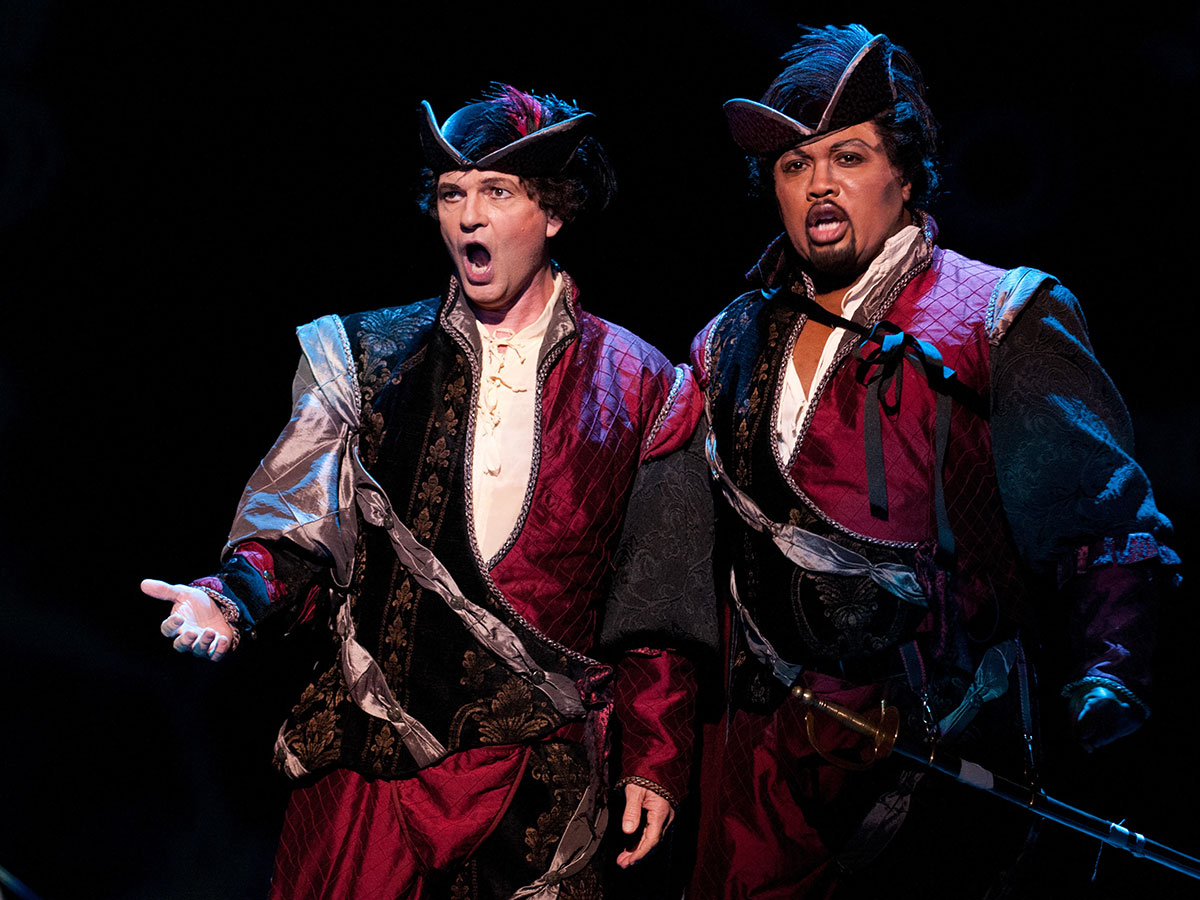
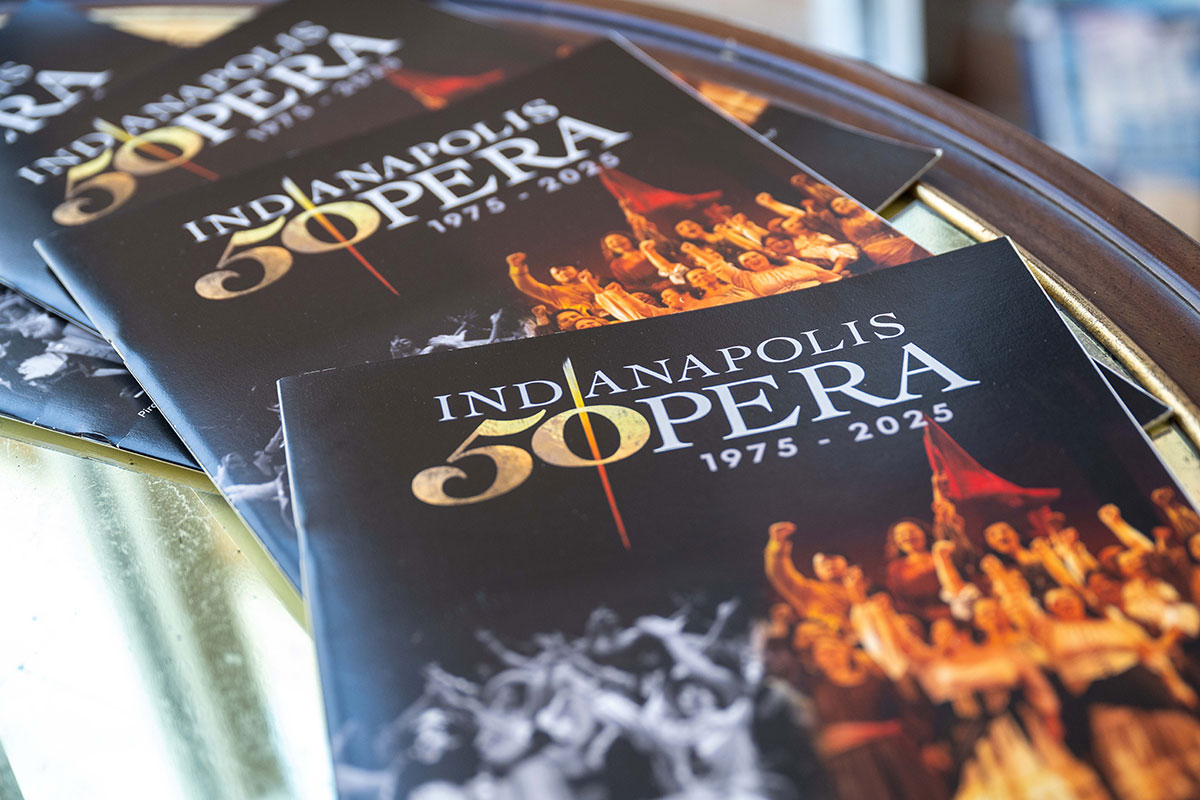
On March 22, Indianapolis Opera will celebrate its 50th anniversary with a gala at Hilbert Circle Theatre. The event will feature the Indianapolis Symphony Orchestra accompanying a roster of high-profile singers from the opera’s past and present.
Soprano Angela Brown, tenor Keith Buhl, mezzo-soprano Kirsten Gunlogson, baritone Robert McFarland, bass-baritone Kevin Short, tenor Gran Wilson and others are scheduled to perform.
For perspective, Starkey said concerts by Italian tenor superstar Andrea Bocelli for two audiences of more than 10,000 at Gainbridge Fieldhouse in 2022 and 2024 are evidence that central Indiana residents are interested in opera as an art form.
“It was extraordinarily exhilarating to see that many people enjoy both of those events,” Starkey said. “I’m going to say you have 15 Andrea Bocellis in the [gala] production, because there are literally opera stars who have been around the world. And it’s just one after another after another.”
Starkey described the gala as “the most extravagant opera experience the city’s ever seen.”
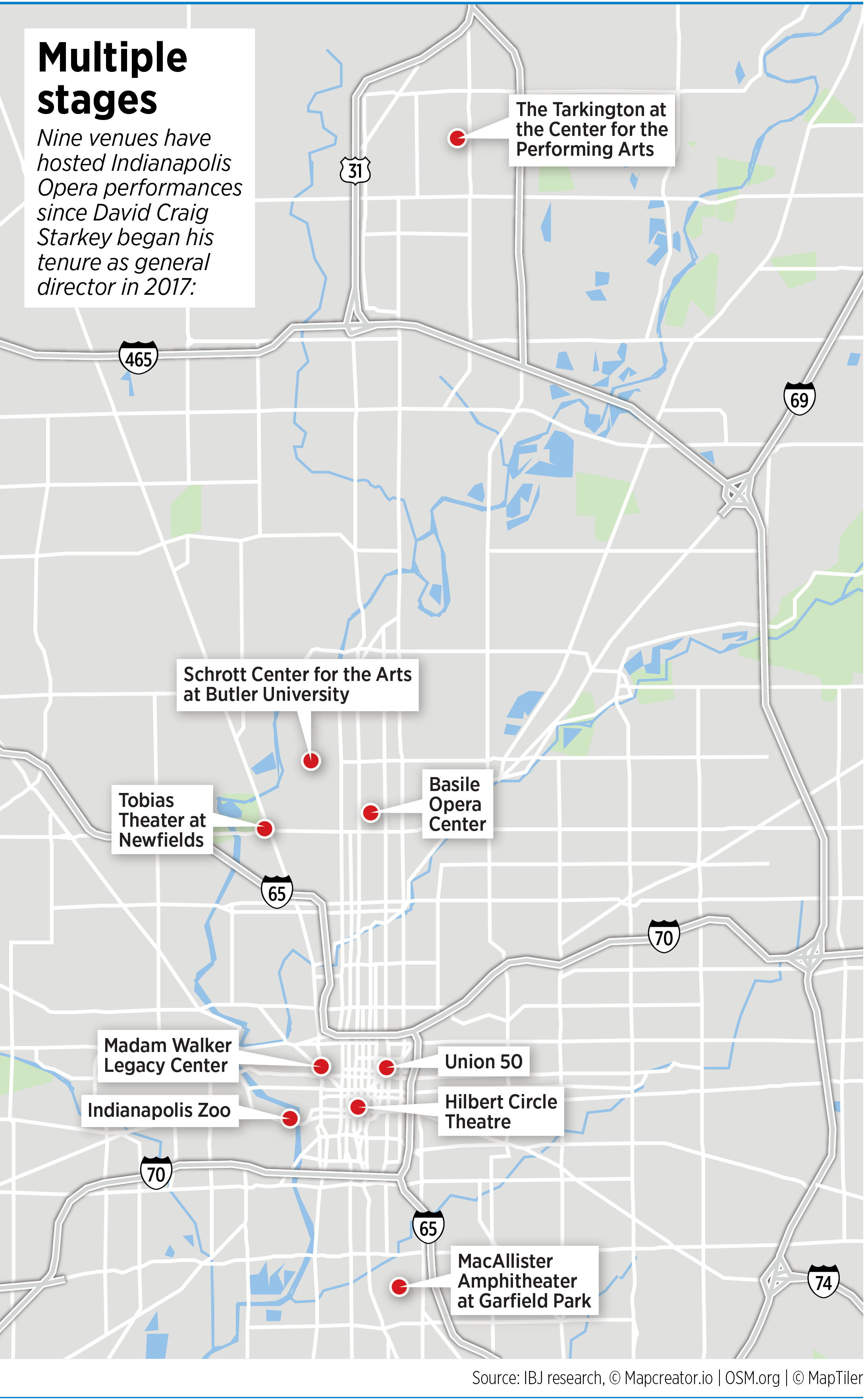
But extravagance hasn’t been Starkey’s calling card during his time in Indianapolis. Although “grand opera”—a style defined by large casts and elaborate sets—was presented by Indianapolis Opera in the 1980s and 1990s, the modern version of the company is a nimble operation that stages events in multiple (and sometimes unconventional) settings.
Venues ranging from Carmel’s Center for the Performing Arts to the Indianapolis Zoo to MacAllister Amphitheater at Garfield Park host the opera’s events.
The idea, Starkey said, is that opera can be offered in any neighborhood.
According to public tax records, Indianapolis Opera had revenue of $1.1 million and expenses of $1.04 million in 2023. In 2022, the revenue figure was $1.4 million and expenses were $999,000.
The company’s operating budget for its 2024-2025 season is $1.4 million. The amount is larger than in recent years, Starkey said, because of costs associated with producing the 50th anniversary gala.
Still, Starkey said, big productions aren’t necessarily better.
“You recognize that not every show is the Super Bowl,” he said. “There has to be intimacy to what you do. I think that is the No. 1 thing that audiences around here have learned to appreciate.”
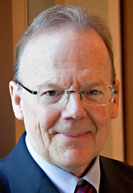
Robert Driver led Indianapolis Opera from 1981 to 1991, when he left to become general director of Opera Philadelphia.
“It’s always going to be difficult,” Driver said of financial challenges faced by opera companies. “It’s never going to be easy, not for anybody.”
Contributions and grants make up the largest segment of revenue for Indianapolis Opera. In 2023, that support was 72% of revenue. In 2022, it was 79%.
Driver, who retired from Opera Philadelphia in 2012, said funders respond to a quality product.
“You don’t really ask for money,” he said. “You get people excited about what you’re doing.”
 Homecoming harmonies
The gala will be James Caraher’s first public interaction with Indianapolis Opera since he exited the role of artistic director in 2014.
Caraher said he plans to conduct the symphony’s performance of “Bacchanale” from the opera “Samson and Delilah,” a selection that features no vocalist (and therefore saves Caraher from playing favorites among the night’s lineup of all-star singers).
Upstate New York native Caraher was hired as Indianapolis Opera’s music director in 1981, continuing a working relationship with Driver that was established at the Syracuse Opera.
Caraher, who moved into the artistic director role after Driver left Indianapolis, said a family atmosphere was forged in the company—from onstage talent to behind-the-scenes staff.
“Nobody really played the big shot who was trying to put people down,” he said. “It was always collaborative and friendly. That’s why a lot of these folks like coming back. Once their careers took off, they could have made a lot more money going elsewhere. But they liked coming back here to do things that were fun, and they knew they’d be surrounded by like-minded folks.”
Caraher’s 33-year run with Indianapolis Opera ended with his unexpected resignation. He and board members had differing opinions about how the company should proceed, and the next step proved to be inactivity as the 2014-2015 season was scrapped.
Caraher, who subsequently joined the faculty at Butler University, isn’t interested in talking about his final days at Indianapolis Opera. He said Starkey has become a friend and a positive representative of the company.
Recalling his early days in Indianapolis, Caraher said he appreciated Driver’s business model of sharing production costs between Indianapolis Opera and Syracuse Opera. Eventually, Opera Memphis was added to the format and a troupe of performers “toured” the three cities in the mid-1980s.
“It was kind of fun with all the traveling,” Caraher said. “A lot of these folks who are coming for this program came repeatedly, and we all started about the same time. Robert and I would find them when they were young and just starting out. It’s like a football team: If you find people you play well with, you keep bringing them back.”

Soprano Nova Thomas became one of the first breakout stars who had close ties to Indianapolis Opera. Thomas, who now teaches at Rice University, sang in nearly 10 Indianapolis Opera productions during a career that included performances throughout Europe as well as in Hong Kong and Mexico City.
“We became more than friends and more than colleagues,” Thomas said of the Indianapolis company. “Terrific bonds are formed. We typically lived in a three-week cycle. You come in, you rehearse, you work together day and night, you put on the show, and then everybody goes home. … But there was a shared purpose among all of us for the importance of putting those stories and art into that particular community.”
Caraher said he’s hopeful the anniversary observation makes room for a remembrance of Indianapolis Opera singers who died, including baritone Robert Orth (1947-2019) and bass Arthur Woodley (1949-2020).
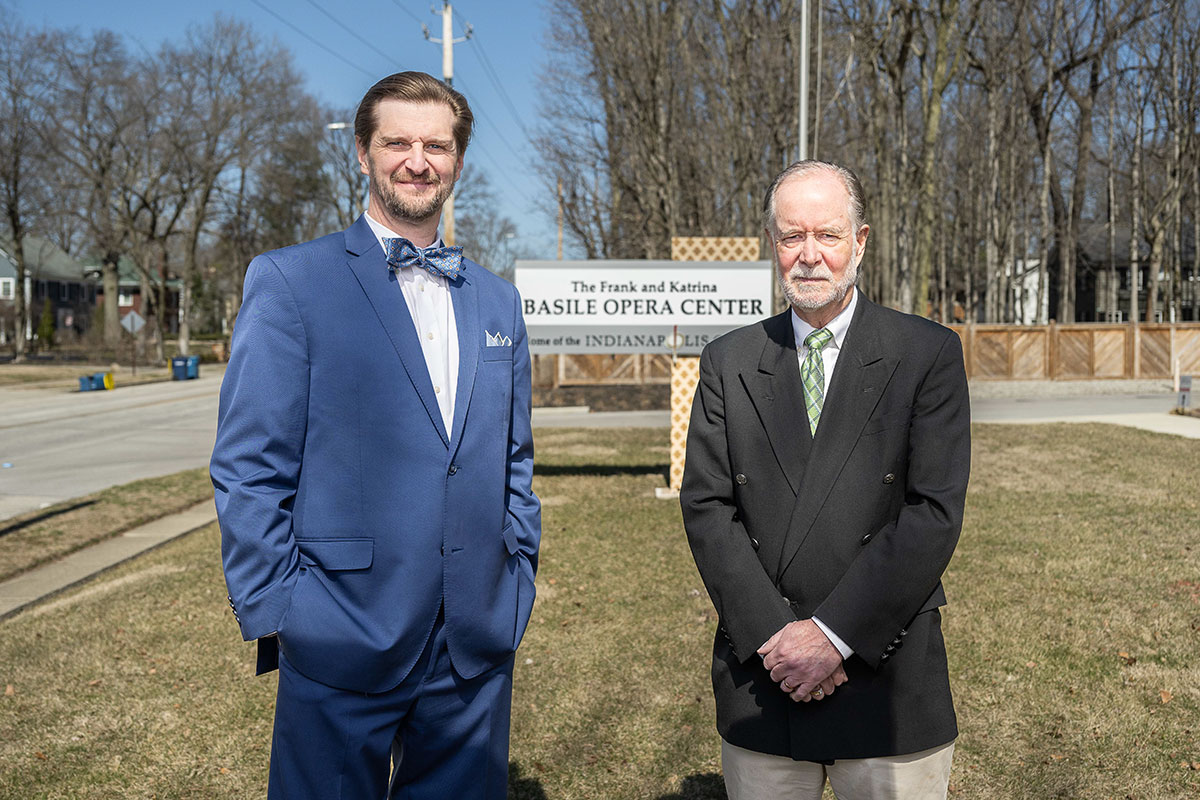
Finding support
Driver said Indianapolis Opera’s operating budget was roughly $200,000 for the 1982-1983 season.
“We raised the money necessary, and we didn’t get in debt again in my 10 years,” he said.
Clowes Memorial Hall became the home venue for Indianapolis Opera in the mid-1980s. That venue is named after George Henry Alexander Clowes, an Eli Lilly and Co. executive who died in 1958.
His son, Allen Whitehill Clowes, was a crucial backer of Indianapolis Opera, Driver said.
“Allen Clowes was a hard one to sell,” Driver said. “It took me about two years, but he was always very gracious, and I spent many lovely evenings in his home. When he said he was sending a generous gift, I was all excited about it. Of course, I was grateful for it, and it was very important. But we got up to about 20 times what his first gift was.”
Caraher said audience sizes decreased at Clowes Hall in the wake of 2008’s recession.
“We filled Clowes Hall at 2,000 seats for almost everything we did,” he said. “But things started becoming difficult. As the economy changed and people’s interests changed, audiences went down. Audience support was no less enthusiastic, but it was in smaller numbers.”
As an example of perils faced by arts organizations, Syracuse Opera—the one-time sibling company of Indianapolis Opera—permanently closed in January after its own 50-year run. Dwindling audiences and financial uncertainties were blamed.
A stage near you
Starkey said that 52 is the average age of an Indianapolis Opera attendee.
“Nobody says that old adage about going to the opera and seeing just the ‘blue hairs,’” he said. “Every age is among us, and every culture is among us.”
The company’s shift to presenting manageable productions in more places helped Indianapolis Opera reach 50 years in good standing, Starkey said.
“It was a very grand experience of a destination and a venue,” he said, referring to the historic model. “You got all dressed up, and you were going to the opera house or the auditorium or theater. It was much more city-oriented. It was much more of a downtown orientation. There was all of this prestige to it, and it was very important for cities to have prestigious culture.
“But over a period of time, that prestige became more and more of a disconnect to the neighborhoods of your city. So it became less of a relationship, and it became more of a pageantry.”
Following the anniversary gala at Hilbert Circle Theatre, Indianapolis Opera will present “West Side Story” May 9-11 at the Indianapolis Zoo. The stage occupies the zoo’s Bicentennial Pavilion west of the gift shop.
Thomas, the Indiana University alum who sang the title role of “Madama Butterfly” in multiple Indianapolis Opera productions, said companies should do what’s necessary to survive.
“Of course, I prefer a big opera house, a big stage, a full orchestra and the event forum that I grew up in,” she said. “But it’s not the only way to communicate this great music. I appreciate any and all efforts that keep it relevant, because the actual art form is relevant.
“There is nothing about it today that is less important than it was 200 years ago, as a reflection of our society and what is going on. If more accessible venues keep it in our communities, then that’s what we should do.”•
Please enable JavaScript to view this content.
Editor's note: You can comment on IBJ stories by signing in to your IBJ account. If you have not registered, please sign up for a free account now. Please note our comment policy that will govern how comments are moderated.