
Subscriber Benefit
As a subscriber you can listen to articles at work, in the car, or while you work out. Subscribe Now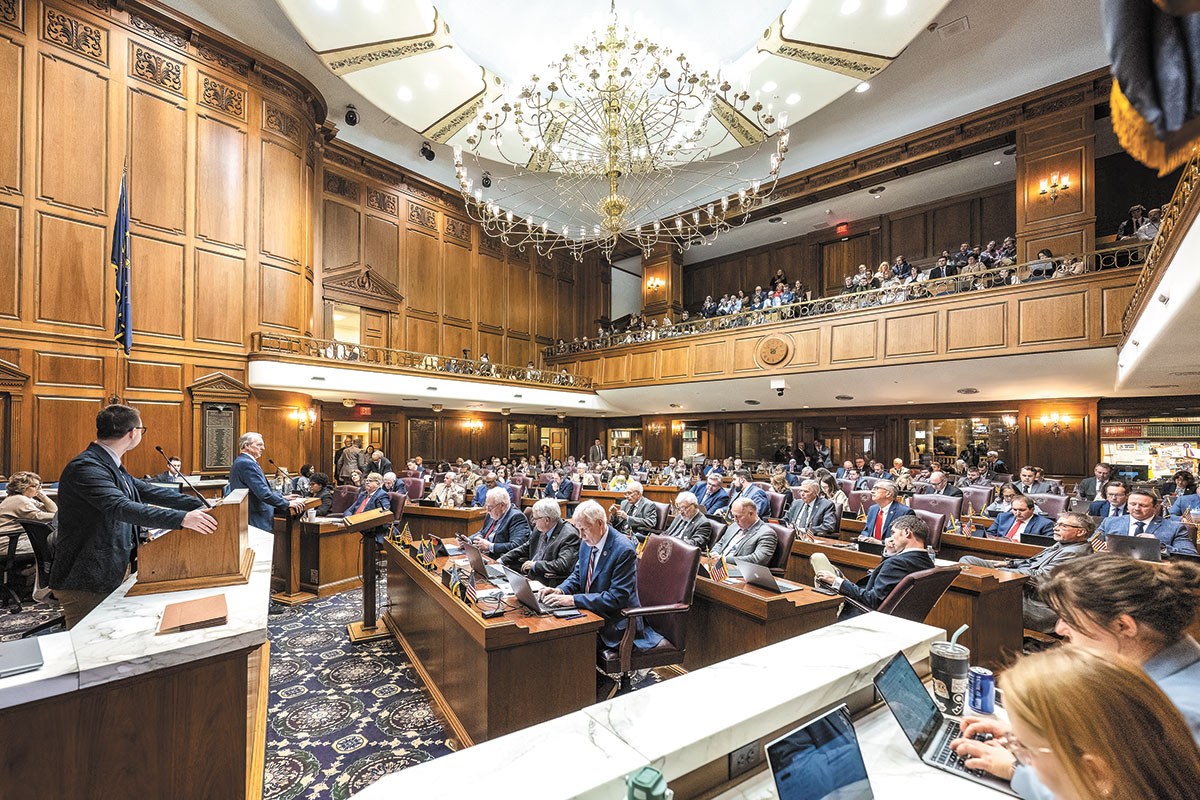
Business owners can expect to see some tax relief and a new state small business office thanks to legislation the Indiana House and Senate approved during the 2025 session that ended last month.
But the Indiana Economic Development Corp., the state’s job creation agency, will have less money for some of its operations and programs under the next two-year budget.
Those are among the results of the legislative session that ended in the early hours of April 25, a few days before the deadline for action set in state law.

The session was the first as governor for Republican Mike Braun, a former state lawmaker and U.S. senator who was elected governor in November. He came into the job promising to remake the state’s economic development strategy to increase transparency and put more emphasis on small businesses and entrepreneurs. He has said the state’s previous approach focused too much on large capital investments and has “picked winners and losers.”
Braun has also vowed to root out wasteful government spending—similar to Elon Musk’s federal Department of Government Efficiency, or DOGE, efforts.
That was especially important as lawmakers came into the session facing a leaner budget year than usual, thanks to slowing state tax revenue and rising costs for Medicaid. The situation became more serious when, just a week before adjourning, lawmakers heard a revenue forecast that predicted the state would have $2 billion less in revenue over the next two years than lawmakers thought at the start of the session.
Here’s how business interests fared during the 2025 legislative session:
Business taxes
Along with widespread homeowner relief, Senate Bill 1 gave many businesses a tax break by exempting more of them from paying what’s called a personal property tax on business equipment.
Under the legislation (which was tweaked on the last day of the session in House Bill 1427), businesses with equipment worth less than $2 million will no longer have to pay the personal property tax. That level had been $80,000.
In addition, lawmakers voted to change a rule that had required businesses to pay property taxes even on their oldest equipment. Under the current rules, the value of equipment for the purposes of taxation could never fall below 30% of its original purchase price, even if the equipment had no real market value.
But lawmakers voted to eliminate that 30% depreciation floor for newly purchased equipment, which will mean tax savings for businesses as that equipment ages.

David Ober, the Indiana Chamber’s senior vice president of business operations and finance, said the changes in SB 1 will “help create a better environment for capital investment and economic growth across Indiana.”
Plus, to encourage development in quantum computing, Rep. Ed Soliday, R-Valparaiso, authored House Bill 1601, which will expand a tax break now given to data centers to include projects related to quantum computing research, advanced computing and defense infrastructure with investments of over $50 million within five years.
Braun had not yet signed the bill into law by IBJ’s deadline.
One tax credit that won’t go into effect this year is Braun’s proposed Hoosier Workforce Investment Tax Credit, which was removed during final budget negotiations. The credit was meant to incentivize businesses to provide worker training that leads to a wage increase.
Budget cuts
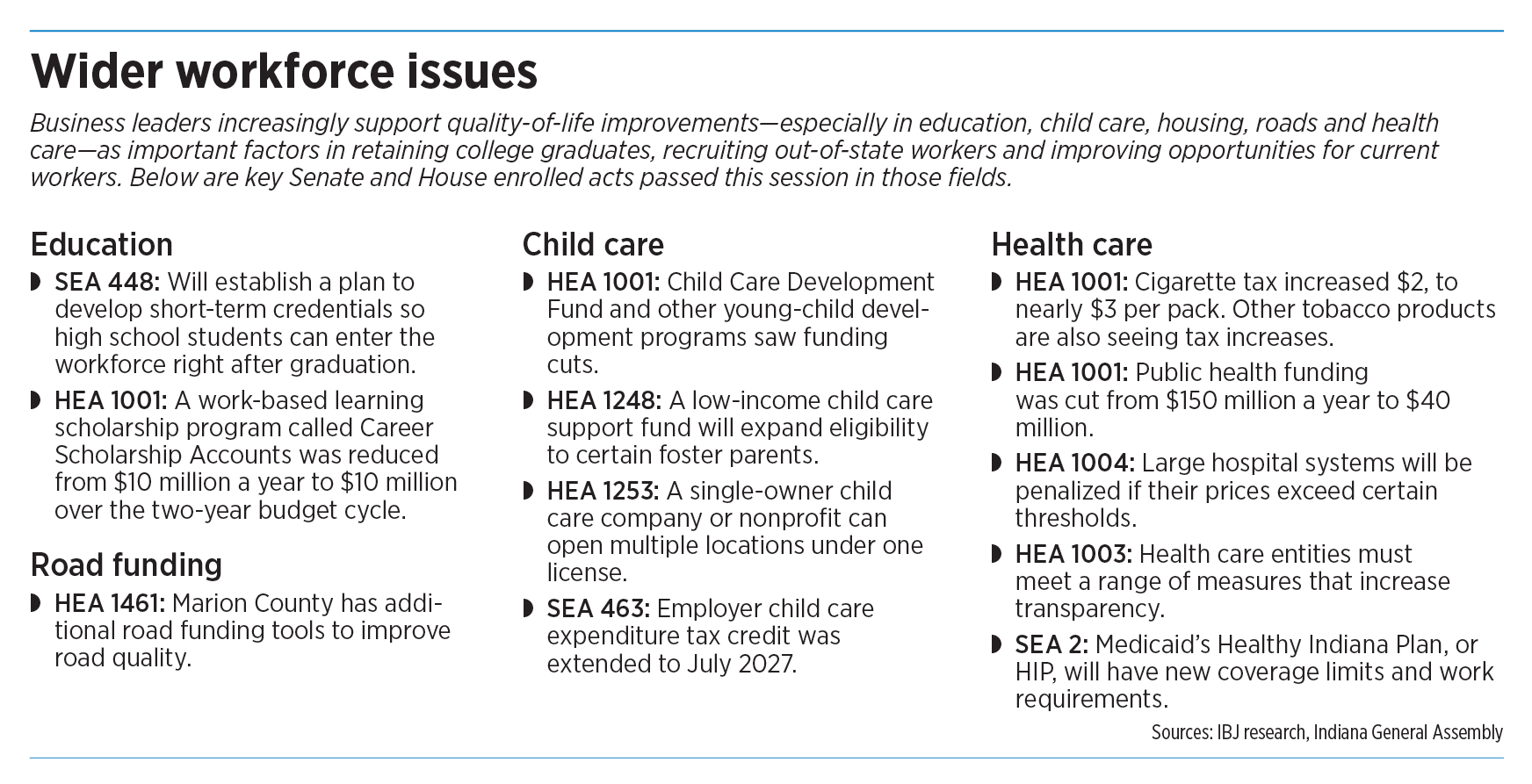
Lawmakers needed to make significant budget cuts during the last week of the session, and one of the hardest hit was the IEDC. Lawmakers cut the agency’s total funding about 25%, eliminating several major programs in the process.
The two-year spending plan—which covers July 1, 2025, through June 30, 2027—provides more funding for IEDC operations and business-promotion support but cuts five funds and programs totaling $35 million.
In all, the budget allocates $74.1 million to the IEDC for general operations, programs and business investment. That’s nearly $26 million less than in the current budget.
And lawmakers slashed the agency’s deal-making fund—used to try to attract the most lucrative companies to Indiana—from $500 million to $1.

“We don’t have the funds to do that,” House budget writer Jeff Thompson, R-Lizton, said about the deal-making fund in February. That was before lawmakers found out from a new revenue forecast that they would have $2 billion less to spend over the next two fiscal years than they expected when they wrote the budget plans that initially passed the House and Senate.
However, the budget bill includes a line that says the state can use other money for deal-making for projects within innovation districts—as long as the bipartisan State Budget Committee, which meets when lawmakers aren’t in session, reviews the request.
The revised revenue forecast meant lawmakers had to rework the budget in the final week of the session. During that process, budget writers increased a line in the IEDC’s budget aimed at business promotion by $20 million, to $37 million a year—and said specifically that money could not be used to pay for any agency operating expenses.
But lawmakers eliminated funding for Manufacturing Readiness Grants (which received $20 million a year in the current budget), the Skills Enhancement Fund ($5.75 million in the current budget), Economic Development Fund ($947,000 currently), a fund to help secure direct flights ($5 million currently) and the Industrial Development Grant Program ($4.85 million).
Lawmakers also cut the annual allocation to the 21st Century Research and Technology Fund, used for investing in emerging businesses and innovation, to $25 million from $32.8 million.
New office
Part of Braun’s plan to retool how the state approaches its economic development strategy includes the creation of a new small business office. The office will manage several new and existing programs to support small business owners and aspiring entrepreneurs.
Sen. Brian Buchanan, R-Lebanon, authored Senate Bill 516, which will establish the Office of Entrepreneurship and Innovation. Braun had not yet signed the legislation when IBJ went to press.
The bill does not stipulate what existing state programs will be absorbed into the office. However, a few potential candidates could be the Certified Technology Park program, the venture capital investment tax credit, ConnectIND interactive portal and oversight of the 21st Century Research and Technology Fund. Similar legislation that did not ultimately make its way to the governor’s desk specifically mentioned those programs.

Adam Berry, Indiana Chamber of Commerce’s vice president of economic development and technology, said the new office could be key to Indiana’s economic growth and could assist entrepreneurs by consolidating resources.
“The real key here is just making sure that we’re providing streamlined services for Hoosier entrepreneurs and businesses to grow and to be successful in Indiana,” Josh Richardson, chief of staff for the secretary of commerce, said during a January committee hearing.
Braun sought $1.75 million annually for the office. But the final budget allocated $1 million annually.
Increased IEDC scrutiny
Braun made IEDC transparency an issue during his campaign, and he found a receptive audience in lawmakers who have been frustrated by the state’s previous moves to buy thousands of acres of Boone County land to create the LEAP Research and Innovation District. (LEAP stands for Limitless Exploration/Advanced Pace).
Early in the IEDC’s work on LEAP, it considered building a 35-mile pipeline to bring water from the Wabash River aquifer to the economic district to augment the area’s water supply, prompting opposition from communities, farmers and residents along the river and raising the ire of lawmakers.
In response, Sen. Eric Koch, R-Bedford, authored Senate Bill 4 to establish the state’s first set of regulations for major water transfer projects. Braun has already signed the bill into law, meaning utility companies or developers now need to apply and obtain approval to build infrastructure that would pipe more than 10 million gallons of water per day to a location at least 30 miles away.
Also, in addition to creating a new small business office, Buchanan’s SB 516 requires the IEDC to notify a county or municipality and the State Budget Committee at least 30 days before a deal closes that involves the IEDC’s purchase of more than 100 acres of land.
And the bill requires that for each innovation development district in the state, the IEDC and involved local governments produce an annual report detailing the district’s tax-increment financing. Innovation development districts allow the state to capture state and local revenue to fund improvements and incentives at the sites. The state currently has two sites under the designation: the SK Hynix site in West Lafayette and Eli Lilly and Co.’s 600 acres in the LEAP District.
Issues related to increased transparency are expected to return to the Statehouse in 2026. Sen. Spencer Deery, R-West Lafayette, told IBJ he plans to bring back his bill to increase IEDC oversight, which could potentially include embedding a state investigator in the agency and creating a transparency dashboard.•
Please enable JavaScript to view this content.
Editor's note: You can comment on IBJ stories by signing in to your IBJ account. If you have not registered, please sign up for a free account now. Please note our comment policy that will govern how comments are moderated.