
Subscriber Benefit
As a subscriber you can listen to articles at work, in the car, or while you work out. Subscribe Now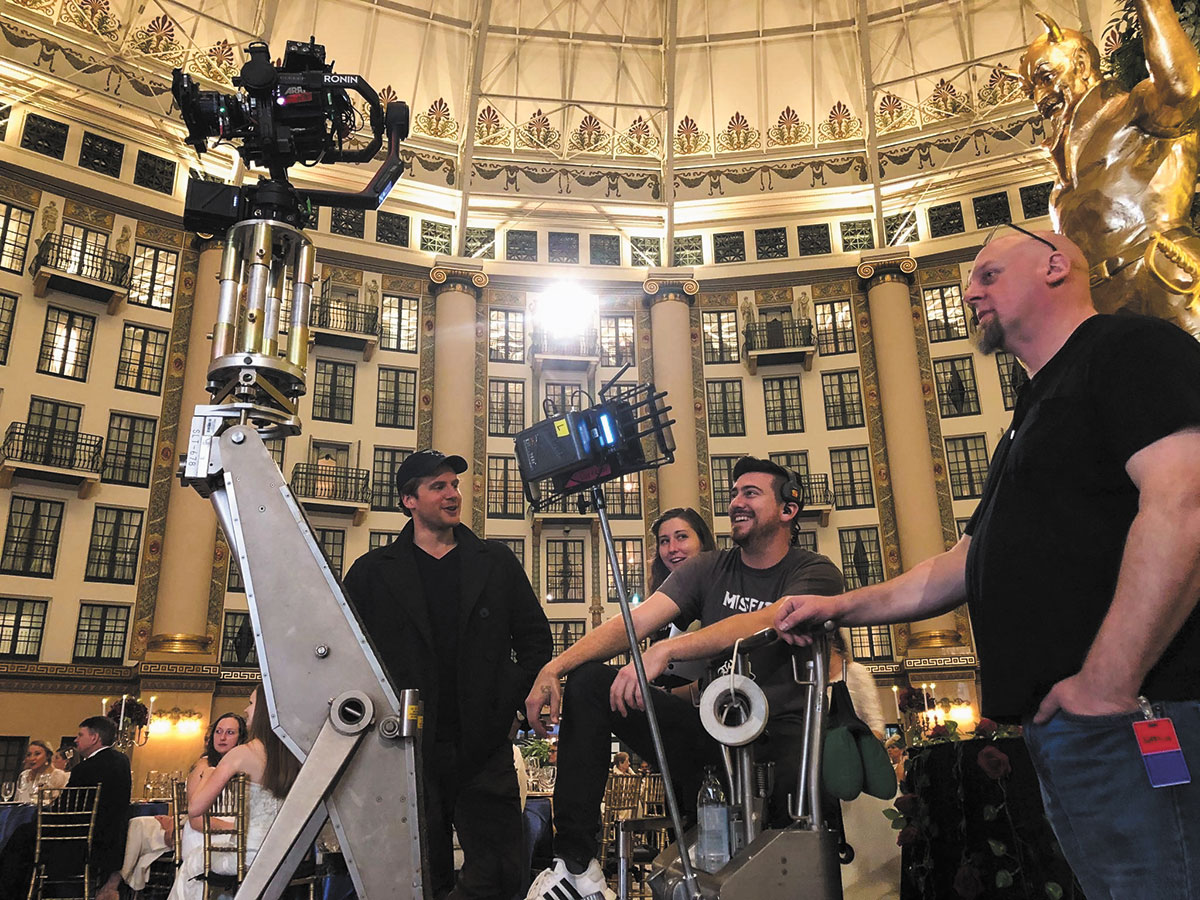
during filming in 2022 at the West Baden Springs Hotel in Orange County. (Photo courtesy of Pigasus Pictures)
In 2022, when Indiana wanted to play catch-up with states that emerged as production hubs for movies, TV shows and commercials, lawmakers established a film and media tax credit.
The legislation, signed into law by Gov. Eric Holcomb, offered up to 30% of a production’s qualifying spending back in the form of a credit against Indiana taxes.
But the incentive languished. Not a single project has been approved by the Indiana Economic Development Corp., which administers the tax credit.
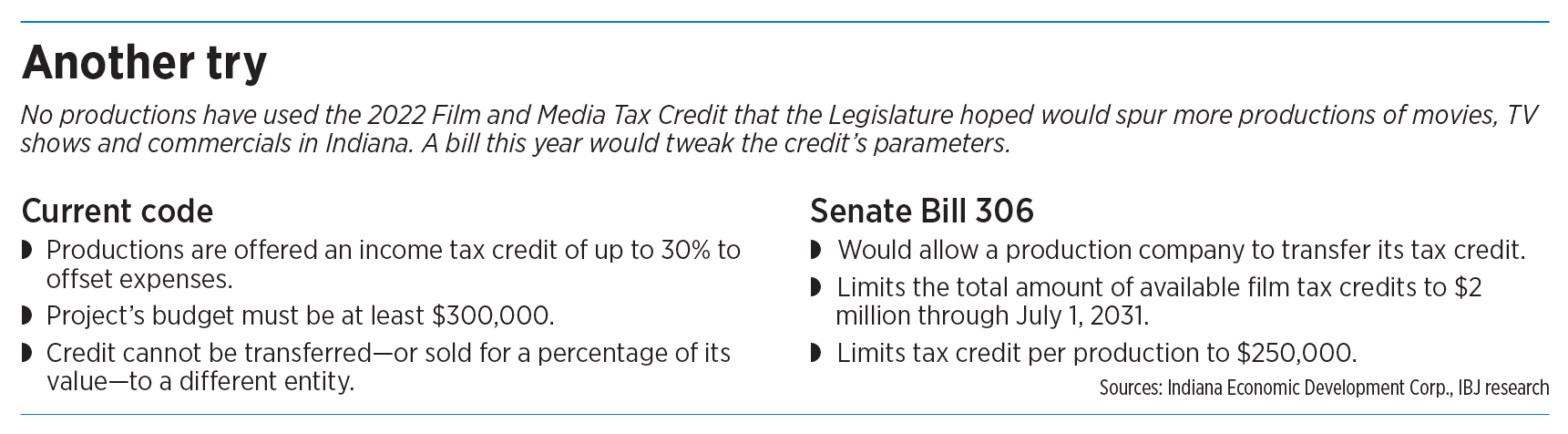
People in the film industry say Indiana is missing out because the state’s tax credit is not transferable—or authorized to be sold for a percentage of its value—to a different entity.
Members of the General Assembly apparently agree. A proposal that would tweak the language—essentially a “Take 2” in filmmaking jargon—could make the tax credit more likely to attract productions and generate economic activity.

Senate Bill 306, authored by Sen. Andy Zay, R-Huntington, and sponsored by Rep. Dave Heine, R-Fort Wayne, allows the producers of a film or other video production to sell the qualifying income tax credits to an Indiana taxpayer, who could then use the credit to reduce their tax burden.
On Tuesday, the Indiana House of Representatives approved the measure 89-3. The legislation now returns to the Senate, which approved a different version of the bill 49-0 on Feb. 10.
Zay can now decide whether to ask the Senate to accept changes made by the House or send the bill to a conference committee, where members of the two chambers meet to find a compromise on the language.
Regardless, the bill’s supporters are optimistic some version of it will become law—although its application will likely be limited to smaller projects.
“It’s a great opportunity for Indiana to continue to diversify our economy,” Zay told IBJ. “Years ago, I think we were a little more in the game. This will hopefully open up some doors and opportunities that could be a big deal here in time.”
In the 1980s and ’90s, Indiana was a primary filming site for movies, including “Hoosiers,” “A League of Their Own,” “Rudy,” “Eight Men Out” and “Blue Chips.” But that has changed, especially as other states implemented financial incentives for production.
In Kentucky, for example, projects can receive up to 35% of qualifying capital and payroll expenditures as a refundable tax credit. The maximum credit per project is $10 million, and a maximum of $75 million is available annually for all approved projects.
And recently, two yet-to-be-released movies with strong Indiana ties were filmed in Louisville:
◗ “Dead Man’s Wire,” a film based on a 1977 hostage incident in downtown Indianapolis involving real estate developer Tony Kiritsis and banker Richard Hall. Louisville native Gus Van Sant, a two-time Academy Award nominee, is the film’s director. Al Pacino is part of the cast.
◗ “The Revisionist,” based on a novelist who sparks controversy by bringing real people into her fictional narrative. Alison Brie and Dustin Hoffman have roles in “The Revisionist,” an upcoming project for Pigasus Pictures, a Bloomington-based company that’s made seven feature films in Indiana since 2017.
In 2024, producers claimed $68 million of credits in Kentucky. The cap in that state is $75 million per year.
According to Kentucky Entertainment Incentive records, “Dead Man’s Wire” can claim a tax credit of up to $4 million, and “The Revisionist” has a potential tax credit of $750,000.
Unfair to investors

Gordon Strain, co-owner of Pigasus, said he’s not sure whether the company’s future projects will be made in Indiana—especially if the state doesn’t act to make its tax credit transferable.
“I would love to,” Strain said. “But it’s not fair to our investors to do so.”
The Indiana film and media tax credit established in 2022 requires a project to have a minimum budget of $300,000. At that minimum size, a 30% tax credit could reduce a producer’s overall income tax bill in Indiana by $90,000.
But because Indiana’s tax credit can’t be transferred, a production company located outside Indiana—or even a smaller one inside the state—can’t necessarily take advantage of it. That’s because the company might not have a tax liability large enough to take the full credit.
If the tax credit is transferrable, a production company could sell the $90,000 credit to a taxpayer at a discount, perhaps for $80,000. The production company then has $80,000 to give to investors or apply to the project’s budget, and the taxpayer can use the credit to reduce its tax liability.

An amendment to SB 306 introduced by Rep. Christopher Judy, R-Fort Wayne, limits the total amount of available film tax credits to $2 million through July 1, 2031. The maximum tax credit per production would be $250,000.
That level of incentive would not have landed the making of “The Revisionist” in Indiana, said Pigasus Pictures CEO Zachary Spicer.
“We couldn’t have filmed ‘The Revisionist’ in Indiana with this proposed legislation, because this movie is more than $3 million,” Spicer said. “If you’re putting a cap of $250,000 worth of tax credits, you’re really putting a cap on budgets being about $1 million or less that are able to benefit from it.”
That means the tax credit would likely be used largely for small productions—commercials, corporate videos and other lower-budget projects.
No blockbusters
Judy acknowledged that a pool of $2 million is modest for the next six years, but he said more money might not be available.
That’s because the film and media tax credit is subject to a larger $250 million limit for tax credits that can be certified by the Indiana Economic Development Corp. during a fiscal year. The agency oversees a number of tax credit programs, most aimed at creating or maintaining private-sector employment in Indiana and training new and existing workers.
That means the IEDC might need to weigh the benefits of a film project against the value of a company expansion when deciding whether to OK the credits, especially if the agency is nearing its overall cap.
“It’s essentially IEDC that will determine how many tax credits of those $250 million will be directed toward film,” Judy said. “From my understanding, those tax credits are assigned to something already. I think it’s going to be a few years before some things open up.”
Zay said it’s encouraging that a specific dollar amount has been attached to the proposal.
“To put something in that bucket is a huge positive,” he said. “Even with this nominal amount, it will give us some proof of concept. If we can invest in a few of these production opportunities in the next few years and can show some return, that will give our fiscal people more confidence that this is a good way to go.”
But that means the probability that a future mainstream film will be made in Indiana is minimal.
It’s not uncommon for production costs for each episode of a one-hour network TV show to exceed $5 million. In 2022, The Wall Street Journal reported that Netflix spent $30 million for each episode of “Stranger Things 4,” a story set in Indiana but filmed in Georgia.

But there’s no shortage of projects that are made for $1 million or less. Pigasus CEO Spicer said many documentary films qualify.
Greg Malone, a prominent member of the Indianapolis film community since the 1990s, operated Road Pictures, a long-running production company that specialized in making commercials.
“The commercial business is extremely important,” Malone said. “A larger commercial will have 15 to 40 people fulfilling roles that are similar to what you find on a feature film, in terms of the different departments and different roles. Having a robust commercial production community does help build the film community.”
Learning curve
Zay credited the digital media arts department at Huntington University for raising his awareness of Indiana’s film industry.
In recent years, the school and its production company, Forester Film LLC, made the films “A Carpenter’s Prayer” and “Patterns.” Up next is a production titled “Overhill Manor.”
“Before COVID, [Dean of the Arts Lance Clark] was sending his folks out to California, and they were working in the industry,” Zay said. “He trained this talent, and they were getting placed in great jobs at Pixar and other studios. Once COVID happened, they actually brought movie production to Indiana. They’ve now produced two feature films, and they’re beginning on their third. His desire is obviously to train this talent and to have opportunities for them right here in Indiana.”
Judy said making Indiana’s tax credit transferable would be a step toward stopping brain drain among film students.
“I think it sends a message to Huntington University, Ball State University and Indiana University,” Judy said. “We heard in testimony that their graduates leave the state because of the lack of job opportunities within the industry here.”

Jennifer Haire is a Carmel High School graduate who’s worked in film production for more than 20 years. After spending most of her career in Los Angeles, Haire moved back to Indianapolis in 2021 when the pandemic revealed that she could work from anywhere.
Haire, who served as a production supervisor on 2023 film “Killers of the Flower Moon,” said she encourages film students to develop their skills where productions are prevalent but also consider a return to Indiana to mentor others.
“Let’s start training our local crew with professional practices,” Haire said. “Right now, if we’re lucky, we’re maybe one crew deep if nothing else is going on when a production is in town. We need more and more. That’s what those schools are trying to do. There are some great programs, but where do the students get to apply their skills?”
Haire mentioned the robust film landscape in Kentucky, Illinois (where transferable tax credits of 30% to 45% are offered, and projects aren’t capped by a maximum dollar figure) and Ohio (where $50 million is available each year for refundable film tax credits).
“It’s embarrassing that we are sandwiched between three states that have thriving film communities and incentives,” she said.
When Pigasus flies
Haire worked as production supervisor on “So Cold the River,” a 2022 film Pigasus made with fellow Indiana company 1804 Productions at the West Baden Springs Hotel in French Lick.
The roster of Pigasus films includes “The Good Catholic,” “Ms. White Light,” “The Miseducation of Bindu” and “The Duel.”
Global content platform Lionsgate released comedic drama “The Duel,” starring Dylan Sprouse, in 500 U.S. theaters in 2024.
Shot at Indiana locations such as Carmel’s Asherwood estate, “The Duel” included a scene in which Lake Michigan stood in for the Pacific Ocean.
Spicer said the initial string of Pigasus films benefited from Indiana’s venture capital investment tax credit, which is transferable. Films became ineligible for the venture capital incentive when the film and media tax credit was launched three years ago.
“The things that we can do here will just have to be limited in scope,” Spicer said, referring to the $2 million and $250,000 caps amended into the current tax credit proposal. “We just have to be very selective about the size of projects that we do and constantly campaign for things to change.”
Road Pictures founder Malone served as producer for “The Ice Cream Man,” a 2024 short film based on Nazi persecution of Jewish citizens in Amsterdam in 1941.
About one-third of “The Ice Cream Man” was made in Amsterdam, and about two-thirds was made in Indiana, where Lake Michigan stood in for the Atlantic Ocean.
“The Ice Cream Man,” starring “The Americans” actor Noah Emmerich, did not receive an Academy Award nomination in the category of live action short film. But the film did advance from a group of 180 qualifiers to 15 titles announced as shortlist contenders by the Academy of Motion Picture Arts and Sciences.
Malone said a transferable film tax credit could bolster the state’s creative economy output, which has been assessed at $9.3 billion per year by Indianapolis-based arts economic development organization Pattern.
“The creative economy is a pretty big one,” Malone said. “We’re just leaving money on the table if we allow Indiana stories to be filmed elsewhere.”
Spicer said he doesn’t want to see an underpowered film tax credit lead to a perception that people don’t want to make films in Indiana.
“I believe everybody is trying to do the right thing in creating an incentive that will help grow an industry, but this [proposal] won’t grow that industry,” he said. “My fear is that in five years, those large projects that I think the state and everybody would be excited about won’t come. So they’ll look at this tax credit and say, ‘Well, we created this, and no one really uses it to its potential. We should just do away with it.’ And that couldn’t be further from the truth. There are so many people who could benefit from it.”•
Please enable JavaScript to view this content.
Editor's note: You can comment on IBJ stories by signing in to your IBJ account. If you have not registered, please sign up for a free account now. Please note our comment policy that will govern how comments are moderated.