
Subscriber Benefit
As a subscriber you can listen to articles at work, in the car, or while you work out. Subscribe Now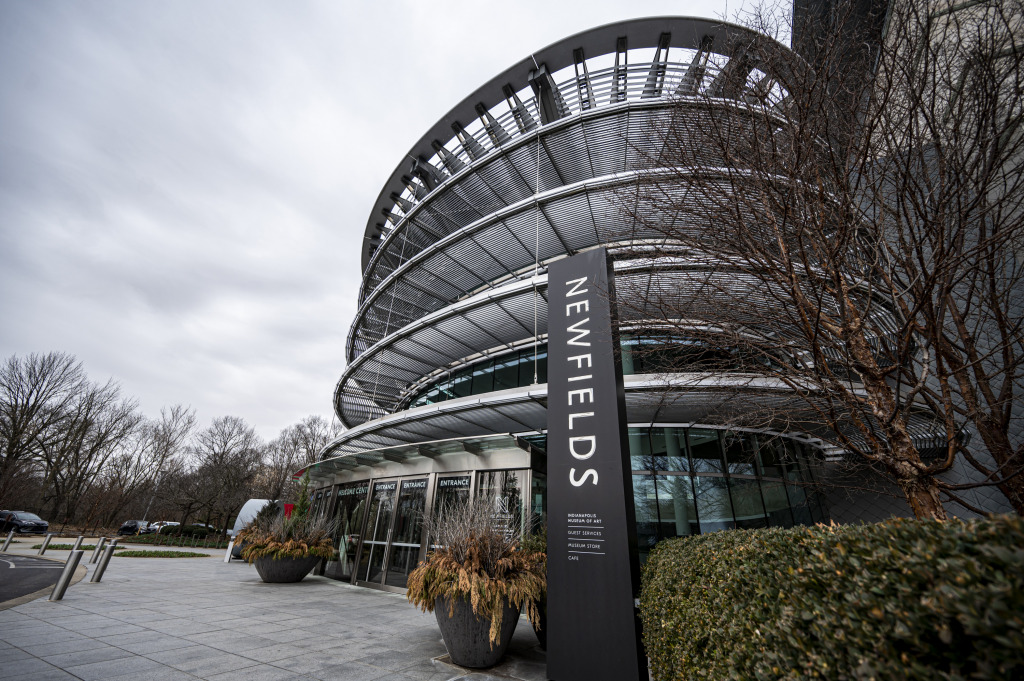
Executives at Newfields showcased the dancing waters of a renovated fountain and announced new operating hours during the museum’s annual public meeting for its boards of trustees and governors Wednesday.
Newfields, 4000 N. Michigan Road, will expand from being open six days a week to seven days a week on May 26—which is Memorial Day. On Mondays, Newfields will welcome visitors from 10 a.m. to 5 p.m.
The meeting also included the election of a new board of trustees chair following years of turmoil among the museum’s top leadership.
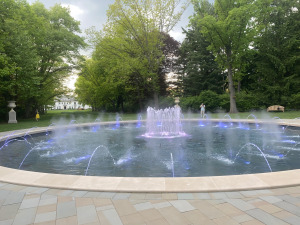
Other announcements included the revival of Glick Fountain east of the historic Lilly House and a preview of upcoming attractions at the Indianapolis Museum of Art.
Here’s what happened during Newfields’ annual meeting.
Newfields elects new board of trustees chair
Darrianne Christian closed her four-year term as board chair with remarks that touched on recent turmoil at Newfields.
“Serving as chair of the board of trustees for the past four years has been a privilege and an incredible honor,” Christian told an audience gathered in the museum’s Tobias Theater. “It is a role that I do not take lightly and, to be honest, with everything that we’ve been through during my tenure, I couldn’t.”
Christian, who was elected to the board in 2016 and was named its chair five years later, has managed through periods of intense public scrutiny of the organization.
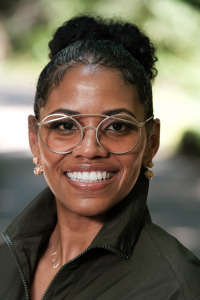
She became the first Black woman selected as board chair in May 2021, in the wake of the resignation of Newfields President Charles Venable—whose resignation was preceded by a controversial job posting that referenced the need to maintain “the museum’s traditional, core, white art audience” while attempting to attract guests from all backgrounds.
Venable’s successor, Colette Pierce Burnette, served as CEO from August 2022 to November 2023. Her tenure ended with an abrupt and unexplained departure. Burnette did not comment on the exit, and Newfields provided no explanation saying it would not discuss personnel matters.
Six board members stepped down in the weeks before and after the announcement of Burnette’s exit.
Burnette was the first Black top executive and the first woman hired for the role at Newfields, an institution founded in 1883 as the Art Association of Indianapolis. Burnette’s successor, Le Monte Booker, was hired in 2024. He is the first Black man in the top executive role.
In January, the vice president of human resources at Newfields accused the nonprofit of race- and age-based discrimination after he was fired. Ernest Gause said his efforts to internally report discriminatory business practices were not welcomed by leadership at Newfields. The organization responded by saying Gause’s termination was “in no way related to discrimination including race, gender or age.”
On Wednesday, board members elected Anne Sellers as Christian’s successor in the role of chair.
Sellers, who has served as the board’s vice chair and treasurer, was managing principal of Indianapolis-based audio-visual tech firm Sensory Technologies from 2006 to 2020, when the company was acquired by Diversified.
CEO Booker, who started his tenure in October, made his first appearance at a Newfields annual meeting Wednesday. Among his announcements, Booker said Michael Berkery, chief operating officer at the Indiana State Fairgrounds & Event Center, will join Newfields as chief operations officer.
New attractions, events at Newfields
In addition to expanded operating hours, the museum announced several additions, acquisitions and upcoming events.
Renovations to Glick Fountain, a 60-foot diameter water feature installed in the 1920s, were financed by a $3.1 million gift from Glick Philanthropies and David and Jackie Barrett. An array of pop jet nozzles in the fountain provide a dancing effect, accompanied by a soundtrack recorded by the Indianapolis Symphony Orchestra.
The next major outdoor project at Newfields will be a flower and vegetable garden planned near the Madeline F. Elder Greenhouse, northeast of Lilly House. A parking lot will be removed to make way for the $4.6 million garden.
Newfields will celebrate the 50th anniversary of the Indianapolis Museum of Art’s acquisition of Robert Indiana’s “Love” sculpture by displaying Indiana’s 1966 painting that inspired the sculpture in September. The museum acquired the sculpture in October 1975.
Among recent acquisitions announced during Wednesday’s meeting was a series of prints by Los Angeles-based artist Derrick Adams. “Parlay 1-4” is a 2024 work inspired by fashion designer Patrick Kelly.
On June 27, Newfields will host an “Artful Party” event to highlight four 2025 exhibitions:
- “Resplendent Dreams: Reawakening the Rococo,” featuring works by Robert Horvath, Anthony Sonnenberg and Diego Montoya.
- “Black Dandelion,” an installation by Kori Newkirk in the Efroymson Family Entrance Pavilion.
- “Composing Color: Paintings by Alma Thomas,” a traveling exhibition from the Smithsonian American Art Museum.
- Lume Featurettes, three-minute videos by students at the Herron School of Art & Design that will screen as part of the “Connection: Land, Water, Sky” show of art and music from Indigenous Australians that opens this weekend at Newfields.
Please enable JavaScript to view this content.
Just give us an artistic kids play scape like every other art museum their size.
Also good riddance to a terrible board chair – looking forward to positive progress there again
Back to the beginning of all this: Why it was considered such an outrageous affront to seek to add patrons of all races while also maintaining “the museum’s traditional, core, white art audience”? It seems to have been solely because a white man dared to include a scrap of language that indicated the tiniest bit of positive energy toward white people
We note that IBJ still puts “white” in lower-case while putting “Black” in upper case. Anti-white racism remains alive and well in Indy’s fashionable institutions.
At least we can feel good about IMA getting rid of “Indianapolis,” “Museum” and “Art” in its name. Recent boards there seem to be embarrassed at being in Indianapolis, and I guess they got bored with the art museum thing, too. “Newfields” sounds like a combination of a nougaty candy bar and a lawn-care service. Genius!
This is a silly and uninformed take – like most of your contributions to society I would guess 🙂
But we can both agree the board chair was terrible – chased off 3 solid CEOs and was only there because their SO donated enough money to the museum
“Silly and uninformed” to expect that combating racism with racism won’t turn out well? Call me proudly silly and uninformed then.
IBJ abides by the same stylebook bestowed on us like Moses from the mountaintop, courtesy of another compromised institution, the Associated Press. Or is it Chicago Manual? American Psychological Association? Does it matter?
Venable did seem to represent a significant “dumbing-down” of an institution that doesn’t stand to benefit from populism. And many things do benefit from it. But I recognize that he was stuck between a rock and a hard place in terms of appeasing two factions.
The operating hours WERE terrible, so that’s one improvement.
Yes it’s a silly take to say the CEO that was sacked was terrible and led them down this path and then to say he shouldn’t have been fired.
If I wanted to revoke someone’s severance and they did something dumb I’d use that to fire them for cause without a payout. That was actually seemingly smart management.
Chasing off the next two CEOs via catty board management by the chair is embarrassing.
Richard, “white” is not an ethnicity, it is a social construct (as is race in general, but that is another topic) used to define an “in-group” and define all others as outsiders.
In the recent past in the US, individuals who were of Italian and Greek ancestry and those of other Southern and Eastern European descent were not considered white, and many were subject to discriminatory practices, like redlining in housing or employment boycotts. Eventually, as their numbers grew due to immigration, there was enough pressure to expand the definition of white to include them.
The category of “white” has been expanded and refined many times over the years, as necessary for its preservation as a tool of class division. It exists to keep the working people from uniting to rise up against their corporate and billionaire masters who exploit their label to hoard wealth for themselves.
In the US, the word Black when referring to a group of people is capitalized because it refers to a specific cultural ethnicity that developed around enslaved people of African-descent who were kept and bred (and often sexually assaulted to produce children) for generations to provide free labor to build and support the vast wealth of what was then the elite caste.
As for Newfields, I laugh at all these comments, the organizations has had problems for years, and many of them were created or exacerbated under the leadership of the previous museum CEO’s.
Max Anderson was a worldly and charming individual who excelled at putting on flashy special exhibits and schmoozing with wealthy donors, but he was also a spendthrift who drained the museum’s endowment. He also had great disdain for ordinary Hoosiers who he condescendingly described to my mother and her friend at an event as being “lizard-brained individuals who only care about basketball”—perhaps what some may deem a fair assessment, but not the sort of attitude that should be held by the leader of a civic institution in Indiana.
Charles Venable was a fiscally shrewd executive, but he was woefully out of touch with the community he served. Despite his impressive art and management background, he was happy to turn the museum into a walled of Instagram experience instead of building it up as a local cultural civic institution. He was also incredibly tone-deaf when dealing with public relations crisis.
Colette Pierce was an accomplished organizational leader and excelled at building community relationships, but under her leadership, there were allegations of persistent discrimination and mismanagement. Whether or not she inherited these issues, they seemed to have continued and worsened under her leadership.
The present CEO, Mr. Booker, despite dealing with an employee controversy during his new tenure, still seems to be a solid choice to reform the organization and rebuild community trust in the institution.
Wow Christopher it sounds like they should have appointed you CEO of the museum. And you take on white vs Black is hysterical. Stop projecting your white guilt.
Wow, Rhea, thank you for the endorsement. Should the Newfields Board wish to make me an employment offer commensurate with my extensive management experience and demonstrated leadership ability, I would be willing to consider it, though I am very satisfied with my current job.
As for my “take” on racial social politics in the US, it is a statement of the facts. And. I am very content with who I am, perhaps if you are feeling guilty, you might take stock of your life. You should also read a book on basic American history.