
Subscriber Benefit
As a subscriber you can listen to articles at work, in the car, or while you work out. Subscribe Now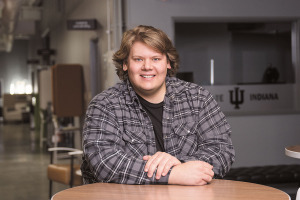
Since before he can remember, Michael Collins has had a fascination with computers and robotics.
“My dad owned a software company, and so I was always around servers in his office, big computers,” Collins said. “They’re very interesting—seemed like magic. I always wanted to know how electronics work and how computers work.”
So by the time he was in second grade, he had his future mapped out: He wanted to attend Purdue University and become an engineer.
Bad experiences in high school soured him on formal education, and by senior year he had decided that college was not for him. But he still wanted to be an engineer, and he loved participating in his high school’s robotics club. The hands-on learning he acquired through that club helped him realize that he could sidestep higher education while still pursuing his career ambitions.
Collins graduated from Danville Community High School in 2019. A few months after, he connected with Fishers-based Pierce Aerospace, impressing the company so much that it brought him on as a co-founder. Collins is one of four co-founders at Pierce Aerospace and leads research and development efforts at the company, which has developed technology for detecting, tracking and identifying drones.
Collins sat down with IBJ recently to talk about his unconventional career path. This conversation has been edited for length and clarity.
Why did you decide to skip college?
I had a pretty tough time in high school. I was bored out of my mind, and just the monotony of it was driving me crazy. … I realized my teachers were kind of wasting my time, or at least in my perspective they were wasting my time. So I thought, “All right, I’m done having my time wasted.”
You mentioned an experience in an Advanced Placement class that you described as a breaking point. What happened?
[The teacher] had a set system of taking notes that we had to use. … [She] basically had us copy the book verbatim. And these chapters were not short—these were 20-page chapters. We had to write it all out. I wrote a program that would take the book, detect topics, write summaries, and then generate a paper in my handwriting on notebook paper that I could turn in. … Writing that software for Advanced Placement world history was kind of a shift in the way I approached school.
What was your first job after graduating from high school?
I was working for a company in Carmel doing idea-level R&D. I’d have an idea given to me by my manager, and I would make a prototype in the span of a day to a week. I was a contractor. It was very interesting, very nonconventional job.
You said you learned about Pierce Aerospace through your father, who had met co-founder and CEO Aaron Pierce at a professional event in Fishers. Then, at your dad’s suggestion, you emailed Aaron. What happened next?
Gary [Bullock, Pierce Aerospace’s chief technology officer] ended up being the first one that reached out to me and got on the phone, and he said they were about to do a hackathon and asked me if I’d be interested in joining them. … So I said, “Yeah, I would love to do this hackathon.” It was at the Indianapolis Motor Speedway. I showed up at the racetrack, and I remember walking in, and I saw Aaron. He made eye contact with me. That was the first time I ever met Aaron. And he shook my hand, and we got to work. … So I like to say that my interview was three days long. I think I got a total of two hours of sleep. So it was an interesting interview, and I managed to write some software and get things working during the hackathon. … We were trying to build a prototype of what we have now as our beacon product. … We built up a very early prototype of what we have now.
 You strike me as someone who doesn’t like to follow the rules just for the sake of it.
You don’t go do a three-day-long interview if you’re following all the rules. … I get bored with normalcy, monotony.
Engineering is a really technical field. Without earning a degree, how have you learned what you needed to know?
Something I learned in high school through robotics is that having mentors is incredibly important. I’ve had many mentors at this point—well-established engineers and professionals—and they have helped me learn a lot. And I think a lot of the things that I’ve learned from them are a lot more applicable than some of the things I would have had to learn in school.
You said mentors have also helped you improve your communication skills. What was the challenge they helped you with?
Not knowing how to effectively communicate in an engineering kind of context. Not knowing how to translate a highly technical situation to less technical project management [language].
And that’s something I still struggle with. But I think that that’s just an issue with engineering in general. … Learning to accept slight inaccuracies just for the sake of communication is a big thing for me. I was very pedantic when I was younger. I would call you out if you got something slightly wrong. Now, I just kind of let it slide. If it becomes important, I’ll explain it.
What do you see as an advantage of not having been to college?
I think I’m kind of free of the standard in some ways. I can kind of allow myself to be blind to the way that things are done usually and think outside the box a little bit. That’s been advantageous a couple times. Some of the things that we’ve patented have just come from me looking at a problem in a different way, coming up with a new solution.
Have you run into disadvantages?
A downside of not going to school is that I don’t have the vocabulary for a lot of things. I have the principles, just sometimes I find that I don’t have the vocab.
So it might be harder to convey a concept to colleagues because you don’t know the proper engineering terminology?
Yes. [But] that’s kind of faded through just experience.
You’re one of four co-founders at Pierce Aerospace, and all of you are actively involved with the company’s operations. When you and your co-founders disagree about something, how do you work it out?
We haven’t had crazy conflicts, and we have a wide range of viewpoints. … I don’t know if we can say this now, but [at one point in the company’s history] we had at least one member of every working generation on the team—and having that variance of viewpoints is incredibly valuable. Because, you know, Gary looks at a problem, and it can be completely different from the way I look at a problem—but then we all want the same thing at the end of the day. And so if we have a disagreement, it’s not a fight. It’s a conversation.
Is there something that you love to do that has nothing to do with technology?
I don’t have anything else that I’m as crazy about, but I do enjoy cooking. I enjoy building stuff, just working with my hands. … I like to work with woodworking stuff. I’ve learned a lot of technical [carpentry] skills, just as life skills, from my dad. He used to be a construction worker, so he knows how to do everything.•
Please enable JavaScript to view this content.
Editor's note: You can comment on IBJ stories by signing in to your IBJ account. If you have not registered, please sign up for a free account now. Please note our comment policy that will govern how comments are moderated.