
Subscriber Benefit
As a subscriber you can listen to articles at work, in the car, or while you work out. Subscribe Now
Indianapolis Mayor Joe Hogsett’s proposed promotion of a city public health and safety leader prompted some in the community to voice concerns regarding the city’s efforts to manage shelter overflow over the winter. But officials say organizers used limited resources to the best of their ability and are working to make improvements for the upcoming year.
Hogsett tapped Andrew Merkley, the current administrator of homelessness policy and eviction prevention in the Office of Public Health and Safety, to fill the director role in that office. But some community organizers and families who stayed in the city’s temporary winter shelter spoke against his appointment, arguing the shelter was unfit for families.
Councilors on the Public Safety and Criminal Justice Committee unanimously recommended Merkley’s appointment on April 16.
At that meeting, several councilors expressed their frustration with systemic factors—not Merkley himself—while addressing residents in attendance.
“You should not have been exposed or had to go through that,” Democratic Councilor Dan Boots said. “I do not blame Andrew Merkley for that. I blame our system, I blame our state that has clearly underfunded mental health and has yanked the rug from beneath our local communities.”
What is winter contingency?
Winter contingency is a period, generally from November until the end of March, in which service providers seek more room for unsheltered homeless individuals fleeing cold temperatures. The 2024-25 winter contingency program budget was $1.2 million, comprised mostly of charitable funds and $578,000 from the city budget.
Wheeler Mission typically takes in hundreds of additional people through the winter months. In May 2024, the privately run shelter, which had long been the primary service provider for winter contingency, announced that it did not plan to continue in that role.
Beginning June 17, Merkley and city staff convened weekly with homelessness stakeholders to identify an overflow space, according to city spokeswoman Emily Kaufmann. Those included Wheeler, St. Vincent de Paul, Rdoor Housing Corp., Greater Indianapolis Multifaith Alliance, Horizon House, Eskenazi Health and United Way of Central Indiana.
It became clear through these meetings that “other providers could not support sheltering operations during winter contingency,” so the city stepped in, Kaufmann told IBJ. The group considered local hotels, three Indianapolis Public School buildings, Central Christian Church and the vacant gym and school building on the Holy Cross campus on the city’s near eastside, she said.
They eventually chose Indianapolis Public School’s former Susan Leach School 68 at 2107 Riley Ave. IPS stopped using the building after the school closed in 2009. In winter 2021, it briefly served a similar purpose as an overflow shelter for homeless families. Otherwise, it has remained vacant since 2019, when a lease ended with the Indiana Juvenile Detention Center.
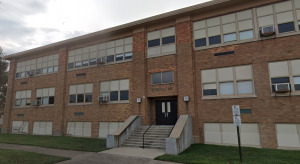
Individuals were housed temporarily in hotels beginning in November 2024 and moved into the vacant school in mid-December.
According to Merkley’s April 16 presentation to the council committee, the temporary shelter served 245 unique individuals, including 61 families.
Aryn Schounce, the senior policy adviser whom Hogsett has named his housing czar, told IBJ that winter contingency, particularly the case-management, is widely regarded as a success. Merkley said that no one at School 68 returned to unsheltered homelessness. Over half of those who stayed there moved into permanent housing, while the rest were self-resolved or referred to another shelter.
Families, activists: City’s plan was an ‘abject failure’
Those who spoke before the Criminal Justice and Public Safety Committee last month offered a different perspective.

Melonie Gluth, a mother who spoke at the April 16 meeting, called her shelter experience “traumatizing.” Another woman, Carrie Cline, alleged that mold exposure gave her son health issues. (The Marion County Health Department identified mold in a former kitchen space that guests could not access, according to the city. It was sealed off on February 26, nearly three months after winter contingency began.)
Rabbi Aaron Spiegel, executive director of the Greater Indianapolis Multifaith Coalition, called the city’s winter contingency management an “abject failure” in his testimony against Merkley’s appointment.
Multiple speakers, including Barb Williams, a housing acquisition representative with Rdoor, spoke about families going outdoors into sub-zero temperatures to shower in hygiene trailers.
Williams, who has been a service provider for a decade, described the planning process as “scrambling.” She said that the service providers “did the best they could with what they had,” but that families should not have had to go outside to shower.
Schounce told IBJ that steps were taken to create a more comfortable space, but that emergency shelters are inherently difficult environments for families.
“If you were to talk to other shelter providers, I think they would describe that these [descriptions] were not unique,” Schounce said.
Winter contingency ended March 31.
City acknowledges issues, possible changes moving forward
Merkley acknowledged that some of the concerns raised by those sheltered at School 68 were valid, but he said the 70-year-old building was “the only option” for the temporary accommodations.
Guests did have to exit the school to use hygiene trailers, but Kaufmann said the trailers were temperature-controlled and had hot water. If the city chooses to use that building again, Kaufmann said leaders will explore creating shower facilities inside the building. She also said a backup, portable boiler was installed in the building and each room was fitted with a window air conditioner at the recommendation of the Marion County Public Health Department.
Spiegel, of the Multifaith Coalition, told IBJ that the traumatic environment people described at the shelter came from the management team’s lack of experience. Aspire Indiana Health staffed the facility, which is the same organization selected to staff the city’s low-barrier shelter, expected to open in 2027.
Kaufmann said “the city is confident in Aspire Indiana Health’s ability” to operate the shelter, once opened.
In addition to operating two central Indiana housing facilities, Aspire also worked at the city’s non-congregate pandemic shelter at the Crowne Plaza Airport Hotel.
Officials have begun planning for the upcoming winter contingency season.
Schounce told IBJ that Wheeler has once again declined to return as the primary service provider for winter contingency. She said she’s already meeting with various stakeholders to identify process improvements.
The full 25-member Indianapolis City-County Council will vote on Merkley’s appointment on May 5.
Please enable JavaScript to view this content.
Editor's note: You can comment on IBJ stories by signing in to your IBJ account. If you have not registered, please sign up for a free account now. Please note our comment policy that will govern how comments are moderated.