
Subscriber Benefit
As a subscriber you can listen to articles at work, in the car, or while you work out. Subscribe Now
In a state known for Hoosier Hysteria in the high school bracket, there have been plenty of madness moments on the collegiate side of the hardcourt in the month of March. While Indiana and Purdue have long been the state’s pedigree programs, several others have made names for themselves during the NCAA men’s basketball tournament, capturing the eyes and hearts of college basketball fans nationwide.
As we enter the best three weeks on the sports calendar—with the annual opportunity to embrace a new Cinderella—here’s a look back on some of the state’s most out-of-nowhere tournament runs since the event’s last major field expansion 40 years ago.
Ball State University, 1990
Following a 29-win season and NCAA tournament trip the year prior, Ball State lost head coach Rick Majerus to Utah, replacing him with assistant Dick Hunsaker. The Cardinals kept things rolling during the 1990 season, earning the MAC regular season and tournament championships and a No. 12 seed in that year’s NCAA tournament.
After toppling Gary Payton’s Oregon State team along with Felton Spencer and Louisville—both of whom ended up as top-10 NBA draft picks—to make the program’s only ever Sweet 16 appearance, Ball State came the closest of anyone that March to beating eventual title-winner UNLV. A narrow loss was highlighted by Muncie native Chandler Thompson’s sky-high putback dunk in the final minutes, which led Brent Musburger to exclaim, “Oh, my! Chandler Thompson, how do you do?” The former Muncie Central High School star led all scorers with 21 points, but Larry Johnson, Stacey Augmon, Greg Anthony and the loaded Runnin’ Rebels survived by a 69-67 score.
UNLV was not truly tested again, blasting their way past Loyola Marymount, Georgia Tech and Duke (by 30 points!) to become NCAA champions. Ball State hasn’t won a tournament game since.
Valparaiso University, 1998
Valpo’s run was just dripping with Indiana basketball cliches—the hometown son of the coach as the team’s star, a final play named “Pacer” (not kidding—look it up!) and one of the most celebrated buzzer-beaters in basketball history.
To set the stage, Homer Drew’s 13th-seeded Crusaders were down two in the final seconds to Ole Miss, before the heroics of his son Bryce Drew saved the day. Thanks to the perfectly executed “Pacer” play—a full-court pass by Jamie Sykes; a quick touch pass and assist by Bill Jenkins; and an epic 3-pointer made by Drew—Valpo earned a shocking 70-69 victory over the Rebels. Drew, the 1994 Indiana Mr. Basketball, went on to lead the Crusaders past Florida State in overtime in the next round, signifying the only two wins of the program’s nine all-time NCAA tournament appearances.
Although the Crusaders were eliminated by another Cinderella in Rhode Island in the Sweet 16, Drew’s shot and Valpo’s season will live on forever. You can even reenact the moment in a special exhibit at The Children’s Museum of Indianapolis.
Purdue University, 2000
On paper, the 2000 Boilermakers paled in comparison to Gene Keady’s greatest teams with players like Glenn Robinson and Troy Lewis. They were not one of his six Big Ten championship squads and included only one eventual NBA player, but those scrappy Boilermakers, led by fan-favorite Brian Cardinal and fellow seniors Jaraan Cornell, Mike Robinson, and Greg McQuay, were one of only two Keady teams to reach the doorstep of the Final Four.
As a No. 6 seed that March, Purdue was nearly upset in the opening round, surviving a close scrape with 11-seed Dayton. However, they followed that scare with an upset of their own over third-seed Oklahoma and got by upstart Gonzaga in the Sweet 16 to reach the regional final. With a long-awaited net-cutting opportunity for Keady, Big Ten counterpart Wisconsin got the best of Purdue on that day, handing the Boilers a frustrating 64-60 defeat to end the run.
Unfortunately, Keady never again came close to his Final Four breakthrough, missing the NCAA tournament outright in four of his final five seasons before concluding his Hall of Fame career in 2005.
Indiana University, 2002
In the aftermath of Bob Knight’s messy ouster 18 months prior, the Hoosiers needed something to unite their fractured fan base—and, for three magical weeks in March 2002, Mike Davis’ Hoosiers did exactly that. Led by future lottery pick Jared Jeffries, sparkplug A.J. Moye and a bevy of 3-point marksmen in Tom Coverdale, Dane Fife and Kyle Hornsby, IU earned a share of the Big Ten title via a four-way split that season, but it was not expected to beat, much less compete with, defending champion Duke in the Sweet 16.
In the regional semifinal, ironically held on hated rival Kentucky’s Rupp Arena in Lexington, IU produced one of the most shocking wins in the program’s illustrious history, rallying from a 17-point deficit to stun the heavily favored Blue Devils, 74-73. The Hoosiers weren’t done there. They proceeded to blitz Kent State with a scalding 15-for-18 3-point shooting performance to stamp their ticket to the Final Four and then topped another title favorite in 31-win Oklahoma in the national semifinals before finally succumbing to Maryland in the final.
Sadly, the epic 2002 march to the championship game remains Indiana’s only NCAA Tournament run past the Sweet 16 in over 30 years.
Butler University, 2011
Most folks will cite the 2010 squad as a Cinderella, but that team had a top-10 NBA draft pick in Gordon Hayward, entered the NCAA Tournament on a 20-game win streak, and spent the regular season ranked as high as No. 10 in the polls. Does that sound like the profile of a Cinderella to you?
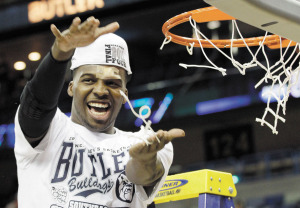
The slipper fit much better for Brad Stevens and the Bulldogs’ stunning encore run in 2011. Despite having 2010 holdovers in Matt Howard, Ronald Nored and future NBAer Shelvin Mack still in tow, that Butler squad was very much in danger of missing the Big Dance in February. Butler was 14-9 at one point after a three-game losing skid to mid-major foes in the Horizon League, but rallied from there, closing the season with nine straight wins and eliminating a nervous Selection Sunday by winning the league tournament and securing an automatic berth to the NCAA bracket.
Similar to the 2010 run, seemingly every tournament game was a heart-stopper for the eighth-seeded Dawgs, as they needed a buzzer-beating putback from Howard to take down Old Dominion in the first round and survived a chaotic, back and forth finish in the final seconds against top-seed Pittsburgh in a second-round upset win. Butler ended up claiming victories over the No. 1 (Pitt), No. 2 (Florida) and No. 4 (Wisconsin) seeds in route to their second straight Final Four appearance. Their carriage quickly turned into a pumpkin in the national championship game, as an ugly shooting performance—missing 52 of their 64 shot attempts (19% field goal percentage)—against UConn resulted in a 53-41 defeat.
The 2011 encore had many more of the elements of a true Cinderella story than the more-discussed 2010 team’s did, but it closed the book on one of the most memorable two-year tournament runs ever produced in this state’s college basketball history.•
Correction: An earlier version of this column misidentified the hometown and high school of Muncie Central High School graduate Chandler Thompson.
__________
From Peyton Manning’s peak with the Colts to the Pacers’ most recent roster makeover, Schultz has talked about it all as a sports personality in Indianapolis for more than 15 years. Besides his written work with IBJ, he’s active in podcasting and show hosting. You can follow him on X @Schultz975.
Please enable JavaScript to view this content.
Editor's note: You can comment on IBJ stories by signing in to your IBJ account. If you have not registered, please sign up for a free account now. Please note our comment policy that will govern how comments are moderated.