
Subscriber Benefit
As a subscriber you can listen to articles at work, in the car, or while you work out. Subscribe Now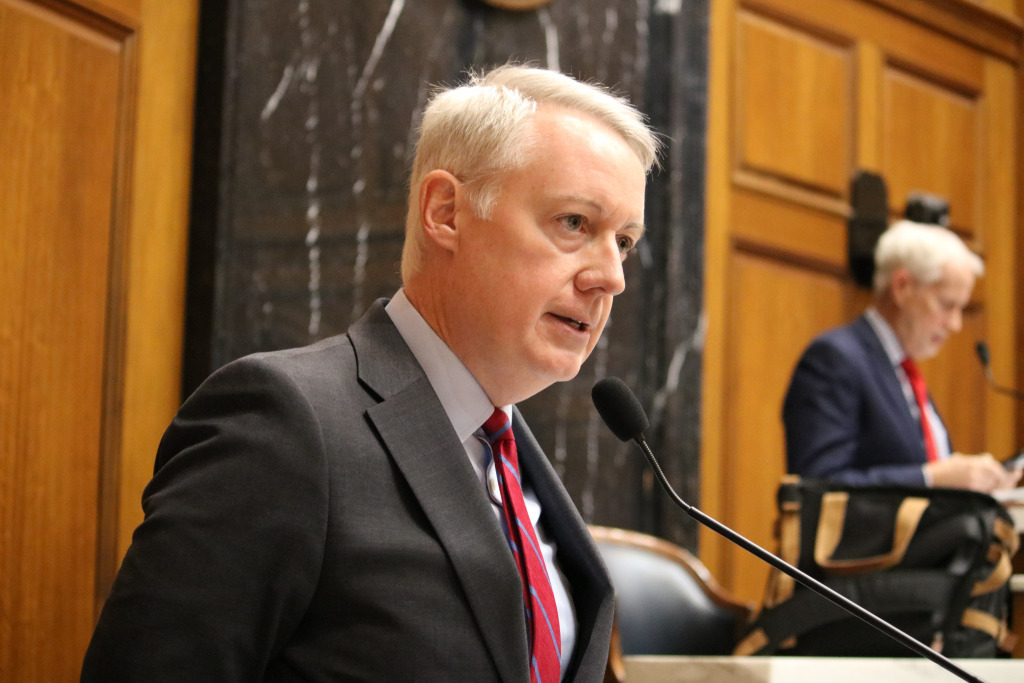
A key House committee greenlit a bill that would require the state to establish a plan to develop stackable credentials for high school students.
Sen. Greg Goode, R-Terre Haute, authored Senate Bill 448 to catalyze the state to rework how it prepares Hoosier students to enter emerging industries hungry for skilled workers, such as life sciences or advanced manufacturing. The bill also includes measures to increase oversight of university degree programs.
“For Indiana to maintain the edge in these areas of creating even more opportunities, we need to have a strong and highly skilled workforce,” Goode said. “Senate Bill 448 helps address these challenges and the opportunities.”
The House Education Committee passed the bill 8-4 along party lines after Democrats disagreed with new language increasing state oversight of the processes to review tenured professors and review college degrees.
“What’s the total cost of additional bureaucracy that we’re imposing on our universities, which we condemn daily?” Rep. Ed Delaney, D-Indianapolis, asked Committee Chair Bob Behning, R-Indianapolis, while debating an amendment.
Gov. Mike Braun, Secretary of Education Katie Jenner and Higher Education Commissioner Chris Lowery are key supporters of the legislation, and several business leaders and chambers have testified in support.
Credential stacking
Under the bill, the state Department of Education must prepare a plan to develop a market-driven credential program with at least three industry pathways and necessary benchmark skills. The legislation does not specify those focus industries, but the state has emphasized building the advanced manufacturing or health care workforce.
The department would also need to include recommendations for programming at higher education institutions. Several colleges, especially Ivy Tech Community College, have already begun developing short-term stackable credentials for emerging industries. Stackable credentials are short-term higher education certificates that allow a student to learn immediately usable industry skills that build on each other through additional coursework.
The department’s plan would need to be completed by Nov. 1.
Lowery said the bill ensures alignment between employer needs and K-12 education so students would have better career outcomes. This builds on recent education efforts to “reinvent high school,” meaning a curricular pivot to create additional high school credit pathways besides college prep.
The legislation aligns with an similar employer-led effort to expand apprenticeship opportunities. The Center on the Economics and Management of Education and Training Systems Implementation Laboratory, or CEMETS iLab Indiana, is building an apprenticeship network and curriculum that seeks to provide 50,000 Hoosier high schoolers with work-learning experiences by 2034.
The initiative aims to bolster the state’s efforts to improve education outcomes and build a more capable workforce, starting with the banking, health care, life sciences and advanced manufacturing industries.
Additional oversight
While the bill seeks to establish a new apprenticeship system for high schoolers, much of the bill now pertains to higher education degree programs and tenured professor oversight.
Under the bill, the Commission for Higher Education would be required to evaluate all college degrees and programs at least once every decade and consider factors like the economy and job placement. The commission largely only approves new degree programs under current law.
Lowery estimated the state has upward of 3,400 program offerings at the state’s public institutions, and this bill would be used to lower that number by rooting out some programs.
“It’s clear the number is too large here,” Lowery said, “and we can simply be more efficient and effective with outcomes.”
Lowery said they would likely target degrees with low student completion rates, while Goode said it could be used to trim costly, low-enrollment programs or those that don’t align with the state’s future goals.
By paring down the number of degree programs, Lowery said the state would provide greater value to taxpayers and employers for workforce development.
Delaney said he is nervous that the language places too much power in the Commission of Higher Education and a political agenda could inform what a college can offer.
The bill also would require universities to think more holistically about their staffing needs when considering extending a professor’s tenure. Boards of trustees would also need to send a report about its tenure review process to the commission for feedback.
Lowery said the move would be a step toward modernizing universities’ business models and inspiring more efficiency.
Delaney said this measure would intertwine university business operations with individual tenured performance in a way that could unfairly lay off qualified professors.
The bill now moves to the House floor, where it could be amended further.
Please enable JavaScript to view this content.
so did they ever vote to make these requirements apply to charter and private schools?