
Subscriber Benefit
As a subscriber you can listen to articles at work, in the car, or while you work out. Subscribe Now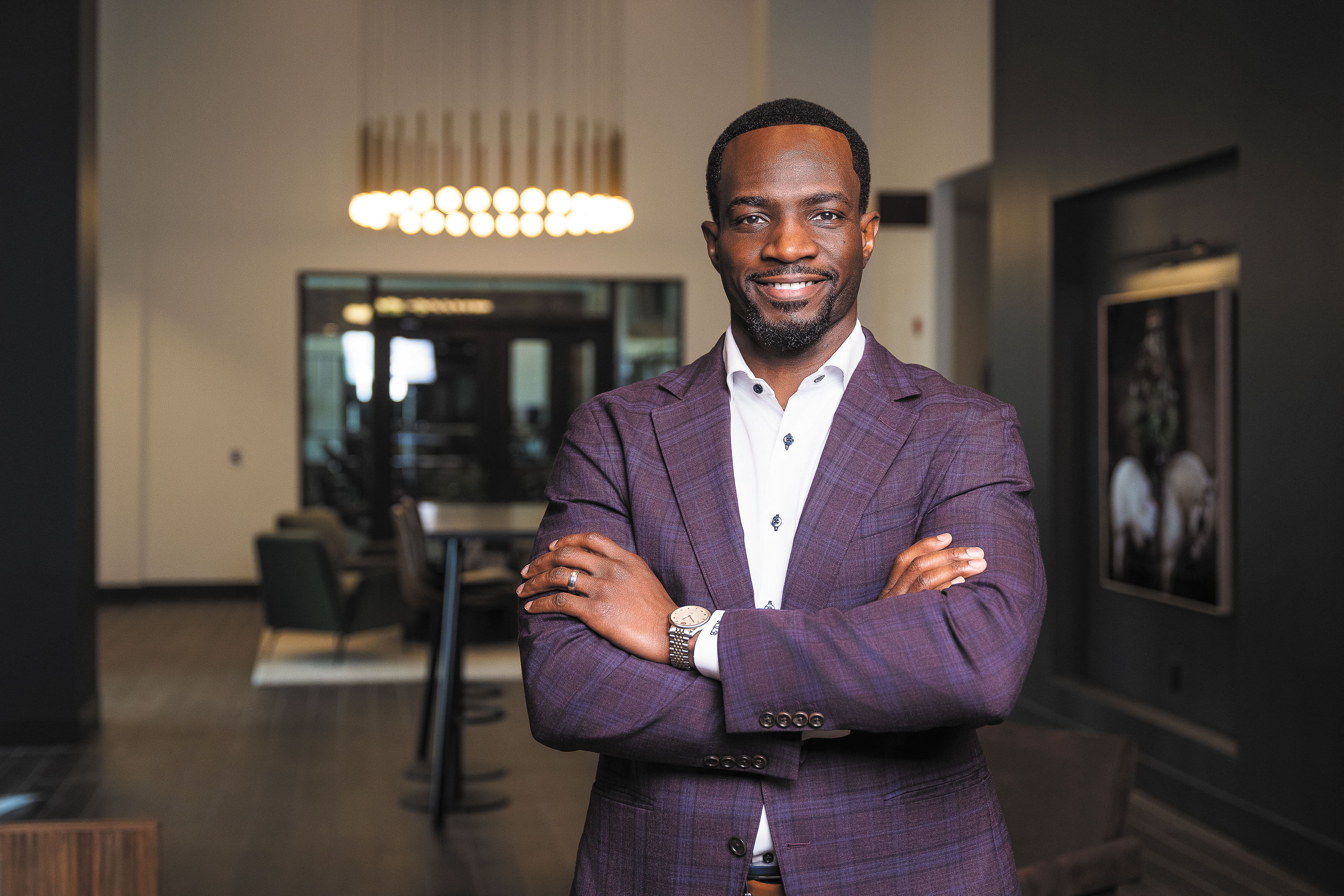
For years, Isaac Bamgbose led efforts by Beloit, Wisconsin-based Hendricks Commercial Properties to build major mixed-use projects—including Ironworks at East 86th Street and Keystone Avenue and the Bottleworks District on Massachusetts Avenue.
But in 2019, the then-27-year-old struck out on his own and founded New City Development.
Despite being waylaid some by the pandemic, Bamgbose’s firm has already taken on a handful of projects, including Polk Stables, a coworking and retail building at East 16th and Lewis streets, and the acquisition of a 190,000-square-foot office building at 2955 N. Meridian St., where New City, United Way of Central Indiana and MDwise have offices.
New City’s first major project, announced in 2022, is Hobbs Station in Plainfield. That $300 million, 125-acre development is to eventually include more than 600 apartments, at least 200 single-family houses, industrial structures, common areas and a mix of retail, office and restaurant space. The first phase of the project was completed in February.
Bamgbose spoke with IBJ about the challenges and highlights of working in the commercial development market and what could lie ahead.
This interview has been edited for length and clarity.
What got you interested in pursuing commercial real estate as a career path?
I fell into it when I was in school through the internship that I did with Hendricks. I had a professor-adviser who connected me with Hendricks, and it was at a really important inflection point for the company, as it was going from being primarily an industrial-focused company to one focused on placemaking developments that would stand the test of time and all the things that it has come to be known for.
So I saw what was possible and the impact you can have with commercial development. I started the internship and turned out to be pretty adept at it, so I decided I wanted to keep doing it.
What ultimately landed you in Indianapolis?
The area had become such a key place for me in my work at Hendricks on projects like the first phase of Ironworks, before the hotel was even there.
It was during the process of developing the hotel there, when I was still living in Wisconsin, that I caught wind of the fact that Indianapolis Public Schools hoped to sell the old Coca-Cola plant. [Hendricks CEO] Rob Gerbitz said, “Will you be my guy on this?” And before you know it, we won it.
At that point, he looked at me and said, “Hey, I think we’re going to need you to move down to Indianapolis to lead that, now that we’ve got Ironworks going.” It just made a bunch of sense, given that I’d already started building some real inroads down here, and I saw an opportunity with a city that was on the rise.
As a young person, who wouldn’t want to do something like that? Indy checked a lot of boxes as I thought about the future beyond just the work.
How did your work at Hendricks lead you to strike out on your own and begin New City Development in 2019?
These smaller municipalities, these suburban markets—the Carmels, Fishers and Westfields of the world—were calling, and Hendricks just wasn’t interested in doing projects in those areas because our hands were full. I saw there was a need in the market for thoughtful placemaking in the suburban areas and other spots beyond the urban core.
I saw an opportunity to capture some of that, which led to projects like Hobbs Station in Plainfield and our Padgett Commons project in Whitestown. But then things like the pickleball facility we just completed over in Fishers. There’s definitely a need and a niche in the market that isn’t being met, and while other developers are active, I saw an opportunity for more placemaking and had the opportunity with the experiences that I had with other projects to [step up] and take those on.
You have the projects you mentioned, plus the Polk Stables development on 16th Street. What other irons do you have in the fire?
As far as other projects, there are definitely things in the hopper that I can’t talk about just yet, but there’s one that I will mention here. We’re looking at, how do we best utilize that office lot we own at 29th and Meridian streets that we bought during the heart of the pandemic?
My team has done a really great job on the leasing side, but we’ve got this really massive parking lot that is underutilized. We’re exploring whether there is a way in which we can do something that really benefits the community and the area. We’ve got a plan there that we think answers those questions.
Why did you opt to take on an approach to development that straddled multiple areas, rather than strictly keep in one lane like multifamily, retail or industrial?
It was super important to do that, because as this was being formed in the pandemic, we didn’t really know what was going to happen with our economy. We didn’t want to spread ourselves too thin but wanted to have different sorts of business lines because of how things affect each other, between retail, housing, office and other commercial uses.
Our approach is focused on how these things can complement each other as part of a true mixed-use development—creating place, not just having space. I’d say it’s a harder way to do development, because you could kind of just stick to one area and hit things down the fairway in that way. But when you do the mixed-use approach, it’s a little bit more complicated. But the product yielded is stickier and has the ability to stand the test of time better.
What has it been like to navigate the financial side of development as you’ve struck out on your own?
It’s not been without its challenge, for sure, and there’s still a lot of uncertainty out there as we face headwinds with construction costs, costs of capital going up, demand softening in some areas of the industry. There’s a lot that you can worry about. But I kind of stick to what’s within my control, and the decisions that I make are really concentrated there, and looking for opportunities in those bounds.
Here’s the thing: Whether it’s an up market or down market, one thing that I know for certain is, there’s always opportunity. That’s been the key, that whether it is big or small, we try to deliver [a strong product] so we can weather whatever economic storm comes our way.
What does it look like to prepare your company so you can, in fact, deliver your projects efficiently?
Inflationary effects haven’t slowed down nearly as much as any of us would like, but because there’s still a lot going on in Indiana construction … there’s an ever-shrinking labor pool. Then you factor in tariffs. I think we’ve not really seen the true effect of that just yet, and it will all depend on what sticks versus what doesn’t tariff-wise over the next 90 days. But that’s a real concern.
One of the things I’ll say is the case, to me at least, in the world of development is that if you’re not active, you’re kind of dead. The idea of fully having pencils down to me just doesn’t ever make sense. But … you’ve got to be cautious, and you can’t get over your skis by going full steam on projects without paying attention to what’s around you.
We’re constantly looking, seeing and testing for whether [a project] makes sense. The beauty in being truly mixed-use is that we can say, “Maybe we need to approach this slightly differently.”
Do you expect you’ll be looking to take on more projects in the Indianapolis core, like downtown?
Oh, we’re absolutely going to be doing projects in downtown and beyond—I love those areas. I’m still a strong believer that you need to be a suburb of somewhere, right? So having a strong core to the city is so important. It’s just a matter of finding the right projects. We’re not just going to do projects for doing projects’ sake in Indianapolis. There’s some things that we’re looking at, but those boxes, again, need to be checked in such a way that it makes sense.•
—Mickey Shuey
Please enable JavaScript to view this content.
Editor's note: You can comment on IBJ stories by signing in to your IBJ account. If you have not registered, please sign up for a free account now. Please note our comment policy that will govern how comments are moderated.