
Subscriber Benefit
As a subscriber you can listen to articles at work, in the car, or while you work out. Subscribe NowOn Tuesday, Eli Lilly and Co. officially broke ground on its $4.5 billion Lilly Medicine Foundry in the LEAP Research and Innovation District in Lebanon.
The foundry, expected to open sometime in 2027, is expected to integrate the Indianapolis-based drugmaker’s research, development and manufacturing processes.
Lilly’s Chief Scientific Officer Dr. Daniel Skovronsky talked with the IBJ about his hopes for the foundry—both in what it can accomplish and what it means for patients.
This interview has been edited for length and clarity.
What excites you most about the Lilly Medicine Foundry and how it is going to change how you work?

Drugs are getting more and more complicated. Instead of just being a simple, small molecule, they’re small molecules that are extremely complex, like orforglipron, because they’re designed to do the job that normally a peptide or an antibody would have done. (Orforglipron is an oral GLP-1 drug in Phase 3 trials for Type 2 diabetes and weight management that’s also being studied for obstructive sleep apnea and hypertension in adults with obesity.)
Most of our portfolio now is these kinds of very advanced modalities, combinations of different kinds of drugs all in one, and there’s never been a place to make them before and to learn how to make them. So, to have this kind of facility, when it’s built, will open so much more space that we can make drugs, and hopefully many more diseases that we can treat and cure.
How important is it that the Lilly Medicine Foundry is going to be built near Lilly manufacturing sites and a short drive from company headquarters?
This facility has two really important links. Probably the biggest and most important link is to our scientists here. … We have more scientists working in Indianapolis than anywhere else, and it’s actually the heart of our process-development organization. The people who are thinking about how to create these medicines and how to manufacture them are here. The other major link is with manufacturing, which we have here in Indianapolis as well as in the LEAP District in Lebanon (LEAP stands for Limitless Exploration/Advanced Pace). Of course, manufacturing is in many places. We can’t be close to all of them, but it’s good to be close to some of them.
How is Lilly working to ensure the company has access to the workforce it needs in Indiana?
We’ll have more than 500 people working at the foundry. These are highly skilled jobs because of the way this is positioned—jobs at the intersection of manufacturing and research and development, so they’re scientific engineering jobs, by and large. We have a collaboration with Ivy Tech, which is a part of it. We’ve committed more than $100 million to run scholarships and research collaborations at Purdue and Ivy Tech. We have 250 Lilly scholars at Purdue and Ivy Tech who are getting degrees to support some of this work, and I hope that many of them will come work at Lilly.
We feel lucky to have great partnerships … Purdue and Ivy Tech, BioCrossroads, IU, CICP (Central Indiana Corporate Partnership), Notre Dame, Rose-Hulman, those are all places where we’re collaborating to build up our presence and have the ability to recruit talent. We’ve been pleased with our ability to recruit both homegrown talent in Indiana and also bring people in when we need.
How will the foundry help support the complex process of clinical trials?
The development of medicine is really two main things. One is running the clinical trials themselves, and the other is process development, which is figuring out how to make the medicine, to support the clinical trials and then, ultimately, to support manufacturing.
This facility supports both of those things, which is the main focus of really most of the people and most of the money in R&D. I know people imagine it’s scientists working on basic biology—and yes, we do some of that. But where the real expense and effort comes is those two things, developing the product and developing the clinical trials. A lot of that work—nearly all of it—has been outsourced in the past, mostly offshore, and so part of this is bringing that back to the United States.
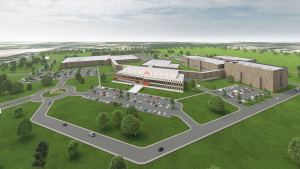
The Lilly Foundry is yet to be built. Can you give people a preview of what it will look like inside?
There shouldn’t be very much office space at all. People there are going to be working in labs. So, it’s a mixture of laboratories that are working to advance how to make medicines, and then smaller-scale factories—many different ones, actually—that are making medicine. We call that a pilot plant, and because we were working across different modalities, small molecules, antibodies, genetic medicines, we need multiple pilot-plant types of facilities to pilot those different manufacturing processes.
And because we have multiple drugs, it’s not like a factory where you can dedicate the whole factory to one drug … ours will be making multiple things at once.
Then, across the whole thing, it’s meant to also be an innovation lighthouse for the whole company … We’ll be piloting new ideas there, like new uses of automation and technologies.
Please enable JavaScript to view this content.
Editor's note: You can comment on IBJ stories by signing in to your IBJ account. If you have not registered, please sign up for a free account now. Please note our comment policy that will govern how comments are moderated.