
Subscriber Benefit
As a subscriber you can listen to articles at work, in the car, or while you work out. Subscribe Now Billy Keller was a rookie with the Indiana Pacers and like most rookies did not feel like one of the guys. The core group of players had reached the ABA finals the previous season and were established All-Stars. It would take time for any newcomer to penetrate the inner circle.
For Keller, at least in his own mind, that happened on March 31, 1970, in a game at Southern Methodist University in Dallas. The Pacers lost badly that night, 145-119, thanks to a fourth-quarter collapse so embarrassing that coach Bobby “Slick” Leonard closed the postgame locker room to the media to talk with the players.
Keller and Mel Daniels, who had been voted the league’s most valuable player the previous season, were the last two to leave and walked back to the team hotel together. Their conversation, 55 years ago, has stuck with Keller ever since.
“That was a turning point for me, to being accepted,” he recalled. “I felt more like I belonged, and it filtered into the games on the court. It was a really good bonding experience for me. I got to know him better on that walk.”
Freddie Lewis—the natural
Every coach craves leadership from players—someone who leads by both word and deed and supports the coach’s standards for on-court performance and off-court behavior. Getting it is another matter. It’s a rare quality, in and out of the sports world, and it exists in many forms.
It’s not an absolute necessity. Raw talent and health will always be the most vital elements of winning teams. But the teams that have it within the playing roster have a greater opportunity to win something meaningful. That’s particularly true in basketball, where the rosters are small, the seasons are long, the demands are great, the ball must be shared, and communication is necessary.
The Pacers won the ABA championship at the end of Keller’s rookie season, by which time he felt like a full-fledged team member. He was an important part of the squads that won it again in 1972 and 1973. The captain of all three of those teams was Freddie Lewis, widely acknowledged among the veteran players as the team’s primary leader.
Lewis was a natural. He says he was the captain of every team he played for, from high school through his final season with the Pacers in their first NBA season (1976-1977). When he was traded from Memphis to St. Louis early in the 1974-1975 season, he was picked up at the airport by a member of the front office staff and informed on the ride into the city that he had already been appointed his new team’s captain.
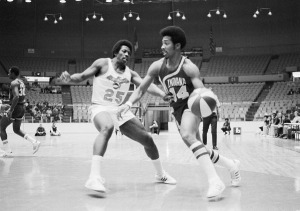
His authority with the Pacers even reigned over Daniels, a fellow alpha. Daniels once laughingly recalled a game in which he complained to Lewis that he wasn’t getting the ball often enough. Lewis cussed him out and said, “If you want the ball, go get a rebound!”
“Leadership was never a problem on our team,” said Darnell Hillman, a member of two of the Pacers’ championship teams. “Freddie always took that role. The things he could say to Mel sometimes … I would think, ‘He said that to Big Fella?!’”
Effective leaders, however, know when to push and when to praise, and Lewis did more of the latter. He assigned nicknames to rookies (Keller was B or B-B, Hillman was Sugarfoot, and George McGinnis was Trotter Wells) to help keep things light and considered himself a mentor to them.
“I always let them know I was there for them, and I always had their back,” he said. “Whatever situations were on the floor or off the floor, I talked to them about it. I told them not to get their heads down.
“I tried to keep their confidence up. If I passed the ball to them and they fumbled it, I’d say, ‘Hey, that was my fault. I should have thrown it a little later or earlier’ or whatever. I wanted them to be comfortable playing with me.”
Leaders by nature are confident and outspoken. Probably headstrong, too. For players, that can lead to conflict with a higher authority—the coach. Pacers point guard Mark Jackson sometimes clashed with Larry Bird in the late 1990s. Indiana University point guard Quinn Buckner didn’t always get along with Bob Knight in the mid-1970s. Lewis had his moments with Leonard in the early 1970s.
“I clashed with Slick many times, even to the point he put me out of practice and sent me home,” Lewis said. “But other times he would say, ‘Freddie, you’ve got the practice; I’m going home.’ We had that kind of relationship.”
Lewis was capable of quiet forms of leadership, too. Jimmy Rayl, a member of the inaugural Pacers team in the 1967-1968 season, recalled sitting on the bus one morning after a road game, waiting to go to the airport. Lewis boarded and handed him a cup of coffee, just as a favor. The memory stayed with Rayl the rest of his life.
Everette Stephens—the confidant
Former Purdue point guard Everette Stephens performed a similarly quiet yet meaningful gesture. He was more fun-loving than outspoken but was sensitive to his teammates’ feelings. Heading into the 1987-1988 season, he recognized sophomore center Steve Scheffler was feeling like an outcast, so he invited Scheffler to join him and his girlfriend to watch “Fatal Attraction” at a local movie theater.
The boiled rabbit scene terrified Scheffler, but Stephens’ gesture gave the sophomore some comfort.
“Everette was the guy who was going to look out for you,” Scheffler said. “If you had to talk to someone, Everette would have been the guy to go to. By far.”
When Jeff Arnold was suspended and eventually kicked off the team, Scheffler became the backup center and blossomed. He was a productive player throughout the season, when Purdue won a second consecutive Big Ten title, and two years later was voted by media as the Big Ten’s most valuable player. He went on to play part of seven seasons in the NBA.
That didn’t all happen because of one movie night, but every nudge along the way helps.
Scheffler witnessed a wide array of leadership examples throughout his playing career. He recalls Matt Painter, a freshman when Scheffler was a senior, having the confidence to suggest to their coach, Gene Keady, that they get the ball to Scheffler more often. It made sense. Scheffler hit nearly 70% of his shots that season but took only 6.8 per game. (Painter, as Purdue’s current coach, makes it a point to feed his centers. Zach Edey took 13.8 shots per game last season.)
“He knew he wanted to be a coach,” Scheffler said. “He was scouting different things. He knew he couldn’t be this big vocal leader, but as a freshman he was as good a leader as he could be. He had the same leadership qualities he does now but didn’t have the power as a freshman.”
Scheffler also was briefly a teammate of Larry Bird’s during a training camp with the Celtics. Bird, he said, held everyone accountable, whether through example or trash talking. If the coaches were having a meeting when practice was scheduled to begin, Bird started it without them and made sure everyone took it seriously.
When coach Chris Ford and his assistants finally arrived, Bird shouted, “Glad you could show up today, Chris!”
Bird, however, didn’t go too far in challenging his coach’s authority.
“He knew it was his team,” Scheffler said of Bird. “But he also knew the coach was a valuable cog in the wheel, and to undermine that authority didn’t move the team forward.”
Mike Conley—the coach
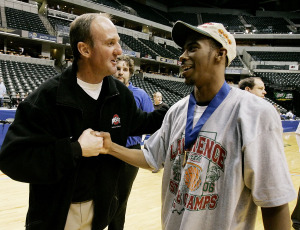
Perhaps one of the high school teams playing for a state championship on Saturday has a leader along the lines of point guard Michael Conley Jr. He, along with Greg Oden, led Lawrence North to three consecutive titles from 2004-2006 and is still going strong at age 37. He was back in Gainbridge Fieldhouse on Monday, in fact, playing for the Minnesota Timberwolves in his 18th NBA season.
He’s valued for his leadership, something his high school coach, Jack Keefer, witnessed many times 20 years ago.
“He was a coach on the floor,” Keefer said. “You just simply let him take care of everything, and he would do it.”
Keefer recalled a game in Fort Wayne when his team was going to have to play without Oden, its all-American center. It had a 41-game winning streak, and Keefer was “really nervous” about extending it with a shorthanded roster.
“What’s wrong with you tonight?” Conley asked.
“The big boy’s not here, and we’ll have to work harder,” Keefer said.
“Coach, don’t worry; we’ve got it,” Conley replied.
And they did. Keefer remembers Conley scoring 38 points and his team winning by 20.
“He just did what he had to do,” Keefer said.
Leaders tend to know what that is.•
__________
Montieth, an Indianapolis native, is a longtime newspaper reporter and freelance writer. He is the author of three books.
Please enable JavaScript to view this content.
Editor's note: You can comment on IBJ stories by signing in to your IBJ account. If you have not registered, please sign up for a free account now. Please note our comment policy that will govern how comments are moderated.