
Subscriber Benefit
As a subscriber you can listen to articles at work, in the car, or while you work out. Subscribe Now When Billy Shepherd played at Butler in the early ’70s, the basketball team traveled to and from most road games on a bus. The postgame meal, eaten on the way home, consisted of ham sandwiches and warm 7Ups brought along for the ride.
“It tasted pretty good, too,” he recalls.
When Brian Evans played at Indiana in the early ’90s, a local barber was giving free haircuts to some of the players. When coach Bob Knight found out about it, he dropped by to order an end to the favors as only he could do.
“We played by the rules,” he recalls.
We could go on, but those glimpses give you an idea of how college athletics once operated, at least in the more honorable programs. Luxuries were rare, players were poor and rules were (usually) followed. In those decades, anyone arguing athletes should be paid for playing their games would have been branded a rebel—impractical at best and a greedy subversive at worst. A scholarship was enough. Shut up and be happy, kid.
But now look. In the Wild West of today’s college sports landscape, with dollars flying like bullets, it’s widely accepted that players, at least those in the “major” sports, should be compensated for their revenue-producing time, trouble and talent. Oh, and that thing about sitting out a year if you transfer to another school? Forget about it. Do what you need to do, kid.
A flip
The shift of power from the authorities to the players is sudden and dramatic. Once living comfortably but constrained, today’s athletes enjoy their very own Shangri La. Many are paid handsomely, even into the millions per season, and they have the freedom to put themselves up for bid every year and transfer to a program that better suits their needs—financially, emotionally or geographically. Their access to instant mobility serves as a sword over the head of coaches. If they don’t like how they’re being coached, they can leave—which often results in easier practices and more “polite” mentoring.
It’s a great day for athletes seeking upward mobility but hell for coaches dealing with the possibility of losing their better players every year and chaotic for fans craving stability.
Nearly 2,000 basketball players have entered the NCAA’s transfer portal since the regular season ended. That averages out to roughly five per Division I team.
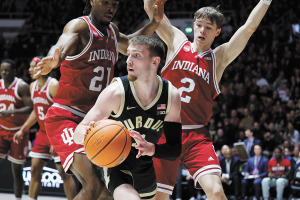
The state’s major programs have all suffered casualties, but Indiana University was hit the hardest. Every player on last season’s roster has either run out of eligibility or transferred, although Luke Goode hopes to win approval for a sixth season. Four of the exiting transfers can be regarded as significant losses. Malik Reneau, a Miami native, is headed to the University of Miami. Ohio native Gabe Cupps is heading to Ohio State. Myles Rice has chosen Maryland. Mackenzie Mgbako has yet to announce a new home.
Even Purdue, normally an island of stability amid swirling seas because of its low roster turnover, has lost four players, two of whom were part of the playing rotation. Cam Heide will go to Texas and Myles Colvin to Wake Forest.
It affects women’s teams, as well, of course, even trickling down to sports that are traditionally non-revenue. Both the Purdue and IU volleyball programs lost multiple standout players because they couldn’t match offers.
There’s give and take to the portal, however, and major programs have at least a 50-50 shot at coming out ahead if they’re adequately funded to pay transfers because they have the advantage of raiding the mid-majors for their best talent. Just ask IU football coach Curt Cignetti, whose first team in Bloomington enjoyed a historic season with an 11-2 record and a spot in the playoffs.
Changes are coming, but it’s a fluid environment with churning waters and probably always will be. Some of the details are being worked out in federal courts as the NCAA and its members try to restore a degree of sanity and fairness. It’s impossible to predict the future of the institution, but there is one certainty: There will be no return to the days of so-called amateurism.
Shepherd compares it to one-class basketball in the Indiana state tournament. Once that ended, there was no going back despite significant public opposition. Evans compares it to AI. Once that was unleashed, there was no turning back despite its potential dangers.
It’s been a long time coming. The concept of compensating athletes had been bandied about for years but wasn’t taken seriously enough by the NCAA until former UCLA player Ed O’Bannon filed an antitrust lawsuit regarding use of name, image and likeness. He won in 2014. By then, it was a regular part of the conversation related to college sports.
Rob Hummel talked about it in 2012, shortly after his playing career at Purdue ended. He cited the example of one of his game-worn jerseys being auctioned off for nearly $3,000, along with those of teammates E’Twaun Moore and Jujuan Johnson. They were valuable because players had worn them, but players weren’t part of the equation.
“They’re going to have to do something, because it’s certainly an issue,” Hummel said then. “You’re working for free, and you’re working in a business that generates millions if not billions of dollars.”
Share a slice
The sad part of it all is that the current mess could have been avoided if the NCAA had been willing to carve up the golden goose fattened by television revenue and share a slice of it with the players to quiet the hunger pangs.
“There was a time the NCAA could have said, ‘We’ll pay $10,000 to all players in [football and basketball] and give two round-trip tickets and hotel stays a year for parents in the NCAA tournament,” Evans said. “Ten thousand a year would have been a ton of money to us. Everybody would have taken it.”
Standout players from past decades can’t be blamed for feeling jealous. Certainly, many in past eras received cash and other benefits under the table, whether arranged by the coach or not. John Ritter a three-year starter at Indiana in the early ’70s, joked, “We had NIL. We called it cheating.”
Although he was aware of players in his era being paid, Ritter’s personal version of a fringe benefit was receiving free chocolate milkshakes at Dairy Queen when he went there after practice to get one for teammate Dave Shepherd, who had been hospitalized after a serious automobile accident on State Road 37. When the owner found out Ritter’s purpose, he comped them.
Now Ritter follows his grandson, Brownsburg star quarterback Oscar Frye, who no doubt will receive far more than milkshakes when he signs with a major program.
You won’t find much resentment among the former athletes over what might have been.
“I’ve asked some of my teammates what [getting paid] would have been like,” former Purdue quarterback Mark Herrmann said. “We just say we enjoyed playing and never thought about being compensated in any way. It was fun talking about how poor we were and how you’re trying to scrounge up a meal for Sunday night dinners.
“Back then, our games weren’t even televised very often. Maybe a handful. We enjoyed the big crowds, but none of us thought about what’s in it for us. We just enjoyed the experience and playing with one another.”
And yet … “I guess it makes sense for athletes to get a piece of the pie,” Herrmann said.
Game-changer
There’s no argument from Rick Mount, a three-time basketball all-American at Purdue from 1968-1970.
“Whatever they get now, yay-rah,” Mount said. “People are raising hell because they have to pay for their son or daughter to go to school, but the athletes bring in all that revenue.”
If anything inspires jealousy among former players, it’s the ability to transfer without penalty. Shepherd signed on at Butler to play for Hinkle, but Hinkle was forced into retirement after his sophomore season. He played his final two seasons for George Theofanis, whose approach was much different.
“That would have definitely been something I considered at that time,” said Shepherd, who had been recruited out of high school by the likes of UCLA, North Carolina, Duke and Florida. “In hindsight, I probably would have made a move after my junior year at Butler.”
Lyndon Jones said he might have transferred from Indiana following his junior season. “Absolutely,” he said. “I weighed things and didn’t do it. [Not having to sit out a year] would have had a lot to do with it.”
Evans believes several of Knight’s players would have taken advantage of the transfer portal over the years if it had been as easy as now, unless Knight softened his coaching style. He joked that if there had been a bus to take team members to the transfer portal following the team’s 106-56 loss at Minnesota in 1994, “about 10 guys would have jumped on it.”
Transferring was far more difficult in his era, Evans said, although he recalled one teammate who faxed in his plan when Knight was out of town on a fishing trip. The thought of having to face Knight in person was deterrent enough for most.
“Guys were afraid to leave,” Evans said. “But if all you had to do was text somebody?”
There are upsides to the current landscape beyond the rewards for athletes. It keeps some in school longer because they can earn more there than as professional rookies. It removes much of the hypocrisy of under-the-table compensation. It also provides help for athletes—some of whom come from impoverished backgrounds—who perform in front of sellout crowds but won’t have pro careers.
“The game is advancing,” Jones said. “It’s a business, and these kids are businesses, and it can teach them some things. But you have to be careful with it. It can ruin some folks if they don’t have the right people surrounding them and they don’t have the right education about money.”
The days when a warm 7Up was a suitable postgame beverage, and a free haircut or chocolate milkshake was a potential scandal needed to end. What’s needed now is a compromise that makes as much sense as it does dollars.•
__________
Montieth, an Indianapolis native, is a longtime newspaper reporter and freelance writer. He is the author of three books: “Passion Play: Coach Gene Keady and the Purdue Boilermakers,” “Reborn: The Pacers and the Return of Pro Basketball to Indianapolis,” and “Extra Innings: My Life in Baseball,” with former Indianapolis Indians President Max Schumacher.
Please enable JavaScript to view this content.
Nice article Mark.