
Subscriber Benefit
As a subscriber you can listen to articles at work, in the car, or while you work out. Subscribe Now It’s illogical, so how do you explain it?
How does Andrew Nembhard, a poor 3-point shooter during the regular season, become a deadly marksman in the playoffs?
How does Tyrese Haliburton, even when having a poor shooting game, routinely find ways to hit game-winning shots in the final seconds?
For that matter, how did Reggie Miller, a good player during the regular season, build a Hall of Fame career on the foundation of playoff greatness?
In other words, why do some players perform best when the pressure is greatest and the competition the toughest while others succumb to the moment and go quietly into the night? Why do some players run eagerly toward the spotlight and embrace the big games and big moments while others look for a place in the shadows?
Coaching? Something in their childhood? Genetics?
Themes can be found. Clear answers cannot.
Whatever, current Pacers fans can be grateful to have a bounty of players who step up as the stakes get higher during the playoffs. Their first-round elimination of Milwaukee and the 2-0 lead they take into Friday’s second-round game against Cleveland has been built on individual performances ranging from impressive to incredible. It’s as if Miller has been cloned a few times over and brought out of retirement.
Miller, of course, was the skinny guy who looked like Olive Oyl but flexed like Superman so often in the postseason. He even wore a Superman T-shirt for two playoff games against Milwaukee in 2000 and backed it up each time to lead an opening-round victory that was the first step on the team’s only journey to the NBA Finals.
He was especially otherworldly in Madison Square Garden, where he deposited a 25-point fourth quarter in 1994, the 8-points-in-8.9 seconds flurry in 1995, a 3-pointer that forced overtime in 1998, and a 34-point effort in the closeout game of the Eastern Conference finals in 2000, all victories.
Miller averaged 18.2 points in regular-season games over his 18-season career but 20.6 in the playoffs. It would be 21.1 if you delete the 2003 playoffs when he labored on two bad ankles, one of which required postseason surgery.
It shouldn’t be assumed that every player, no matter how great, can boast of better numbers in the postseason. Larry Bird, Wilt Chamberlain, Oscar Robertson and many other Hall of Famers averaged fewer points and shot a lower percentage in the games that count the most—understandable given the factors of improved competition and fatigue from the long season.
I once asked Miller to explain how he so often managed to perform better amid playoff pressure.
“It’s the odds,” he said. He truly thought the odds were in his favor to do so.
Sunny side up
That doesn’t make sense mathematically, but it does reveal one of the success factors behind stardom on the biggest stages: optimism. Delusional optimism, perhaps, but optimism just the same. And the collective optimism of these Pacers in these playoffs has been unprecedented so far. Twice within a week, they found ways to win when all seemed lost—down seven points with 40 seconds left in overtime in Game 5 against Milwaukee and down seven with 48 seconds left in Tuesday’s Game 2 victory at Cleveland.
Nembhard feels it. He hit 34% of his 3-pointers over his college career and 29% during the recent regular season but hit 57% of them through the first six playoff games. He missed all four attempts in the seventh at Cleveland on Tuesday but found other ways to contribute. He finished with seven rebounds and a game-high 13 assists and got a steal with 27.1 seconds left that set up Haliburton’s game-winning shot.
Nembhard has hit his share of them. He hit a 3-pointer from out top with one second left as a freshman at Florida to lead an SEC tournament victory over LSU. He did it as a rookie with the Pacers two years ago, hitting a buzzer-beater off Haliburton’s crosscourt pass to beat the Lakers in L.A. He did it in Game 3 of the playoff series against the Knicks last season when he hit a step-back 30-footer with 16.4 seconds left despite being one of seven from the field to that point.
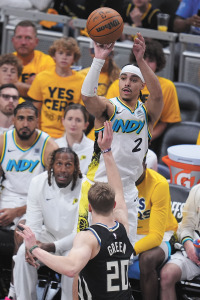
His postseason accuracy is nearly eerie. He didn’t hit three 3-pointers in a single game this past season but did it four times in the first six playoff games, including five of six on Sunday in Cleveland. He doesn’t celebrate such moments; he just smiles as if he knew it was coming.
Nembhard gives credit to his “Pops,” Claude, who coached him as a youth.
“He put me in those situations,” Nembhard said.
“I loved those situations growing up, where you’re counting down the shot clock in your driveway. It’s fun for me. You make them sometimes, you don’t make them other times. But you step into them with full confidence; that’s the best way to go about it.”
Pops confirms.
“He loves this stuff,” Claude Nembhard said earlier this week. “He’s always played in big games. He lives for this [stuff]. He has no fear.
“[Sunday] night he said to me, ‘Dad, it was so loud in [Game 1]. It was louder than it was in New York last year. But it makes you Zen. All you have is the court. It was so surreal.’
“It locked him in.”
‘It’s what I do’
Haliburton is likewise routinely dependable in the clutch. Beyond that, really.
The 3-pointer he made while drawing a foul from Giannis Antetokounmpo off an inbounds pass while running to his left to beat Milwaukee during the regular season, in front of Miller and a capacity Gainbridge Fieldhouse crowd, will live on highlight reels forever.
His dunk with 10.8 seconds left helped force an overtime in Game 5 against Milwaukee last week. He then hit a 3-pointer to kick off the overtime and wrapped it up by beating Antetokounmpo for a layup with 1.3 seconds left for the game-winning points.
He topped everything Tuesday at Cleveland, scoring eight points in the final 1:24, including a step-back 3-pointer with one second left for a 1-point victory.
“It’s what I do,” he said afterward.
He also gives credit to his “Pops,” who cheers him on from the end zone of every home game, even to the extreme of walking onto the court to celebrate the closeout victory over Milwaukee.
“You know my dad,” he said, smiling. “He has always put that confidence in me to take the big shot at the big moment.
“Everybody who loves basketball grows up imagining those moments. In the driveway for me, also in the living room, having that imaginary hoop. You live for those moments, and that’s part of having your impact on the game. It’s a lot of fun and something I live for. I’m sure there will be many more opportunities throughout my career, and I’m sure I’ll miss many more shots. And I’ll probably make many more shots. That’s just part of basketball.”
Aaron Nesmith must have a vivid imagination, as well. He hasn’t made the dramatic 3-pointers Nembhard and Haliburton have but has made them more consistently than anyone in this year’s playoffs. He’s hit 56% of his field goal attempts—including a timely rebound-dunk off a missed free throw in Game 2 of the Cleveland series—as well as 56% of his 3-pointers through the first seven games of the playoffs.
What are the odds?

Imagine the moment
Visualization is a common theme here. It seems the more kids imagine they are shooting to win games when practicing on their own, the more likely they are to do it.
But if it were as simple as visualization or encouragement from Pops, however, crunch time excellence would be a lot more common. James Harden, the NBA’s MVP for the 2017-2018 season, a selection to the 75th anniversary all-time team and a certain future Naismith Hall of Famer, has a habit of coming up short—the most recent example being his seven-point effort on two-of-eight shooting in the Los Angeles Clippers’ Game 7 loss to Denver last Saturday. Over his last three Game 7’s, dating back to 2020, he’s hit just nine of 34 field goal attempts, including three of 18 3-point shots.
Sports psychologist Richard Trammel works with athletes from a variety of sports throughout the country to help them establish confidence for such situations. He uses mental-skills training but does wonder if there’s such a thing as a “confidence gene.” Are some athletes—people in general, for that matter—born with the confidence to make game-winning shots?
“There’s no proving it,” Trammel said. “It’s all supposition.”
Athletes succeed or fail under extreme pressure, he said, based on their mental outlook.
“It’s the perception of pressure,” he said. “Some players enjoy the spotlight. It’s a chance to showcase their talent in front of the largest audience possible. But some people do not enjoy being in a giant spotlight.
“It’s based on a fear of criticism. If it gets onto SportsCenter that a player choked, some people don’t want to be involved in that kind of environment. They don’t want their name out there in a national dialogue.”
Miller, Nembhard and Haliburton all have expressed their love for the bright lights. Miller often tried to make it even brighter, adding more pressure, such as by saying he “hated” the Knicks heading into a playoff series or by donning the Superman T-shirt to rile up the Milwaukee fans. “I always play head games with myself,” he once said.
Those three also share similar backgrounds. All have or had strong fathers who played basketball and supported their careers without pushing them. Trammel, however, sees no direct correlation between an athlete’s upbringing and clutch performance. Proof of that would be Roger Brown, the greatest pressure player of the ABA Pacers, who did not come from a stable home environment but was confident to the point of arrogance in the playoffs. Brown always promised to be ready at “money time.”
All we know for sure are the outcomes. And for the Pacers, those lately have been glorious, no matter where they come from.•
__________
Montieth, an Indianapolis native, is a longtime newspaper reporter and freelance writer. He is the author of three books: “Passion Play: Coach Gene Keady and the Purdue Boilermakers,” “Reborn: The Pacers and the Return of Pro Basketball to Indianapolis,” and “Extra Innings: My Life in Baseball,” with former Indianapolis Indians President Max Schumacher.
Please enable JavaScript to view this content.
Editor's note: You can comment on IBJ stories by signing in to your IBJ account. If you have not registered, please sign up for a free account now. Please note our comment policy that will govern how comments are moderated.