
Subscriber Benefit
As a subscriber you can listen to articles at work, in the car, or while you work out. Subscribe Now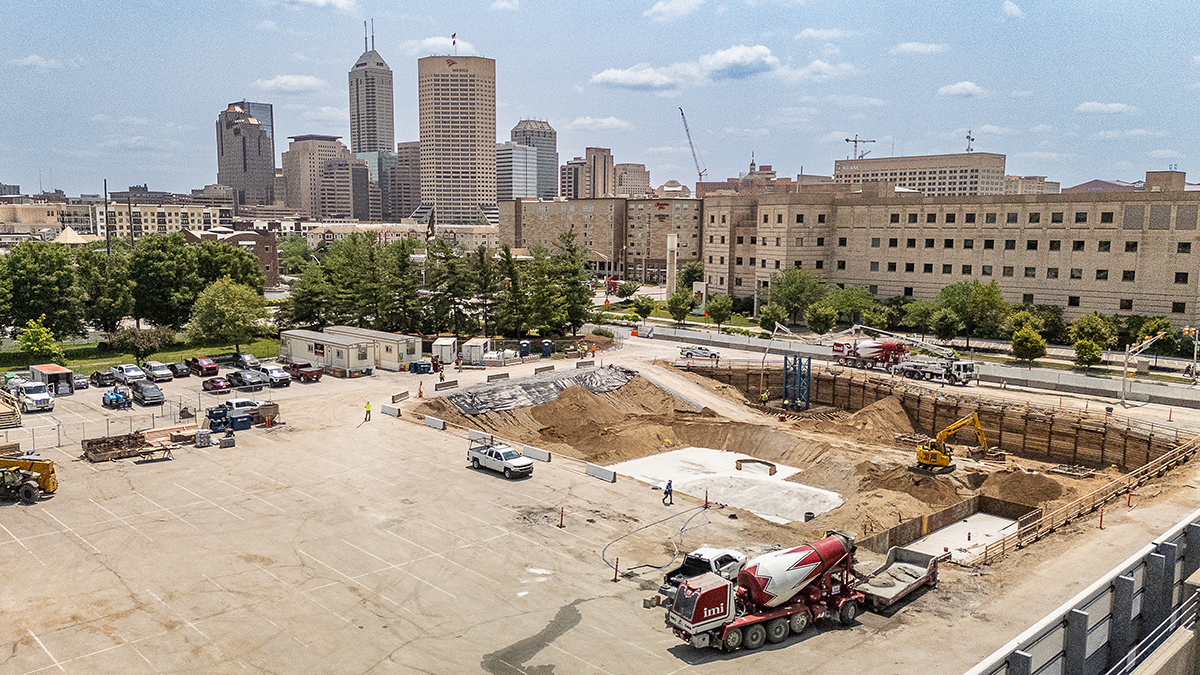
Purdue University’s long-term aspirations for its Indianapolis campus are about as high as the buildings it’s looking to construct there.
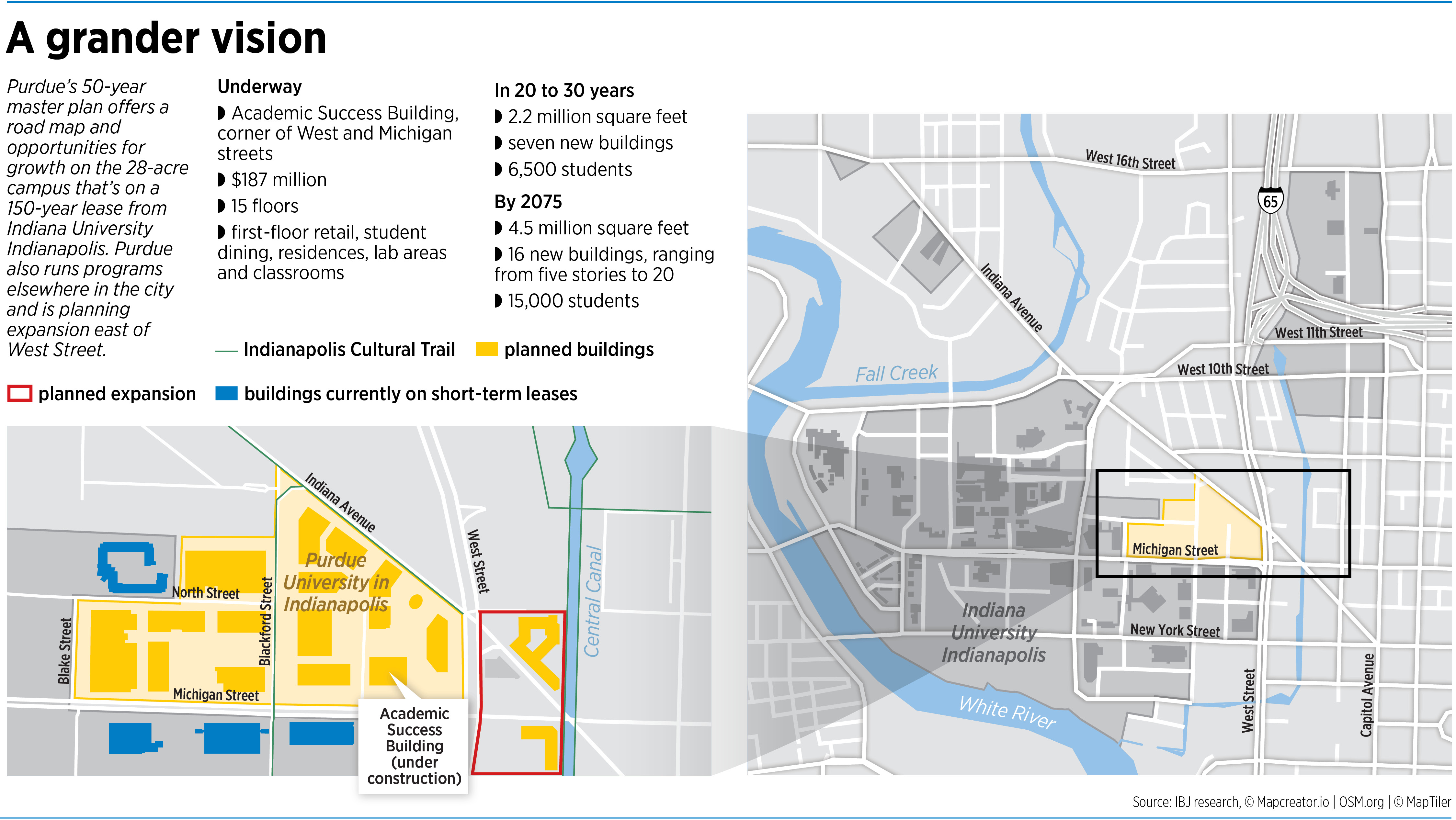
The school has a goal of serving upward of 15,000 students in the capital city by 2075, with its 28-acre parcel and a smattering of programs across other buildings in Marion County serving as an extension of its West Lafayette campus.
But to hit that mark with such limited space—the acreage is among the smallest for an urban university in the United States—Purdue recognizes it must get creative in its design approach while also navigating the historical nature of Indiana Avenue and safety challenges posed by busy West Street.
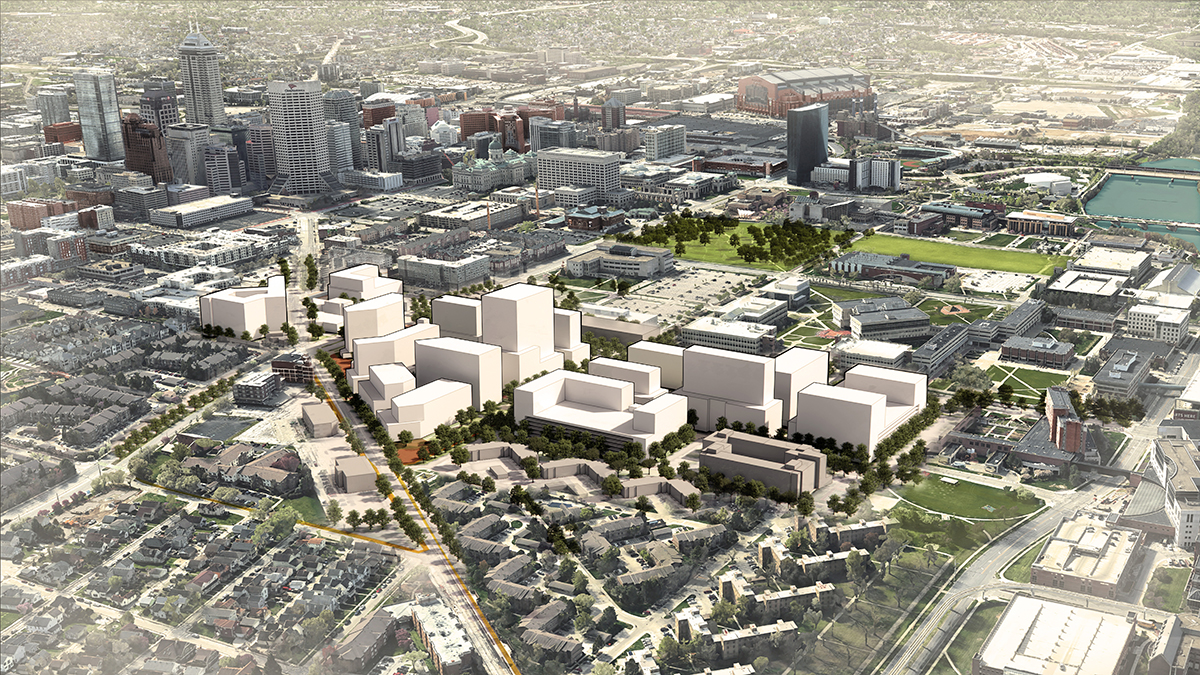
The university’s early concepts for the site call for 16 buildings ranging from five to about 20 stories, as well as a handful of others on the east side of West Street, the eight-lane roadway that separates the campus from the rest of downtown.
The first of the structures, the 15-story Academic Success Building, is already under construction on the northwest corner of Michigan and West streets, which will essentially be the front door to Purdue’s campus. Right now, the campus consists of parking garages and lots and a handful of leased IUI buildings.

Dan Hasler, who has led Purdue’s efforts to grow in Indianapolis since the split of IUPUI last summer, said while the buildings “aren’t going to be nearly as tall as the city’s tallest buildings,” he expects the mix to give the university its own notable skyline.
Purdue secured its campus site through a 150-year lease with IU Indianapolis.
“If we’re going to be an urban campus, it means we’re going to be dense, right?” Hasler said. “It doesn’t mean we put a traditional suburban-style, low-rise campus in a city. This land is more valuable, and it calls for more density, and the way you get more density is by going vertical.”
The height of Purdue’s buildings will only be accentuated by its contrast with the south side of Michigan Street, where Indiana University Indianapolis’ buildings generally range from three to six stories.

Bill Browne, founding principal of Indianapolis architectural firm Ratio Architects, said he’s not surprised by Purdue’s strategy. The school had little choice but to go up.
“They are physically limited by IU Indianapolis and, to some degree, by Indiana Avenue,” so their only option is high-rise buildings, he said.
The near-term plan for the university—the next 20 to 30 years—calls for seven new buildings totaling 2.2 million square feet, although the school hasn’t set a construction timeline. That plan would include more than 3,200 beds, as well as classrooms, labs and amenities to support as many as 6,500 students.
A gateway similar to what’s found on the West Lafayette portion of the campus is expected to be built in the next few years, as well.
But the university hopes to eventually offer as many as 5,300 beds and 4.5 million square feet of programming space.
By comparison, the IU Indianapolis campus sits on more than 500 acres. While that’s smaller than urban campus The Ohio State University, which spans 1,700 acres in Columbus, it’s still larger than many others, including Vanderbilt University in Nashville and New York University in Manhattan, at 330 acres and 230 acres, respectively.
All the marbles
Jessica Leonard is a principal with Baltimore-based design firm Ayers Saint Gross, which counseled Purdue in its master plan efforts. She said the Indianapolis buildings will be based largely on the design aesthetic found on the West Lafayette campus—primarily red brick and glass curtains. But Indianapolis construction will still have its own flair to fit within the neighborhood and to complement the taller structures.
The planner said about 60% of the acreage is expected to be green space, a major change from the assortment of parking lots and garages that constitute the balance of the land now.
“For me, it was a dream to be able to think about” what could come from this master plan, Leonard said. “It’s rare that you get a somewhat blank slate. But … you still have to think about the infrastructure, the buildings that exist today, the parking and a lot more that went into the phasing of this plan.”
Purdue plans to conduct feasibility studies and gauge its programming needs before continuing construction beyond the Academic Success Building—and each structure will have its own design process.
In addition to leasing land from IU, Purdue is also leasing a handful of IU Indianapolis buildings short term for programming. Those leases are expected to become long-term contracts, although plans haven’t been finalized. Some spaces, like the IUI library will continue to be shared.
Purdue is also implementing what it calls a “marbling” strategy throughout Indianapolis, locating some programs in other parts of the city. And it plans to extend its campus across West Street, with residence halls and other amenities in the 500 block of Indiana Avenue.
Purdue’s presence “doesn’t all have to happen on that 28 acres,” Hasler said. “There are opportunities all over the place that don’t require us to feel confined” by the land the university is leasing from IU Indianapolis.
The university estimates 80% of its Indianapolis population will be served through the main campus extension at the former IUPUI, with the rest at locations across the city.
Already, Purdue has secured strategic partnerships that allow for 10 ancillary spaces across Indianapolis and Speedway, among 55 agreements it has put in place for research, co-op and internship opportunities in biosciences, pharmaceuticals, engineering and technology innovation.
That includes co-location of programs at the campuses of the under-construction Elanco Animal Health Inc. headquarters at the OneHealth Innovation District along the White River; Dallara’s North American headquarters in Speedway; and SpectronRx, which has operations on the city’s northwest side.
A big investment
As the university has gotten its Indianapolis operations off the ground, it has secured space in multiple downtown apartment buildings to serve as residence halls.
It has also partnered with local firm Arrow Street Development on a $100 million, 12-story mixed-use project now under construction in the 500 block of Indiana Avenue, with a long-term lease of most of the apartments for student housing. And over the past year, Purdue has acquired several other parcels along Indiana Avenue, West Street and the Central Canal, with hopes of incorporating those into its campus.
While it’s not entirely clear how much the master plan will cost all-in, Hasler said the university will use fundraising and public-private partnerships to support development of the district. It could also ask the Indiana Legislature to chip in. The Legislature paid for the Academic Success Building as well as the James T. Morris Arena now under construction at IU Indianapolis.
And for now, at least, state leaders are expressing support. House Speaker Todd Huston, a Republican from Fishers, said in written remarks to IBJ the university’s master plan shows it “continues to demonstrate innovative, forward-looking leadership for its students” and that the work already underway in Indianapolis exemplifies the school’s interest in creating opportunities for students and keeping talent in the state.
“I look forward to continued partnership with Purdue as they advance this vision and contribute to our state’s economic success,” Huston said.
Rep. Jeff Thompson, a Republican from Lizton who chairs the budgeting-writing Ways and Means Committee, said he also supports the school’s plan and its continued tuition freeze, which has kept most tuition fees flat since 2013.
“Their strategic partnerships with Indianapolis-based firms and leadership as a hub for bio works research necessitates a bigger campus and more available housing in our state capital,” Thompson said in a statement. “I look forward to further conversations about these plans as they move forward and am eager to see continued innovation and economic growth as a result.”

IU Indianapolis is continuing to build out portions of its campus, as well. A new Medical Education and Research Building at the IU School of Medicine, a STEM Lab Building and the IU LAB building at 16 Tech Innovation District will add more than 650,000 square feet to that campus footprint by the end of 2027.
“As an established campus with more than 20,000 students, we’re focused on the projects we have underway right now that will make us an indisputable partner in the future of the city and central Indiana,” Todd Richardson, Indiana University’s chief operating officer, said in a statement.
Facing challenges
While the Purdue University plan is not bound by the same zoning and design regulations as private development, Hasler and other Purdue officials said the school is still working closely with nearby businesses and residents to be a good neighbor.

That includes conferring with the Ransom Place neighborhood and stakeholders along Indiana Avenue to ensure that the university’s buildings don’t overshadow the area, which was historically home to a large concentration of Black-owned businesses and thousands of residents before the creation of IUPUI and is still home to community hubs like the Madam Walker Theatre.
Evan Hawkins, senior director for administrative operations at Purdue, said the school has spent the past two years trying to find ways to ensure its development doesn’t impede progress elsewhere on Indiana Avenue. It also worked closely internally and with its consultant to concentrate taller development in its master plan away from the avenue and further toward the center of its campus.
“We have been very intentional—not just with students, faculty, staff, researchers and academics—with engaging in the most authentic way we can with our neighbors and our civic partners to understand the legacy and the dynamics,” he said.

Rodney Byrnes of Arrow Street Development, which has a residences contract with Purdue, and local musician and activist Claudia Polley are among the most prevalent voices along Indiana Avenue. Each said Purdue has listened to their concerns and the school seems to share their vision for the neighborhood.
“Every conversation I have with the university starts with the question, ‘How does this impact the surrounding residents and neighborhood?” Byrnes said. “I’ve been in development for a few decades now and have not worked with a partner that is as centered around community impact as Purdue has been. It really is refreshing.”
For her part, Polley said that while Purdue has been proactive in engaging with her and others in the neighborhood, she thinks the area would benefit from more communication and collaboration among all the major players in the area, including both universities, Indiana University Health, 16 Tech and various developers.
“There’s a lot of money, there’s a lot of energy going on, but it’s not coordinated,” she said. “Everybody has their own vision, and while most of them talk to one another, it’s not codified. Indiana Avenue is ready to be revitalized, and it should just be done in the right way. The best way is for all the players to be around one table reasonably often to say, ‘This is what we’re doing.’”
Another development hurdle that Purdue and the neighborhood face is eight-lane West Street, which Hawkins called a “barrier” and a “challenge.”
The university is interested in working with the city, state, IU and the neighborhood to “be in the solution business,” Hawkins said, and to find a way to improve both vehicular traffic and pedestrian safety.
Byrnes, the developer, said he’s confident a solution can be found, whether using bridges, tunnels or other means. Doing so, he added, needs to be a priority.
“As we increase the density of the area, bringing more people and students to the street, there needs to be a thoughtful plan to lessen the pedestrian risk,” he said. “There are cities all over the world that have dealt with a similar situation, and I am confident there are building and traffic design solutions for the current situation.”•
Please enable JavaScript to view this content.
I’m sorry, there are no design aesthetics on the West Lafayette campus. That layout was butchered years ago and to repeat that mess would be a trevesty. Comon. You are world class architects. You can do better. Come up with something unique that defines the creativity of the University. It is a well know architectural maxim that the best designs come out of the most difficult constraints. Dont believe me? See Frank Lloyd Wright. Quit copping out. Do it.